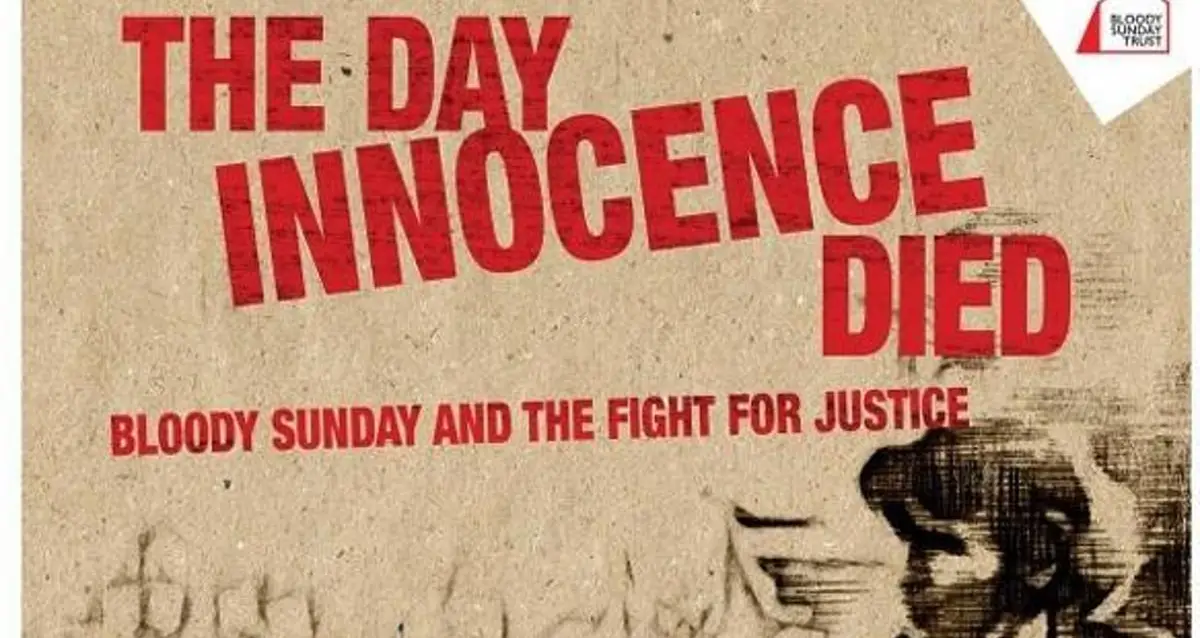
This feature-length documentary (106 mins) is the latest film by the Rainbow Collective directors Hannan Majid and Richard York. Their previous filmTo Kill a War Machine, about Palestine Action supporters and their campaign to stop arms supplies destined for Israel and the ongoing slaughter of tens of thousands of Palestinians, was banned by the UK government when Palestine Action was designated as a ‘terrorist organisation’. As co-director Richard York explained during the introduction to the first public screening of the Bloody Sunday film in London recently, there was no discussion or advice about the film from the government, it was just banned from being seen. Richard explained that the government position was that the feelings of the audience on seeing the film about Palestine Action activists might result in ‘criminal’ actions in the future. This is a clear case of political censorship, and yet another instance of the UK government’s support for genocide in Palestine.
Indeed one of the strengths of the film is the way in which testimonies from the family whose friends and relatives were murdered by British paratroopers in the Bloody Sunday massacre in Derry are linked to other examples of atrocities carried out by the British army in Aden, Kenya and Palestine. Strategies such as stop and search, arbitrary detention, injuries and even deaths caused in custody are not only seen in colonial occupations but also present in the treatment of many Black people in the UK.
The massacre of fourteen unarmed civil rights demonstrators in Derry in the north of Ireland in 1972, was one of a number of other such killings, Ballymurphy in August 1971 where paratroopers killed ten people, Springhill massacre in July 1972 (six people murdered) and New Lodge shootings in February 1973 where five people were killed. An inquest into the Ballymurphy massacre took place only in 2021!
Bloody Sunday was perhaps the most disgraceful of these killings, though every death was avoidable and all the killers should have been brought to justice. But the British supported the privileges of the unionist majority of protestants in the North of Ireland, and the repression of the catholic minority in the partitioned island of Ireland. As the film shows, catholic communities in the north suffered from poverty and discrimination, kept out of better-paid jobs and if not property-owners or lease-holders, were denied the right to vote. Civil rights campaigns mobilised thousands and these demonstrations were met with force.
On Bloody Sunday demonstrators were shot down by the paras, who were then defended by the British establishment and photographs were released of one of the dead men with allegedly nail-bombs stuffed into his jeans. One of the people interviewed in the film stresses how unlikely it would be to go on a demonstration with nail bombs stuck into the pockets of jeans, and convincingly argues that this ‘evidence’ of intent to kill was planted by the actual British murderers. This is the same strategy the police and most of the media used against the Liverpool football fans killed at Hillsborough. Smear the victims… if they died they had it coming. The film draws this parallel and the Bloody Sunday families’ and the Hillsborough families’ campaigns for justice were the result of tireless campaigning to get justice.
The documentary is based on oral and visual evidence from those affected by Bloody Sunday, and many of the bereaved also died before any sort of justice was achieved. Historical footage and still images are assembled to construct a powerful sense of anger against the British state and its armed bodies of (mostly) men. There is the case of one of the seriously wounded being taken away from the scene of the killings in a car to a hospital only for those accompanying him to be taken away by soldiers and his being left to bleed to death in the back of the vehicle. One woman never recovered from the killing of her husband and ended up in an asylum. The shocking scenes of the killings and the dead bodies are backed up by the close-ups of the faces of the interviewees. It is as if we can see the traces of their experiences in every line on their skin.
The film allows the people to speak for themselves and was made by the directors following a request by The Museum of Free Derry and The Bloody Sunday Trust. The film-makers speak through their creative editing process, not voice-overs telling us what to make of all we hear and see. They do not seek for funding from any official bodies as they want to be free of constraints on their work. They rely on donations from the public and community organisations.
The second part of the film deals with the fight for justice and accountability. In 1972 Lord Widgery conducted a tribunal which concluded the soldiers were fired on and were basically just doing their job. i.e. trying to stop protests by killing people. The Bloody Sunday justice campaigners, as this film shows, discovered some surviving documents in the National Archives showing the tribunal was a stitch-up. Many of the original documents were destroyed and Widgery did not call any people injured on the day to testify. More campaigning by the families resulted in the Saville inquiry begun in 1998, which essentially concluded Widgery had covered up a massacre by soldiers representing the British government. In 2010 the Saville inquiry concluded that all those murdered had been totally innocent and that there was ‘no doubt’ Soldier F (granted anonymity like the other paras) had shot Michael Kelly, Patrick Doherty and Barney McGuigan (in the back of the head as he went to help Doherty) and that they were all unarmed. At the Inquiry, Soldier F admitted that he shot the three victims, but claimed they were petrol bombers or had a weapon. However, evidence from the inquiry was inadmissible for the murder trial of Soldier F in 2025, as he had earlier been granted immunity from prosecution in exchange for testifying. However due to persistence against the odds and faced by the lies and cover-ups by the British state, the Bloody Sunday campaigners for justice had secured the admission that all those murdered were innocent and then-Prime Minister David Cameron issued an apology.
However, as many who testify in this film remark, British imperialism still plays its part in repressing those who fight for national liberation and the right to a free and equal life for them and their children. The current support for Zionist genocide is just one example. The next film project by Rainbow Collective is entitled Defend our Juries. In the current climate of rigged trials for activists, corrupt judges, and moves to restrict the right to a trial by jury by David Lammy, a black MP who ironically prides himself on campaigning against discrimination against young Black men in the justice system (see The Lammy Review 2017), this is an important documentary project.