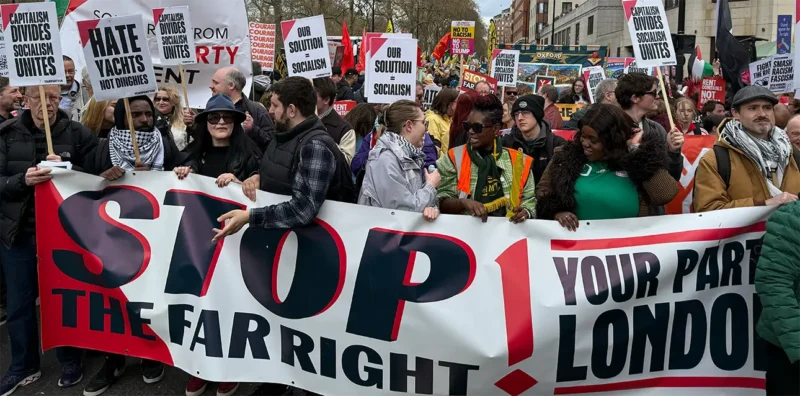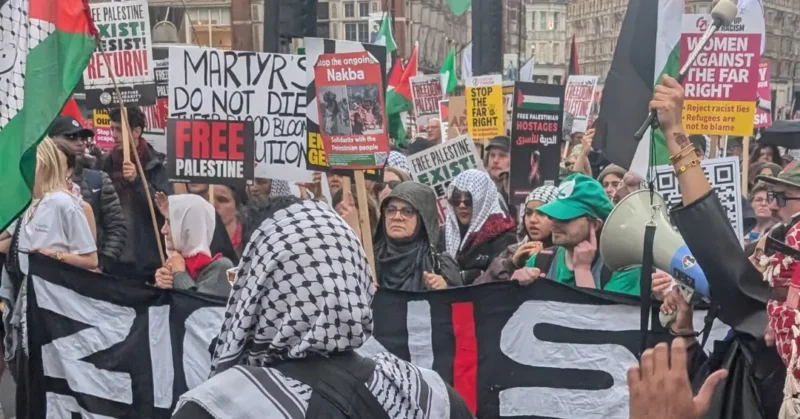

On 28 March, hundreds of thousands marched through London against racism and the far right. Six weeks later, when Tommy Robinson’s Unite the Kingdom movement returned to the capital, the Together Alliance was nowhere to be seen.
The Metropolitan Police had refused the Palestine movement its planned route through Westminster, giving priority to Robinson’s march instead. The Palestine demonstration was diverted, while the wider Palestine and anti-fascist movements had neither prepared the forces nor provided the leadership needed to challenge the police restrictions, including by marching anyway.
Robinson’s supporters marched through Whitehall, practically unopposed. The events of 16 May showed how poorly organised the opposition to the far right remains, despite the enormous numbers who had demonstrated in March.
Together is now holding summits to establish local alliances across the country. But its proposed strategy threatens to entrench the weaknesses exposed in May.
The limits of Together
At the Manchester summit, Together’s interim chair Kevin Courtney explained that the charitable status of participating organisations prevents the alliance from endorsing campaigns against political parties such as Reform or Restore. Local Together alliances may also be unable to support counter-demonstrations against far-right marches.
This is the consequence of trying to build the broadest possible coalition by accommodating its most cautious members.
Of course charities, faith organisations and liberal groups should be encouraged to support anti-racist campaigns. But what is gained by assembling hundreds of organisations if the resulting alliance cannot campaign directly against Reform or mobilise to confront fascist marches?
The answer from Together’s organisers is that Stand Up to Racism can continue organising counter-demonstrations and other activities that Together cannot endorse.
But SUTR already organises local anti-racist groups, demonstrations, stalls and community events. It already has the backing of major trade unions. Together’s proposals for local alliances largely reproduce this activity, with an even broader list of sponsors and a more restrictive political basis.
Together may reach people and organisations beyond SUTR’s existing supporters. But it does nothing to resolve the weaknesses of the anti-fascist movement exposed on 16 May. Indeed, if local alliances cannot campaign openly against Reform or mobilise against fascists, what political purpose will they serve?
The result is an attempt to build an amorphous movement around general appeals for tolerance, diversity and inclusivity, while leaving direct political opposition to the far right to others.
The far right is not an abstract threat to social cohesion. Reform is organising to take political power, while Robinson and other far-right groups are attempting to establish themselves on the streets. Labour’s adoption of anti-migrant policies has helped legitimise their arguments.
An anti-fascist movement needs to confront these organisations and the politics they represent. Together’s deliberately non-party-political, liberal approach evades that responsibility.
The problem cannot be overcome by collecting more institutional endorsements. We need to build independent working-class organisation capable of campaigning against the right, mobilising opposition to fascists and fighting for a political alternative.
Rebuilding working-class organisation
The trade unions should play an important part in fighting the far right. But the affiliation of a union does not mean its members are organised to participate. General secretaries can endorse demonstrations and speak from platforms without committing their organisations to much beyond publicity and financial support.
Decades of anti-union laws, defeats and bureaucratic retreat have weakened workplace organisation. Renewing the unions requires politically active rank-and-file members, able to organise their workmates, challenge the leadership where necessary and confront racist arguments in their own workplaces.
The working class also extends far beyond the organised trade unions. Millions have no effective union representation. Migrant communities, tenants’ campaigns, students and local anti-racist groups have often taken the initiative in resisting racist intimidation and attacks.
Reform has exploited anger over insecure jobs, falling living standards, housing shortages and declining public services, directing it against migrants and refugees. Its influence needs to be challenged in the workplaces and communities where it is growing.
The argument against racist scapegoating must be accompanied by campaigns over wages, housing, public services and equal rights. It also means opposing Labour’s own anti-migrant policies and its attacks on working-class living standards.
Organise to fight
Reform’s electoral advance needs sustained political opposition in workplaces and communities. Against fascist marches, racist intimidation and attacks, we need mass counter-demonstrations, organised stewarding and the collective defence of threatened communities.
The Together summits bring together many people who want to organise such opposition. Activists from the same boroughs, workplaces and campaigns should use the opportunity to establish contact and begin planning joint activity.
Where fascists are planning to march, local groups should coordinate opposition, approach union branches and community organisations, and prepare the publicity, stewarding and practical arrangements needed to mobilise. Where migrants face threats or racist attacks, they should organise solidarity and defence. Workplace militants should take the arguments against Reform into their unions and workplaces.
These efforts may begin with small numbers of activists from different organisations. Through common activity, they can develop into local committees of action, involving people with real connections to the workplaces and communities they represent.
Such committees need to be able to decide what action is necessary and organise people to carry it out. They cannot be constructed simply by gathering together nominal delegates from organisations whose members remain uninvolved.
They should work with Together wherever useful. But activists willing to campaign against Reform, mobilise against fascists or challenge police restrictions cannot be bound by the reluctance of others to participate.
Workers Power advocates a workers’ united front against the far right: bringing the organisations of the working class into common struggle, alongside the communities and campaigns facing racist attacks. This requires rebuilding the fighting capacity of the trade unions and developing new centres of organisation in workplaces and communities.
Workers Power also argues for independent working-class political organisation, capable of uniting these struggles and fighting for a socialist alternative to Labour and the right.
The March demonstration showed that opposition to the far right exists on an enormous scale. Now we need to develop the organisation and political leadership capable of mobilising it when and where it is needed.