As the 90th anniversary of the Battle of Cable Street approaches on 4 October, events in Dover and Portsmouth remind us why the lessons of 1936 remain timely. On that day, poor Jewish immigrants, Irish dockers and some 300,000 London workers halted Britain’s largest and most menacing fascist party, the Blackshirts.
Britain’s would-be Mussolini or Hitler was Oswald Ernald Mosley, 6th Baronet, a rich Staffordshire landowner and socially a very different figure from his Italian and German models. No wonder Leon Trotsky called him ‘an aristocratic coxcomb’.
But this meant he had many upper-class friends, including Winston Churchill, and was married to the daughter of Lord Curzon, variously Viceroy of India and Foreign Secretary. He entered parliament as a Tory in 1918 but defected to Labour in 1924, winning a seat in the Black Country constituency of Smethwick.
A year after the 1929 Stock Exchange Crash, unemployment had reached 2.5 million. While the Labour Chancellor followed financial orthodoxy and cut the dole, Mosley proposed a radical plan, influenced by John Maynard Keynes, that used state spending to stimulate recovery.
He was supported by left-wing figures like Aneurin Bevan and miners’ leader AJ Cook. But the Labour conference narrowly rejected it and he split from Labour to form the New Party in March 1931, together with a group of party left-wingers.
But the New Party failed to win a single seat in that year’s general election. So by October 1932, after a visit to Italy and a meeting with Il Duce, he had decided that parliamentary democracy was a hopeless failure and rebranded the party as the British Union of Fascists (BUF). Because he had a considerable personal fortune, he was able to employ 150 full-time staff and rent a disused Chelsea barracks where he could drill his uniformed followers. At its high point the BUF had some 40,000 members.
His personal charisma and extensive ties with the business and political establishment stood him in good stead. His most prominent backer was press mogul Lord Rothermere, whose Daily Mail, in January 1934, carried his own signed editorial under the headline ‘Hurrah for the Blackshirts’.
Other industrialists supporting him included Lord Armstrong of arms manufacturer Vickers-Armstrong, the car maker Sir William Morris, and AV Roe, founder of Avro Aircraft. Another sympathiser was Lord Londonderry, who owned a large part of the Northumberland and Durham coalfield.
A section of the capitalist class was therefore attracted to Mosley, although the majority supported the grand coalition known as the National Government. It had won a landslide victory in the 1931 election after Labour prime minister Ramsay MacDonald dissolved Parliament. The so-called National Government then set about unloading the costs of the depression onto the backs of the working class.
What is fascism?
In the most economically powerful (imperialist) states, parliamentary democracy is the easiest way of keeping the class struggle within limits tolerable to capitalism, so long as revolutionary forces within the working class can be kept under control by normal legal methods.
But if or when the class struggle rises to heights that threaten capitalism’s very existence, including the rise of political forces that threaten revolution, then these ‘peaceful’ means become insufficient and the most powerful elements within the ruling classes look for an alternative. Such a situation often occurs during a prolonged economic crisis when the employers need to raise the rate of exploitation of their workers to meet the challenge of foreign competitors.
If there is a danger that the army might become unreliable, and the police and security services insufficient to contain the workers’ movement, capitalists begin to look for a mass force among the lower middle class, unemployed ex-servicemen, unorganised and poorly paid workers, even the criminal elements. Fascist movements rally these angry and desperate groups by fomenting hatred against immigrants or other ethnically distinct minorities and combining racism with pseudo-revolutionary rhetoric.
If these forces can take control of the streets, with either the assistance of the police or their benevolent neutrality, then ever more decisive sections of the ruling class may decide the time has come to crush and atomise the political parties of the working class and the trade unions, enabling them to raise their profit rates at home and prepare for war with their rivals abroad.
However, during the Great Depression of the 1930s, which saw one in five workers on the dole, the crisis did not mature into a really revolutionary one. Why? Because, apart from the militancy of Wal Hannington and Harry McShane’s Unemployed Workers Movement, no mass revolutionary movement, political or trade union, appeared.
But looking at events in Europe and the USA, a minority of the bosses saw the need for a movement willing to use strongarm tactics and act as an auxiliary to the police in the event of a strike wave, such as the massive factory occupations in France in June 1936 and in the USA later that year. They feared that mass workers’ action could force a bourgeois democratic government to grant concessions that would reduce profits and, in their view, threaten some businesses with bankruptcy.
The Blackshirts on the march
Nevertheless, in early 1934, the international situation looked threatening. In Austria a semi-fascist regime crushed an uprising by Vienna’s workers and it looked as though fascist leagues in France, whose riots brought down a government, might even come to power. Indeed, had it not been for a one-day general strike and a mass demonstration by Parisian workers, this might have taken place.
Mosley, encouraged by Hitler’s success in smashing the most powerful workers’ movement in Europe, launched a series of marches through working-class areas to show that he too could establish supremacy on the streets. Typically the Labour Party and trade union leaders placed their hopes on the bourgeois state and urged workers to ignore these marches and rely on the police and the courts.
Fortunately, at the grassroots level things were different. Socialists in the Independent Labour Party (ILP) and Communist Party (CP) recognised the threat. Mark Krantz, in a book published this year, Bye Black Shirt! – The Fight Against Antisemitism and the British Union of Fascists 1934–36, gives a vivid account of the mushrooming, in a whole series of cities and towns, of united front committees and defence squads against the fascists.
In Manchester and Leeds, Edinburgh and Glasgow, activists came together from the ILP, the CP, the Young Communist League (YCL), plus Jewish youth organisations, both socialist and Zionist, and the Unemployed Workers Movement.
Antifascist servicemen’s groups proved a useful core for stewards needed to defend labour movement activities against the Blackshirt thugs. They trained defence groups to protect Jewish areas against pogroms and mobilised thousands against Mosley’s 1934 speaking tour.
Nigel Todd’s In Excited Times (1995) records that the BUF attacked an ILP rally outside a dole office, leading to the creation of the Newcastle Anti-Fascist League on 10 May, with a defence force of 200 stewards, half of them unemployed. Street battles with the BUF in Newcastle and Gateshead settled it, with workers turning out in thousands to besiege the Blackshirts in their own headquarters.
A high point came with Mosley’s Olympia rally on 7 June 1934. The Guardian reported that 10,000 people, including far-right Tories, packed the huge venue for a spectacle of patriotic songs, drummers and brilliant spotlights. Mosley entered to salutes and acclaim from 2,000 uniformed Blackshirts.
The CP and ILP had already mobilised thousands in a counterdemonstration outside the hall. Inside, protesters repeatedly heckled and interrupted Mosley’s ranting speech, and squads of his stewards mercilessly beat them. Newsreel cameras captured the violence, and the resulting film was shown in cinemas regularly attended by working-class audiences, alerting many people who had never encountered the BUF to the brutality of fascism.
The battle for London’s East End
Undeterred by some of his Tory supporters deserting him, Mosley doubled down on his violent street politics, this time concentrating his forces against the Jewish population in East London. The high point was his plan to march through the centre of the working-class Jewish community in London’s East End, in Stepney, Whitechapel and Bethnal Green.
Between August and October 1936, the BUF, which had serious support in some of these areas, postered and daubed the streets with virulently antisemitic slogans. They firebombed Jewish shops or smashed their windows, beating up individuals. The high point was to be a march on Sunday 4 October, involving four open-air meetings and ending in a mass rally in Victoria Park.
But the militant forces of the working class and the Jewish community were ready for them. The Independent Labour Party (ILP) played a prominent part in this. It had quit the Labour Party in 1931 with tens of thousands of members and in the process turned to the left, becoming what Trotsky characterised as a centrist party, oscillating between left reformism and revolutionary rhetoric.
A small number of British Trotskyists had entered the ILP on Trotsky’s advice. The party had a policy of physically confronting Blackshirt marches and called for action to stop Mosley’s large mobilisation as soon as it was announced.
An ILP meeting at Hackney Town Hall called for ‘an overwhelming demonstration against the Fascist march’ and called on East End workers to mass at Aldgate in such numbers that the march would be impossible. It issued a militant leaflet to this effect (see box), but no printer would take on the job, so as one militant records, ‘for hours at the Head Office members duplicated copies… and soon were being distributed in thousands throughout East London.’ The London Evening Star ran a front-page headline, ‘ILP Call to the Workers’, printing the ILP’s statement underneath.
The CP has always claimed the major credit for Cable Street and certainly its militants in the East End deserved much of this on the day. However, in the days beforehand the CP was in considerable political confusion. Why was this? Under Joseph Stalin’s leadership of the Communist International, the British party’s line had been that of the Third Period (1928–33), totally opposed to united fronts with the Social Democrats. In Britain they dubbed the Labour Party and the ILP ‘social fascists’.
This disastrous line contributed in Germany to the victory of Hitler in 1933 by preventing the mass workers’ parties from combining to smash Hitler. Under the impact of this disaster, including the complete destruction of the communist and socialist parties and the trade unions, the Communist International belatedly turned to joining united fronts with the other working-class parties.
But in 1935 another Stalinist turn took place towards allying with so-called progressive bourgeois parties, including the Liberals and Conservatives. This ‘popular front’ policy meant playing down physical confrontation on the streets with the fascists, as a concession to the capitalist parties they were trying to attract.
The ILP’s actions were even more important in the light of the serious error the CP leadership was making. The CP had planned a rally in Trafalgar Square on 4 October in support of the Spanish Republic’s resistance to Franco. Fair enough, but they took the line that this took precedence over stopping Mosley. A CP leaflet and the Daily Worker were still calling for workers to assemble on the Embankment and march to Trafalgar Square.
Joe Jacobs, born to Russian-Jewish immigrants in 1913, was a member of the YCL and the CP in Stepney. In his memoir Out of the Ghetto he recalled what happened:
‘The London District CP leadership decision was that, despite Mosley’s march, the party should tell people to go to Trafalgar Square and come back in the evening to protest after Mosley had marched.’
He cites the circular sent to Stepney activists:
‘Keep order: no excuse for Government to say we, like BUF are hooligans. If Mosley decides to march let him. Don’t attempt disorder (Time too short to get a “They shall not pass” policy across. It would only be a harmful stunt). Best see there is a good, strong meeting at each end of the march. Our biggest trouble tonight will be to keep order and discipline.’
Jacobs’ response?
‘I was furious. I could hardly believe my eyes. How could they be so blind to what was happening in Stepney? The slogan “They shall not pass” was already on everyone’s lips and being whitewashed on walls and pavements… The pressure from the people of Stepney, who went ahead with their own efforts to oppose Mosley, left no doubt in our minds that the CP would be finished in Stepney if this was allowed to go through.’
He and many other rank-and-file YCL and party members bombarded the CP’s headquarters in King Street with protests. Their pressure worked: at the last minute, the leadership changed its line and instructed all branches to rally at Aldgate instead of Trafalgar Square.
Cable Street
Assembling in Royal Mint Street, near the Tower of London, 5,000 BUF supporters were intent on marching through the East End to a triumphal rally in Victoria Park, chanting, ‘The Yids, the Yids, we gotta get rid of the Yids’. The police had pledged to Mosley that they would ensure his right to march through Aldgate and the heart of the working-class and Jewish community.
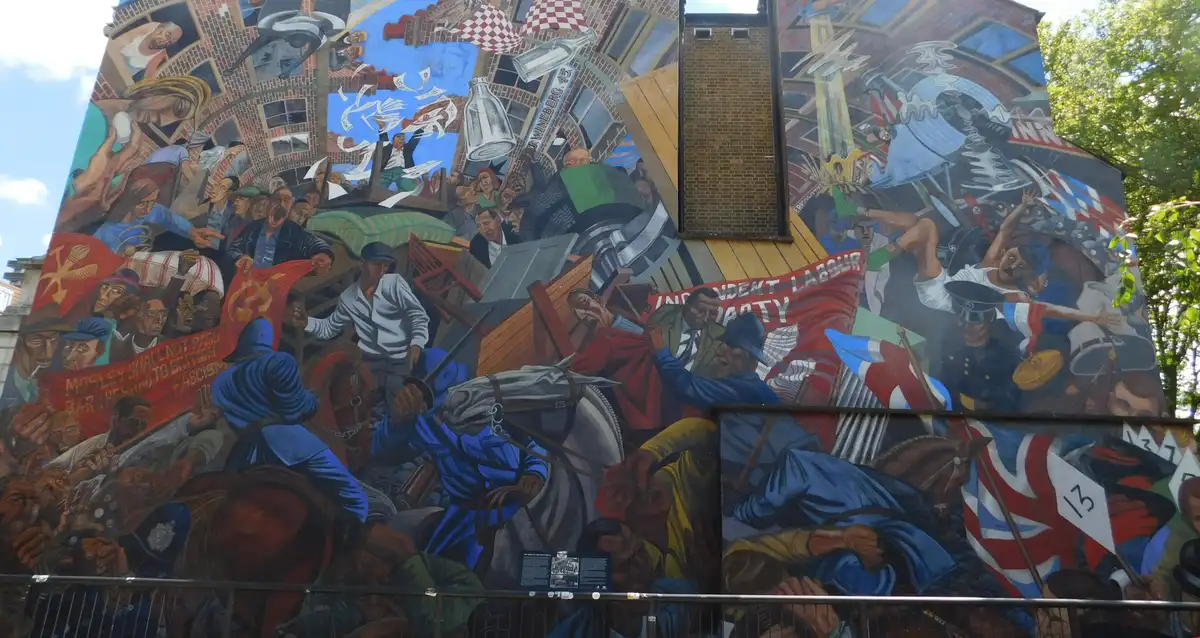
But huge numbers of antifascists had already gathered at Gardiner’s Corner, Aldgate. The police deployed 6,000 officers, both mounted and on foot, to clear a way for them into Whitechapel. The police charged the crowds repeatedly, but four tram drivers abandoned their vehicles, strategically blocking the road. Unable to clear the way, the police then directed Mosley to divert his forces down the parallel but narrower Cable Street, hoping to bypass the main blockades.
But in Cable Street too the crowds were ready. They had armed themselves with billiard cues, bricks and bags of marbles to bring down police horses. Workers overturned a lorry to use as a barricade, levered up paving slabs, and showers of missiles sent the Met’s finest pell-mell into retreat.
By mid-afternoon Police Commissioner Sir Philip Game had had enough and ordered Mosley to abandon the march. The demoralised Blackshirts trooped through the empty streets of the City of London and dispersed. Meanwhile celebrations broke out all over the East End.
Though this victory was a tipping point in the rise of Mosley’s forces, it did not crush them. It was, however, a warning to those in the ruling class who toyed with fascism that it would not go unopposed. However pacifist the Labour and trade union leaders were, there were those who could mobilise the working class and immigrants from below.
The victory was possible only because of sustained local organisation: united fronts that brought together trade unions, workers’ parties and immigrant groups, backed by forces prepared to mobilise whenever fascists took to the streets.
Today, with the activities of racist populists like Nigel Farage’s Reform and Rupert Lowe’s Restore Britain and the street mobilisations of fascists like Tommy Robinson and Danny Thomas, it is time to build such united fronts once again.