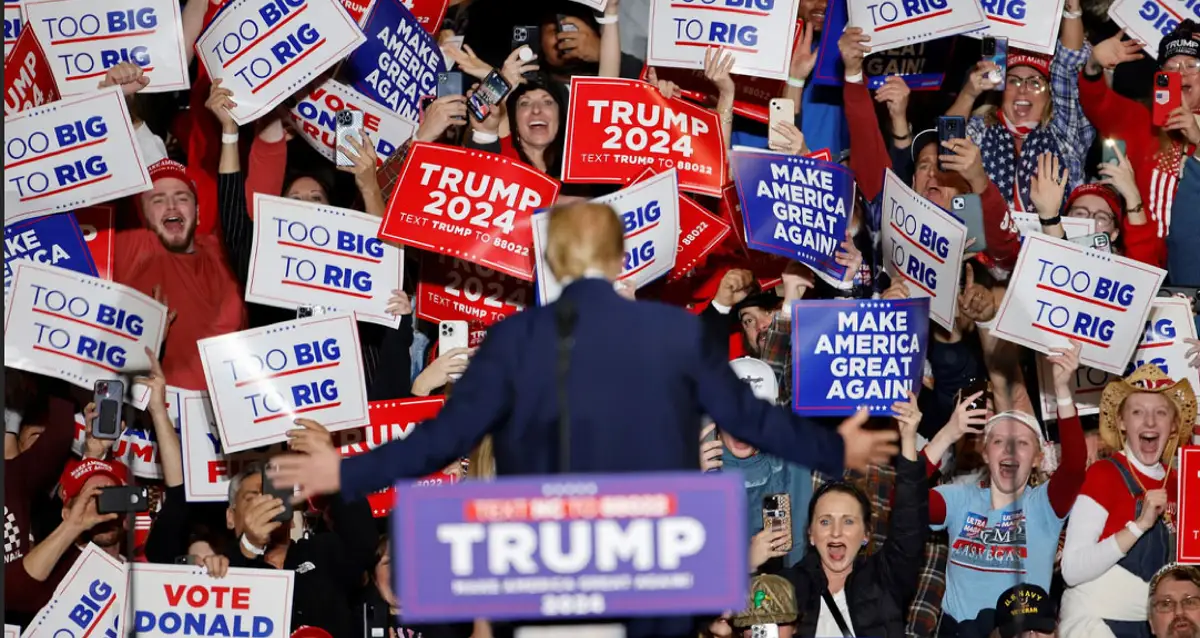
When Americans voted on 3 November, Donald Trump said they should imagine he was on the ballot. Clearly millions did, and it was a disaster. Everyone knew they could pass judgment on his second term. In the event, the loss of seven seats in the Senate and 25 in the House was a massive repudiation of his record, both domestically (the raids and murders by ICE agents, at least 980,000 migrants deported without legal process) and on foreign affairs. Trump is the man who promised to keep the US out of foreign wars, before launching two brutal, expensive and failed wars on Iran which predictably set gas prices at the pumps soaring, including diesel for farmers in the Republican states.
The promises on which Trump returned to office simply collided with the experience of millions of Americans. Despite the booming stock exchange, primarily due to the AI bubble, the main winners of which are multi-billionaires like Elon Musk, Jeff Bezos and Mark Zuckerberg, living costs were a major source of anger. His tariff wars have added to uncertainty for businesses and consumers and threatened US foreign markets which, combined with the fuel price surge caused by the Iran war, has driven the headline inflation rate to 3.7%.
Pushback
But November 2026 is very far from the collapse of Trumpism. Trump has boasted that when it comes to measures passed by a Democrat Congress ‘I’ll be Mr Veto’. It would take two-thirds majorities in both houses to override Trump’s veto. His executive orders and the actions of federal agencies would remain in force unless challenged through the courts or otherwise overturned. He still commands many states, despite losing five gubernatorial races, and he has a 6-3 conservative Supreme Court majority.
Nevertheless, the loss of both Houses will seriously constrain how much of his domestic programme he can impose during the remaining two years of his presidency, including further measures on taxation, cutting social spending and purging the machinery of government.
Abroad, where presidents have traditionally exercised far greater freedom of action, he retains the power to provoke further confrontations, but Congress can tighten the purse strings. And the Republican Party will have its eyes on November 2028 and the evident unpopularity of wars and arms spending. Trump has repeatedly threatened a new onslaught on Iran and has been moving more ships and air power into the Gulf region, but, as the last 6 months shows, such an adventure could backfire both militarily and economically, thus igniting a huge wave of opposition at home. On the other hand, if he does not act it will add to the narrative of US decline.
Democrats in the House can block new legislation, investigate the administration and use negotiations over spending to frustrate its plans. They could initiate impeachment proceedings, if not against Trump then against figures like Pete Hegseth. Winning the Senate gives them a say over appointments to the federal judiciary and senior posts in government.
The repeated ‘No Kings’ protests have demonstrated the scale of opposition to Trump. But the 17 October demonstrations were heavily Democrat dominated and thus emphasised early voting and the need to mobilise against attempts to obstruct the count or certification of the results. Defending the ballot against Trump’s attacks was important but the Democrats succeeded in harnessing this movement to restore their own political fortunes.
With figures such as Alexandria Ocasio-Cortez riding high in the polls as the Democrats’ potential leading contenders, there is a danger that opposition to Trump will be channelled into promising progressive reform through the Democratic Party. Such a project would subordinate the movement to the electoral ambitions of a party that has repeatedly disappointed its supporters in government.
Socialists must defend democratic rights and social gains against Trump without making the focus of resistance, as do the right wing of the Democratic Socialist (DSA), to get more figures like AOC on the 2028 Democratic ticket. The alternative is to build an independent working-class party in the unions, workplaces and communities, capable of resisting Trump’s attacks regardless of who controls Congress.
A weakened president, a wider war?
There is a further danger in assuming that congressional defeat would make the administration impotent. American presidents have frequently pursued military operations despite losing control of Congress. When the Republicans lost the 2006 midterms amid widespread opposition to the Iraq war, George W. Bush responded in January 2007 by sending more than 20,000 additional troops to Iraq. Congressional control of spending and the power to investigate the executive are important restraints, but they have seldom given legislators an effective veto over the conduct of foreign policy.
Trump may be even more tempted to exercise his powers abroad if his domestic programme becomes bogged down. The war against Iran is already deeply unpopular, not least because disruption to oil supplies has pushed up prices at American petrol stations. Early in October he announced that the US would not attack Iran again before the midterms, while leaving the blockade of Iranian ports in place. But the uncertainty following Israel’s 27 October election adds another combustible element. Neither Netanyahu nor his principal rival, Gadi Eisenkot, has secured a clear governing majority. Netanyahu has openly courted Trump’s backing and threatened renewed attacks on Iran, while Eisenkot has also welcomed American military action against Tehran. The struggle to form a government could bring fresh pressure on Washington to support further escalation.
Ukraine presents another unresolved conflict. Trump has sought to bargain with Putin over an end to the war, recently easing sanctions on Russian fuel while pressing Ukraine to accept concessions. Such manoeuvres may encourage Moscow to calculate that further military pressure will extract still more favourable terms. The difficulty for Trump is that he has repeatedly promised peace while pursuing policies that risk prolonging or widening the very conflicts he claims to be resolving.
There is a wider contradiction here. For decades the US maintained its supremacy through a network of alliances, institutions and agreements which, however selectively enforced, helped Washington regulate relations between capitalist powers. Trump increasingly treats these arrangements as obstacles to securing immediate American advantage. But by weakening the guarantees on which allies have depended, and offering concessions to rivals while threatening them with force, he also encourages other governments to pursue their own ambitions more aggressively. The resulting instability is not necessarily something Washington can control, still less turn to its advantage.
Further escalation against Iran could draw retaliation across the Gulf, intensify the energy crisis and deepen Trump’s political difficulties at home. Nor would a Democratic Congress necessarily restrain him: both parties remain committed to maintaining American military predominance, however much they disagree over its methods.
While this crushing electoral defeat has restricted Trump’s freedom to govern at home, it still leaves him commanding the world’s most powerful military state for another two years. Attempts to overturn or discredit the election results will require determined opposition, but resistance cannot end with defending a Democratic congressional majority. Workers confronting deportations, cuts and repression need independent organisations capable of taking action beyond the ballot box, just as opposition to renewed American military adventures will demand more than appeals to Congress. A weakened Trump presidency could still prove a dangerous one.