Student activist Rosa Favre spoke to Workers Power about the blockades and police repression, the struggle to bring workers into the movement and what it will take to win.
Q. How did you become involved in the protests, and what prompted students at your university to take action?
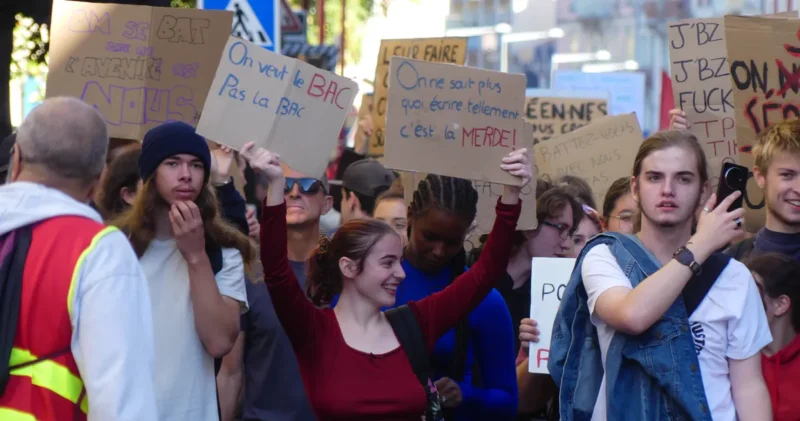
At the end of September, there was general agitation against austerity at my university, but the student body was quite unreceptive to the highschoolers’ mobilisation until the week of the 5th October. On Monday, there was a General Assembly which gathered 500 students and workers. Highschoolers from Paul Eluard, Saint-Denis, have convinced the attendance to stop talking about blocking the university and just do it. And so it was done!
Q.:What are the movement’s main demands? Have they moved beyond conditions in education?
The movement’s main demands quickly moved past these more practical grievances. The whole picture of lack of means of the public sector was pointed out as a culprit for them, like the need of the bosses to quickly have access to cheap labour, as well as the systemic racism that many pupils suffer from. In short, the question of the future has become central, and how class disparities affect the picture. The unprecedented repression the movement faced also brought to mind the murder of Nahel, a 17 year-old boy of Algerian descent killed by a cop. So the same anti-police demands were also quickly raised.
Q. How are the protests organised?
Most of the demonstration dates were actually first and foremost called by the grassroots organisations. At first, spontaneously by a given mobilised lycee, and then in regional coordinations of lycees, interlycees, and universities, interfacs, whose participants were simply the motivated individuals attending. Now, we are quickly moving towards national and regional coordinations of locally elected or randomly sorted delegates. At every occastion, trade unions were then forced to follow in footsteps to guarantee the safety of protesting children.
Q. How widely have the protests spread?
At peak mobilisation of the lycees, 891 out of 3,700 were blocked, while all universities have been “perturbed”, in the words of the PM. The movement, which started in the colonies, has reached poor suburbs, rural areas, bourgeois highschools and even private catholic institutes. It has been difficult to reach more rural areas, which know the media will show no interest in their struggle by comparison, how many cameras where riveted onto the bourgeois Henri IV lycee? The highschoolers have also suffered from increasing fatigue under the triple plight of state repression, school president maneuvres against the mobilised students, and sustained militant activity which requires getting to school at 6am.
Q. How have teachers and other workers supported the movement?
The most widespread images were those of teachers protecting pupils from cops. But the solidarity also took forms more in line with their job, teachers and school supervisors refusing to disrupt the blockades or to give the names of mobilised students. There were reports of railroad workers and garbage collectors starting GAs to discuss of solidarity actions with highschoolers, among which a few strikes. These are of crucial interest, because many workers want to protect their children against the State by themselves, which they only can do if they strike!
Q. How do students connect education cuts with rearmament, and how has the government responded?
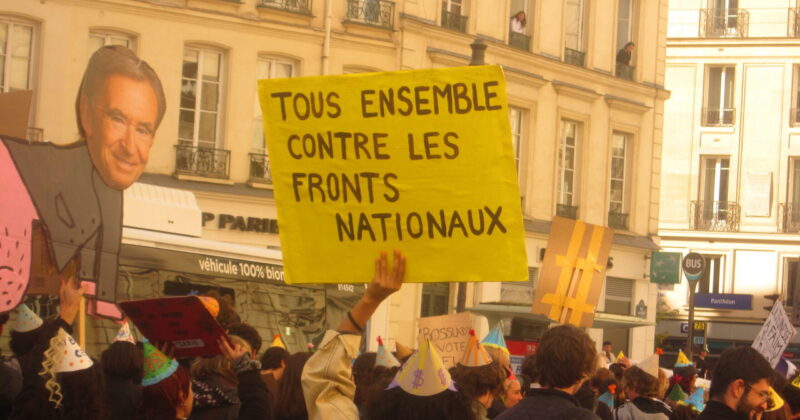
Yes, absolutely and it is one thing that makes the movement so progressive! It has from the get-go started by comparing the dilapidated state of schools and the ever increasing means for the army and the police, or the tax breaks given to the rich and the biggest businesses. The government is embarrassed by the progress of such ideas, and scrambles for any possibility to appease protestors. Yet, its reactionary character forbids it from ever conceding anything. It has banned the usage of stun grenades by police, before giving them back to the CRS for the 17th October demonstration. Lecornu has come back on a few of his attacks on education, before he cut an additional 1,588 teaching jobs.
Q. What lessons do protesters draw from May 1968 and the struggle against the CPE in 2006
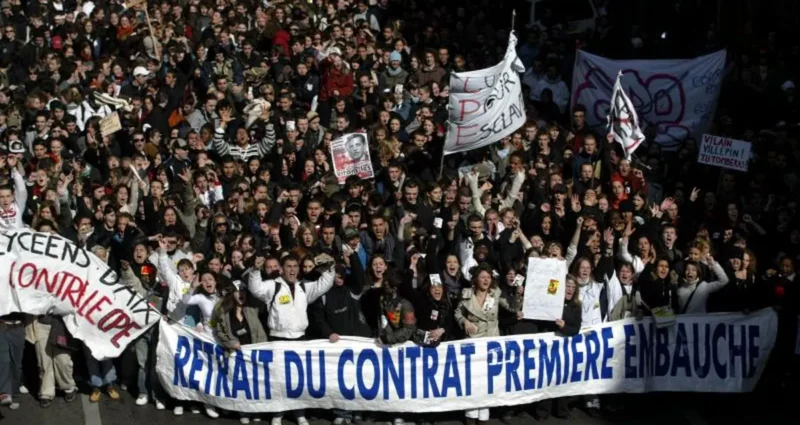
CPE [a discriminatory youth employment contract introduced in 2006] and May 68 are often talked about as inspirations, even moreso for the latter one. The CPE is often taken as a benchmark for a successful movement to succeed, it needs a democratic and national student body, CNE, Coordination Nationale Etudiante, with deciding powers, namely to coordinate the movement at a national level. And everyone wants a May 68. What it means depends on the person. Some want more individual freedom, other want to culturally change society by giving free lessons to highschool pupils from working-class neighbourhoods, and others want students to join the workers. The necessity of the general strike was also raised in a few assemblies, but with little going towards a comprehensive strategy to prepare it.
Q. How political are the protesters, and how do they view the unions and parties of the left
The young protestors are, obviously, left-wing. Now, the question of political affiliation is a complicated one. The most prominent left-wing party, La France Insoumise, has a wide-reaching impact on the movement, because that is the political force that most youth look up to. At the same time, a significant share of the mobilised youth harbours a deep suspicion of every figure of authority parties are seen as profiteers, trade-unions as treacherous. This can have positive effects, like protecting the movement when the student trade unions negociate with the PM without anyone’s approval. However, there is a tendency in some to refuse any kind of authority even democratically elected by the rank-and-file or even collective choices. These must be dealt with cautiously, as they give rise to sporadic behaviours, undesired by the majority of mobilised workers, students and pupils.
Q. What role have students from working-class and immigrant neighbourhoods played?
They first struck the match that set French society ablaze, and it is where mobilisation perseveres longest, because they have the least to lose and the most to win. They saw how much their parents worked to promise them a great future they most probably never will have. A new country is at war every month, and military expenditures keep increasing. But who will become the future soldiers, except them? They saw Nahel getting shot gratuitously by a cop, and how the media falsly claimed he represented a danger to the officer. They know the capitalist system wants them to become fodder, either to a cop, a cannon, or a boss. And they won’t give in before they have given it all. So when they sing “Tout le monde deteste la police!”, everyone takes them seriously and joins them.
Q. How have the police and school authorities responded?
School authorities have called cops or on their own workers to disrupt the blockades. The violence can escalate very quickly, especially in working-class or immigrant neighbourhoods. The result is uneven. Without such massive State repression, there wouldn’t have been such unanimous support for the movement. It is actually school authorities that better break the motivation. Indeed, one goal of blockades is to get a “banalized” day of school, meaning pupils can concentrate on political activities. If that doesn’t come their way, they could face academic consequences. So the blockade becomes an end in itself, which is a serious pitfall if the movement locally stagnates to blockades without a bigger plan, people could lose interest or hope.
Q. Are students debating what strategy is needed to win?
Yes, all of these debates exist. Many students and pupils are hoping the blockades continue, as it is the condition for continued and high involvement in the movement but they see that it doesn’t make the movement progress towards its demands. So some start to look at ways to massify without blockades, like with national demonstrations and ways to organize them like the CNE. Some reach to industrial workers but the perspective of a mass indefinite strike is not yet precise in many minds.
Q. What has surprised you most about the movement?
What surprised me most is the development of a sense of collective responsibility. Students feel responsible to protect highschoolers. Mobilisations in bourgeois areas criticize their media overshadowing of working-class mobilisations. Workers feel like they must protect working-class children against the violent tyranny that cops enforce on the streets. And this attitude is very political, as it makes people receptive to collective action, and willing to enforce collective decisions. Those are the rudimentary needs of collective democracy, a new way to organize that can supplant capitalist society. Participants in such powerful assemblies feel that power and honor it with responsibility and the desire of radical change.
Q. What comes next?
Next, we see the aftermath of the 17th October demonstration and the significance of the 5th November as an action day called by the intersyndicale. Will it rally workers? Will trade unions get involved en masse? That is difficult to tell right now, but I think it most certainly will challenge trade-union leadership to issue calls for strike days in the coming weeks. If workers get involved, they will need to raise their own demands, just like their children did. These must be against the cost of living crisis, austerity packages and rising militarisation. To me, this movement has the power to make the French bourgeoisie concede that it cannot attack “its” working-class frontally anymore. This could dissipate the risk of the coming to power of the RN in the presidential elections 6 months from now, and lessen involvement in rising inter-imperialist tensions. Any international mobilisation of students gets talked about here and gets us going. So organise school blockades, hold GAs, go on strike, elect local and national action committees, and fight along with our demands!