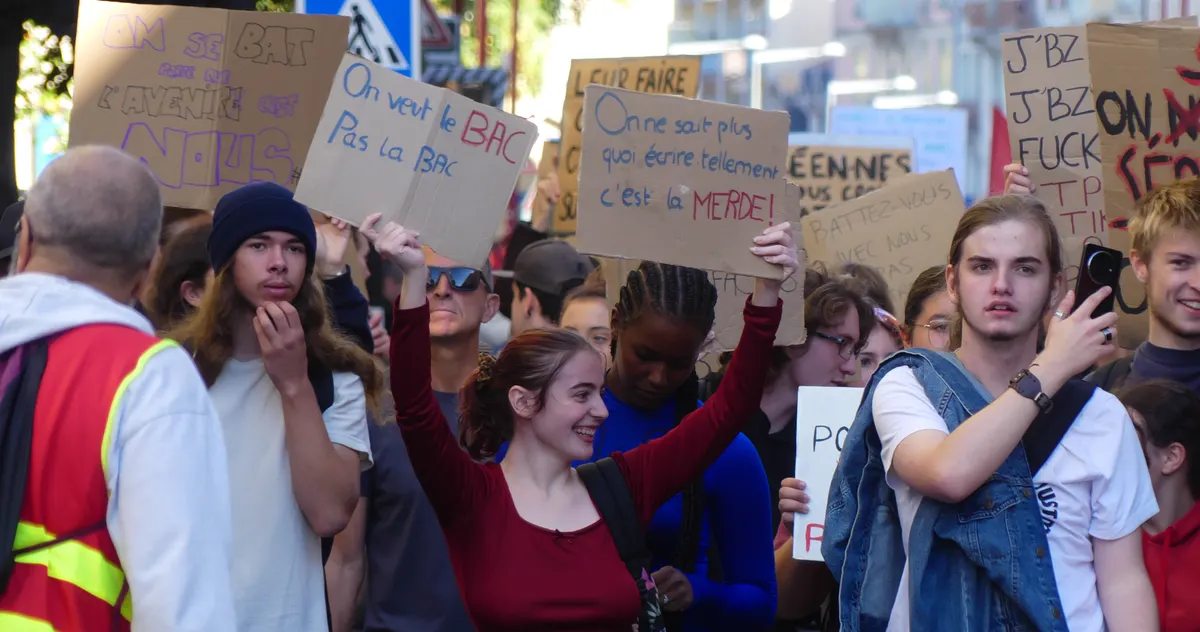
France is witnessing one of its biggest youth uprisings in decades. What began in the country’s lycées—high schools for 15 to 18-year-olds—over teacher shortages, overcrowded classes and crumbling buildings has spread across the country and begun to draw in university students and trade unionists.
It comes as Prime Minister Sébastien Lecornu prepares an austerity budget aimed at cutting €54 billion from public spending.
The protests began on 21 September with a blockade at a lycée in Créteil, a working-class suburb south-east of Paris. Students were protesting against exhausting timetables, oversized classes, missing teachers and rundown buildings, particularly in working-class areas. There is also widespread dissatisfaction with the opaque and complicated nature of Parcoursup, a national platform for university admissions.
From there the movement spread rapidly. By 1 October the Interior Ministry said actions had taken place at more than 1,000 schools, with 222 blockaded. More than 6,000 people have since been arrested. By 5 October, 4,406 minors had been held in police custody and 1,483 were facing prosecution.
On 6 October the movement reached a new pitch. The government counted 266,000 demonstrators across France, while the organisers estimated 450,000. University students joined in significant numbers, with blockades and mass meetings at campuses including Jussieu in Paris and Rennes.
Repression
The government’s first answer was repression. Interior Minister Laurent Nuñez denounced what he called “urban violence”, while Lecornu deployed the infamous CRS riot police to restore “republican order”.
There have been repeated reports of police attacking teenage protesters. A student at Lycée Herriot in Lyon described five officers pinning down a 15-year-old, beating him with batons and tear-gassing him before putting him in a police van.
Another student said the blockade had initially been peaceful: “But then things completely kicked off because the police started abusing their power. They were the ones who went on the offensive—we’re just defending ourselves.”
The scale of the injuries has made repression a central issue. Official figures record more than 200 pupils injured since the movement began. In Tours, a 16-year-old was blinded in one eye after being struck by a police rubber bullet. Another student suffered a serious eye injury in the Paris suburb of Argenteuil, while in Lens a 15-year-old lost a hand after a police grenade exploded.
Demonstrations have taken up anti-police slogans alongside demands over education, while trade unionists have organised stewards’ groups to defend young protesters.
The government and the right have also tried to portray the revolt as an operation organised by the left-populist La France Insoumise (LFI) and the “ultra-left”. Marine Le Pen’s National Rally has joined the attacks, while conservative politicians have even raised the prospect of banning LFI.
But the movement was not conjured up on the instructions of any party. It grew out of conditions in the schools and spread through social media, local blockades and the example set by students elsewhere.
Reports from Paris describe a highly politicised mood. Young demonstrators have chanted “Revolution”, “Macron, you’re screwed” and slogans against National Rally leader Jordan Bardella, while showing a keen appetite for political argument and literature. Palestine flags are ubiquitous. This is not yet a movement with a clear political leadership, but thousands of young people are looking for answers beyond the immediate grievances that first brought them onto the streets.
Get The Spark in your inbox
Workers Power’s weekly newsletter
Workers and students
The most important development is the growing contact between the youth revolt and organised workers.
Teachers have supported blockades from the beginning. More than 300,000 public-sector workers demonstrated during a strike on 29 September, according to the CGT, alongside lycée students and workers from parts of the private sector.
For 6 October, the CGT called on its organisations to stand alongside the students, provide places for them to meet and protect their right to demonstrate. It also encouraged its unions to use strike action where permitted by open strike notices.
In Paris, CGT stewards formed protective lines around school students during the march. One socialist present compared the scenes with the mass demonstrations against Macron’s pension reform: the unions provided organisation and protection, while the young people themselves supplied much of the energy and political character of the protest.
There have been other concrete examples of workers joining the movement. In Strasbourg, striking rail workers joined students defending a university blockade against the police. At the same time university students are beginning to organise their own assemblies and link up with the lycées.
But displays of solidarity are not yet the same thing as the workers’ movement entering the field of struggle. On 5 October the main union confederations—the CGT, CFDT, FO, UNSA and FSU—called their next national strike and demonstration for 5 November. That leaves an entire month between the present explosion of youth struggle and the next united day of workers’ action.
Lecornu is already trying to use that breathing space. With mass closures and remote teaching failing to end the movement, the government has proposed a platform for students’ grievances and a half-day without lessons in every lycée for a controlled “internal democracy” discussion between students and staff. The education minister has also promised rapid responses to complaints about missing teachers.
Meanwhile the austerity budget that the unions themselves oppose would freeze public-sector pay and social benefits and abolish another 1,588 permanent teaching posts. Calls are also circulating for a nationwide mobilisation over fuel prices and the cost of living on 17 October, which lycée activists are already discussing as the next horizon for their movement.
Waiting until 5 November risks allowing the government to regain the initiative. The unions should bring forward national strike action and seek to unite the lycée and university revolt with workers fighting over pay, jobs, public services and the budget.
Assemblies and coordinations between schools and universities are already beginning to appear. Similar organisation in workplaces and unions could turn solidarity into strike action and create a common fight against Lecornu’s austerity budget.
The youth movement has already shown that repression cannot simply drive it off the streets. If workers enter the struggle in force, escalating strike action rather than relying on isolated days of protest, the government would face a much more serious confrontation. That raises the perspective of building towards a general strike capable of defeating the cuts.
It would also offer a different answer to the social crisis from the racist and authoritarian politics of Le Pen and Bardella. The chants against the far right heard on the demonstrations show that many of these young people already see it as an enemy. The challenge now is to turn an extraordinary youth revolt into an organised movement powerful enough to win.