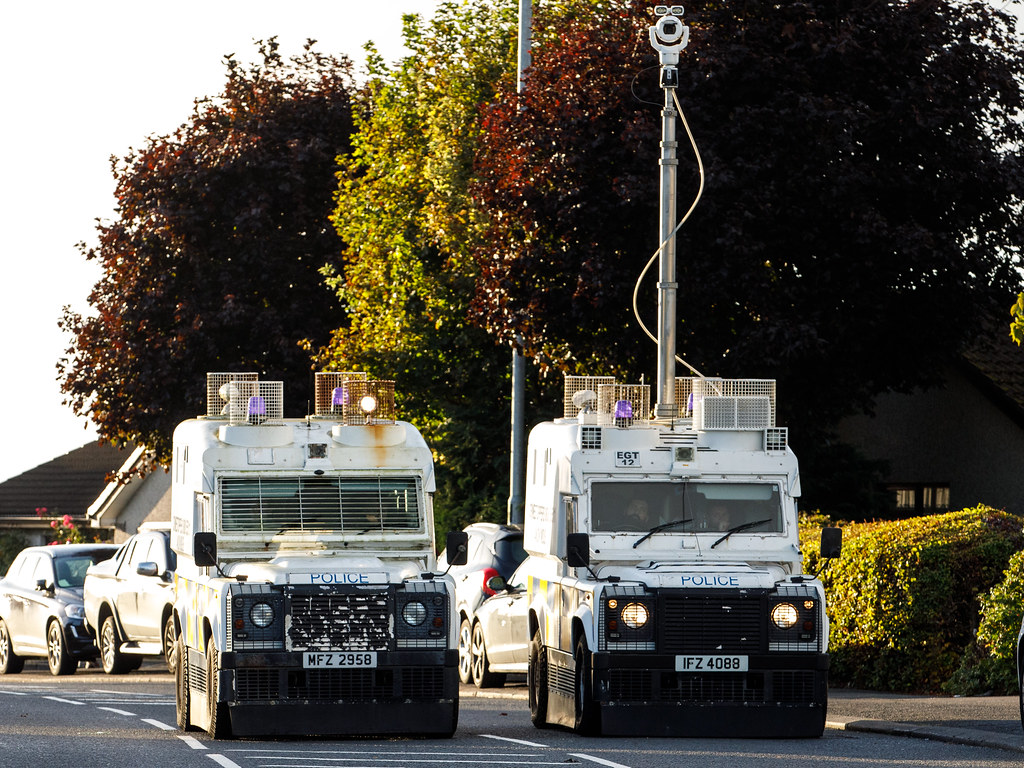
The last weekend in September saw the residents of Garvaghy Road in Portadown and their supporters successfully block the unwanted and provocative march of the Orange Order through their area. A continuous blockade lasting over 24 hours saw up to 3,000 supporters during the day and around 1,000 at night, defying the Parades Commission’s decision to allow the march through the nationalist area. The blockade was lifted on condition that no march would take place once the protest dispersed and that talks would quickly follow.
For those of us who were there, there were no wild scenes of celebration, but a steely determination that the fight had only just begun. We were under no illusions that the Orange Order and their bigoted supporters in the DUP and TUV won’t be back again to demand their so-called right to march in areas in which they are not wanted. This peculiar trait of Unionism has its roots in the supremacist ideology underpinning the six-county state of Northern Ireland. Their ‘right’ to march is in fact a weapon of intimidation and harassment against those who want a united Ireland.
Of course, the area has a history of attacks on the nationalist minority which, in the 1980s and 1990s, resulted in the murders of 18 Catholics by loyalist paramilitaries. In those days, the Orange marches were forced down Garvaghy Road by the police and were often the occasion for intense rioting, which also spread to other areas in the north. This was the trigger for the setting up of a Parades Commission in 1998 that was meant to sort out these contentious parades. The Good Friday Agreement (GFA) also came in that year, designed to usher in a new period of peace and shared government.
So for 28 years the Garvaghy Road parade was banned. Until this year, when the High Court quashed the Parades Commission ban because of a procedural error in following its own rules in issuing it. One commissioner ‘resigned’. But in reviewing the next application from the Orange Order, the Commission felt sufficiently embarrassed not to ban the march. The police could see no problem with this — that is, until they were forced to stop the Orange Order from marching on Sunday. Various legal challenges and counter-challenges followed in this farce.
When the ban was lifted, there was a torrent of outrage from a wide range of bodies, including the Alliance Party, the SDLP and Sinn Féin, although the Irish government could only express ‘concern’. All Prime Minister Burnham could say was that the decision had been ‘independently determined’ and that we need ‘calm’. Yet it is the British government that appoints the Parades Commissioners, and presumably it must have a view on, if not an influence over, allowing such a ridiculously provocative march to go ahead.
Most importantly, the Garvaghy Road Residents Coalition had organised mass meetings and vowed to stop the march. In this they were supported by eleven other nationalist residents’ groups concerned that their agreements might unravel. Breandan Mac Cionnaith, the spokesperson for the GRRC, has rightly commented that the ‘Orange Order has put us through hell’ and that they should be apologising, not threatening to march again.
The important principle that needs to be upheld here is that democratically run residents’ groups should have the final say on who marches into their area. No Parades Commission nor international mediator should override the residents. It is not a question of mediation or negotiation if a community rejects such sectarian marches with all their accompanying violence. There is no reasonable justification for going through an area that doesn’t want you.
Peace process in peril
The protest was a remarkable display of solidarity from across the north and beyond. Hours of pouring rain could not dent the determination of the protesters. Residents’ groups and Sinn Féin had clearly mobilised. Sinn Féin First Minister Michelle O’Neill, in condemning the march, said it ‘brings into question how this whole peace process works’. Yes, it does. This point was put more poignantly by a local resident on the protest: ‘we have a first minister in government, we have a peace agreement so why are we having to go through this torture again?’ No wonder we heard the call of ‘bring Stormont down’ from some of the protesters.
There has to be a clear evaluation of the failures of the Good Friday Agreement. Whilst it may have brought peace, it has not altered the sectarian nature of the northern state; in fact, it has institutionalised the sectarian distribution of power and privilege. The state still has a police force that will force through these unwanted sectarian marches if that is the law. And if that fails, then bring in the troops again.
The GFA’s prize of a border poll is as remote and illusory as ever and depends on a British government that alone determines when to have it, and Burnham stands in a long line of British prime ministers who won’t call one. It is ‘off the table’, he says. Insofar as the GFA respects the Unionist majority or veto on a united Ireland, it has copper-fastened partition. This means that the Irish people as a whole are still denied the right to determine the future of the north.
The simple fact is that the GFA was a pro-imperialist agreement to disarm the republican resistance and to ensure the constitutional nationalist parties, as Sinn Féin has become, share power with Unionism. In this way Sinn Féin has become complicit in implementing Westminster budgets which have deepened austerity and ruined public services. But forcing Orange marches down nationalist areas was a step too far for Sinn Féin, worried about the Assembly elections next May and a worsening cost-of-living crisis for its voter base.
The GFA and its devolved Stormont are not delivering. As Gerry Carroll, People Before Profit MLA, said: ‘What protected and defended the Garvaghy community wasn’t Stormont or the Parades Commission, it was thousands of ordinary people standing together on the Garvaghy Road in the rain.’ Mass mobilisation of working-class people can defy and win against reactionary bigots who want to take us back to the Middle Ages. This problem will not go away. Our residents’ groups will need to organise and coordinate the defence of our communities through democratic structures that involve and integrate all residents, in particular the youth.
But neither is Stormont delivering on its so-called peace dividend for workers. The Executive can only beg for more funding from Westminster but has no strategy for securing it. On a whole range of social and economic fronts, we need to organise in our workplaces and unions to defend our standard of living and services through mass mobilisations and industrial action. This means a fight against the British government and all of its failed institutions in Ireland. Catholic and Protestant workers must unite in that fight to defend their interests as a class and dispatch the Unionist bigots and elite to the dustbin of history.