
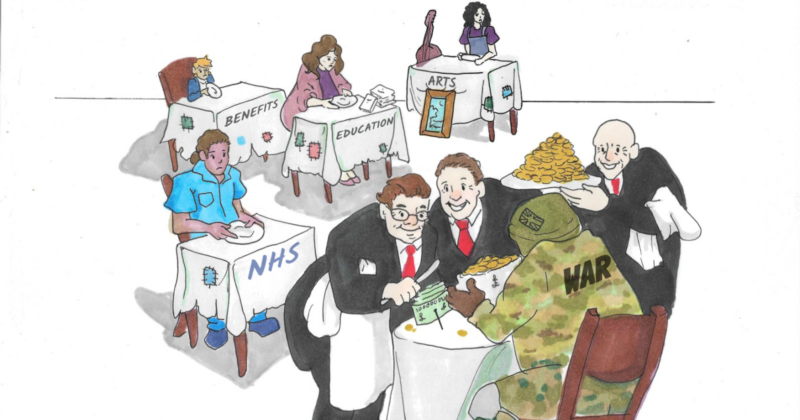
John Healey’s first Budget was designed above all to reassure the financial markets. With debt interest already costing the government £14 billion more this year than last, the Chancellor was determined to avoid anything that might unsettle investors. The City was satisfied: government borrowing costs fell, shares rose and analysts welcomed the absence of surprises among the budget’s record-breaking 98 separate measures.
For households, there was some, very modest relief. Up to 20 million homes will receive a one-off £100 payment towards energy bills, financed by a temporary surcharge on banks. But that will be swallowed up by rising prices. The energy price cap is forecast to increase by nearly 30% in January, adding roughly £500 to the annualised cost of gas and electricity for a typical household. VAT on electricity has been cut and fuel duty frozen, but both measures expire in July 2027. The extra 3% bank surcharge itself ends in March 2028.
These measures will do little to reverse the prolonged squeeze on living standards. The Office for Budget Responsibility (OBR) forecasts no growth in real earnings in either 2027 or 2028. Its explanation is straightforward—wages are expected to grow more slowly than productivity, allowing profits to recover their historical share of national income. A relatively weak labour market will help by ‘reducing workers’ bargaining power’.
In other words, the government’s economic forecasts depend on employers restoring their profits while workers’ wages stagnate. Whatever Andy Burnham may have promised about a fresh start, this is the basis on which his government intends to revive British capitalism.
Labour’s national renewal
Britain’s fifth prime minister in four years entered Downing Street in July promising an end to ‘politics as usual’. His government has certainly adopted a more interventionist approach to industry and investment than its predecessor. But the purpose of that intervention is to restore the profitability and competitiveness of British business, with the state assuming risks that private investors are unwilling to take.
The Budget provides another £20.4 billion for the National Wealth Fund and British Business Bank. Healey has instructed the Wealth Fund to make defence production a central priority and to turn local development plans into ‘investable opportunities’ for private capital. More than 10,000 businesses will receive electricity discounts of up to 25% from April 2027, while company start-ups will pay just 10% capital gains tax on up to £10 million of lifetime gains.
The government has also approved Shell and Equinor’s Jackdaw gas field, another concession to the energy companies and the unions lobbying on their behalf.
Above all, Burnham has made rearmament central to his plans for British industry. Healey resigned as defence secretary in June over Keir Starmer’s refusal to increase military spending sufficiently. Now, as Chancellor, he has found another £4.7 billion for the Defence Investment Plan and set a target of spending 3% of GDP on defence by 2030.
Meanwhile, Burnham’s promises to improve public services have been pushed further into the future. Free personal care under a National Care Service will have to wait until the next parliament. At Labour conference he insisted that he had to be ‘honest about what the country can afford’.
There is a clear difference between what the government can afford when it comes to subsidising business and expanding the armed forces, and what it considers affordable when it comes to improving workers’ lives. Public investment is being directed towards making British capital more competitive, while demands for higher wages, better benefits and improved services are subordinated to the Treasury’s spending limits.
Cuts are coming
The Budget has postponed rather than resolved the contradictions in the government’s spending plans. Most of the difficult decisions have been left for next year’s Spending Review, but there is already enough information to see where the axe will fall.
Under existing plans, defence spending will reach 2.7% of GDP in 2027–28. Raising it to 3% by 2030 will require roughly another £10 billion a year. Healey has promised to set out how this will be financed alongside the Spending Review.
Even the military spending already agreed is being partly funded through cuts elsewhere. Departments have been required to surrender around 1% of their capital budgets each year towards defence spending up to 2029–30. Capital budgets pay for building and repairing schools, hospitals and other public infrastructure. The Department for Education alone is contributing £76 million a year from its investment budget between 2027 and 2030.
The Warm Homes Plan loses £1 billion, including £720 million from grants to help households replace gas boilers with heat pumps and £180 million from schemes supporting low-income households. This will mean less public money for improving heating systems and reducing dependence on gas, just as another surge in prices exposes the cost of that dependence.
According to OBR chair Jonathan Haskel, departments outside defence, health and education face real-terms cuts of around 2.6% over the final three years of the forecast. This will mean further pressure on already overstretched local government and public services.
The government is also preparing changes to the benefits system. Healey insists that the welfare bill must fall, although he has avoided announcing specific cuts. Alan Milburn’s review of youth unemployment, due in November, proposes financing additional support for young people partly through reductions in their benefits. Burnham has endorsed the principle that young people should be expected to accept whatever ‘opportunities’ they are offered. Stephen Timms’ review of disability benefits is due by the end of the year.
Pensioners have also been given notice of the ending of the triple lock linking the state pension to wages, inflation or 2.5%, whichever is highest. Britain’s state pension remains one of the least generous in western Europe. The triple lock has allowed it to gain ground gradually on average earnings, but from 2030 the government will put a stop to that catch-up. Pensions will still be protected against inflation, but increases above earnings growth will no longer permanently raise their value relative to wages. The savings are supposed to help finance the new care service.
Young workers, meanwhile, have lost the promise of equalising minimum wage rates. Instead, all rates will increase by 3.9% in April, with the increase effectively wiped out by the 3.8% inflation forecast for early next year.
Taken together, these measures give a fairly clear picture of the government’s intentions. While the Budget offered some immediate relief, the Treasury is preparing to restrain wages and benefits, reduce spending on services and divert an increasing share of public resources towards rearmament and subsidies for private investment.
The unions need a new strategy
The trade union leadership has offered little serious opposition to this programme. Unison general secretary Andrea Egan complained that the Budget fell short of Burnham’s ambitions. Unite’s Sharon Graham dismissed it as ‘baby steps’, but welcomed the additional defence spending and demanded that military expenditure rise to 3%, and then 3.5% of GDP, as quickly as possible. She has also called for more orders for Typhoon fighter jets.
Unite, along with the GMB, has similarly campaigned for the Jackdaw and Rosebank oil and gas developments, arguing that they are necessary to protect jobs and industrial capacity.
But this strategy leaves workers dependent on securing further contracts for arms manufacturers and oil companies. It accepts that the future of British industry should be determined by the investment priorities of the employers and the state, even when those priorities conflict with the interests of other workers.
Under the government’s spending plans, higher military expenditure means still less money available for public services and benefits. Expanding oil and gas production leaves workers dependent on the profits and investment decisions of the energy multinationals, while doing nothing to overcome the country’s dependence on fossil fuels.
Why are Unite and GMB not campaigning with the same determination for a massive programme to replace gas heating in homes, workplaces and public buildings as they are for new oilfields and military contracts? Such a programme would create demand for skilled engineers, electricians, construction workers and manufacturers, while reducing energy bills and dependence on imported gas. Yet the government is cutting the very funds needed to develop this work.
The union leaders’ approach encourages workers in different industries to see their interests as opposed to one another. Defence workers are told that their jobs depend on rearmament, while public sector workers and benefit claimants are told that the money is not available to meet their needs.
Of course workers employed in arms manufacturing and the fossil fuel industries should not be made to pay for the conversion of those industries. Their jobs, wages, conditions and pensions must be protected, with guarantees of alternative employment and retraining where necessary. But that requires a fight for public investment and workers’ control, not for more military contracts and oilfields.
What we should fight for
Britain does not lack the resources or skilled workers to meet its needs. What it lacks is a government prepared to put those resources to use for the benefit of the population rather than the profits of private industry. Burnham is prepared to mobilise public money to expand arms production and subsidise British business, but not to undertake the investment needed in housing, heating, transport and public services.
If there is a skills shortage in this or that trade or industry, then there are one million young people desperate to be trained for the job. We demand a massive increase in technical training for youth, who should be paid a living wage while they train and be guaranteed a permanent job on trade union rates on completion.
A socialist alternative would start by taking control of investment out of the hands of the banks and big corporations, and drawing up a programme of production based on social need.
The country needs millions of homes insulated, gas heating replaced with cleaner alternatives, a massive expansion of renewable energy, new public transport infrastructure and a programme of council house construction. Much of the industrial capacity and skilled labour required already exists in the defence, aerospace, engineering and energy industries.
The labour movement should demand the conversion of these industries to socially useful production, with guarantees for every worker’s wages, employment and pension. The Lucas Aerospace shop stewards demonstrated the possibilities in 1976, when they produced their own plan for using the company’s technology and skilled workforce to meet social needs. Such plans should be drawn up by workers themselves, in cooperation with the communities that would benefit from them. They should then use them to mobilise for strike action to secure its implementation.
But a serious programme of industrial reconstruction cannot be left to private investors, whose decisions are governed by the pursuit of profit. It requires public ownership of the banks, utilities, transport networks and major industries, including the data centres and digital platforms now receiving substantial state support.
These industries should be nationalised without compensation to their major shareholders and placed under workers’ control. A publicly owned banking system could direct investment according to a democratically agreed plan, rather than relying on the National Wealth Fund to persuade private businesses to invest. Public ownership of energy would make it possible to bring down bills by ending private profiteering and directing investment towards the infrastructure needed to reduce costs, and accelerate the shift away from fossil fuels.
Workers also need a direct answer to the continuing erosion of their living standards. The unions should fight for a real living wage, calculated by workers’ organisations themselves and automatically increased in line with the cost of living. Pensions and benefits should be raised to provide a decent standard of living and protected against inflation. The lower minimum wage rates for young workers should be abolished.
These demands are inseparable from opposition to the government’s military programme. The labour movement should reject Nato’s spending targets and Britain’s support for the US-Israeli war on Iran and the Zionist state’s genocide of the Palestinians. The billions being earmarked for rearmament should instead be used to rebuild public services and expand socially necessary production. Britain should leave Nato.
This programme would make it possible to guarantee livelihoods while transforming Britain’s industrial base, instead of leaving workers at the mercy of government contracts and the market. It would also end the dependence of public services and living standards on what the Treasury considers affordable within the limits set by profitability.
None of this is beyond the country’s productive capacity. Nor is there any parliamentary obstacle to Labour carrying out such a programme with its present majority. The obstacle is political. Burnham’s government is committed to preserving private ownership and profitability, and it will not voluntarily undertake measures that challenge the power of the banks and major corporations.
A programme that puts workers’ needs before profits will therefore have to be fought for, not simply presented to ministers as a more sensible alternative.
No return to austerity
There is little time to lose. Milburn’s recommendations on youth unemployment are expected this month, with Timms’ disability benefits review following before the end of the year. Public sector pay settlements for 2027–28 will be constrained by the limits agreed in the Spending Review, and further departmental cuts are already planned.
The unions should begin preparing a coordinated response now. Campaigns against benefit cuts need to be linked to those over pay, jobs and public funding, bringing together workers, claimants and young people facing the same government programme.
That will require more than resolutions and lobbying. Union branches and trades councils should begin organising joint campaigns and preparing for coordinated industrial action. Where the union leaderships refuse to act, members will need to build rank and file organisations to push them into action and, where possible, organise independently of them.
The danger of allowing Labour to preside over another prolonged period of stagnant wages and deteriorating services is considerable. Reform and the Tories will seek to exploit the resulting anger, blaming migrants and welfare claimants rather than the employers and the government’s economic priorities.
The Spending Review will not be the beginning of the attack. Much of the preparation is already under way. The labour movement needs to organise its resistance before the cuts are announced, rather than waiting until they are being implemented. We need a new coalition of resistance, but this time based on local anti-cuts groups and union branches, democratically accountable to a delegate conference.
The great upheavals across Europe show that it is possible to link the demands and the forces of the workers and the youth to shake governments to the core. Workers in Britain lag behind those in Europe but though no fault of their own. We must demand our union leaders join in the European revolt and take our place among the front ranks of resistance—and if they don’t, they should be pushed aside to make way for new leaders who will.