Last Sunday, the Green Party conference voted by 1,022 to 813 to declare that Zionism is racism, committing the party to a single democratic state in all of historic Palestine, with equal rights for all. No mainstream British party has done this before, and its significance is made clear by the reaction from all corners.
Within hours of the vote, Israel’s foreign minister Gideon Sa’ar had barred Green leader Zack Polanski from entering the country. The foreign ministry called the motion ‘a clear antisemitic text’ and the ban ‘a first step’. President Isaac Herzog called it ‘a disgrace’.
British politicians were quick to join in. Prime Minister Andy Burnham, whose government only last month acknowledged ethnic cleansing in the West Bank, called the vote ‘a completely wrong decision, a terrible judgment’ and demanded that the Green leadership reverse it. Labour chair Bridget Phillipson called it ‘shameful’ and Tory leader Kemi Badenoch denounced the Greens for ‘disgraceful antisemitism’. The Board of Deputies branded the party ‘extremist’, while the European Green Party rushed to distance itself from the decision.
But why such fury over a conference motion in a party with five MPs?
Because it challenges a central commitment of British foreign policy: the preservation of Israel as a Jewish state. Israel is a major military and strategic ally of the United States, central to the maintenance of Western power in the Middle East. Britain has interests of its own in the region, but its influence depends heavily on its close alliance with Washington and the wider system of military, diplomatic and economic relationships that sustains US domination.
Successive British governments have criticised particular Israeli policies while defending the state itself. Burnham’s government has gone further than its predecessors in recognising Palestinian statehood and imposing restrictions on Israeli settlements. But its commitment to preserving Israel as a Jewish state remains unchanged.
The two-state solution has long provided a convenient way to reconcile this position with professions of support for Palestinian rights. Yet since the Nakba of 1948, hundreds of thousands of Palestinians have been denied the right to return to their homes. Decades of occupation and settlement expansion have carved the West Bank into fragments, while Gaza has been rendered uninhabitable. The territory on which a viable Palestinian state could be established has been systematically swallowed up.
Within these limits, criticism of Israel’s government is permitted. You can condemn Netanyahu, and now even speak of ethnic cleansing, as Burnham’s government does. But what you definitely can’t do is question the Zionist character of the Israeli state itself. That means confronting the racism of a political project built on the dispossession of Palestinians and the denial of their right to return.
The Green conference crossed that line. Its support for a single democratic state, with equal rights for Palestinians and Jews, challenges the assumption that Israel must continue to exist as a state in which one people enjoys national privileges at the expense of another.
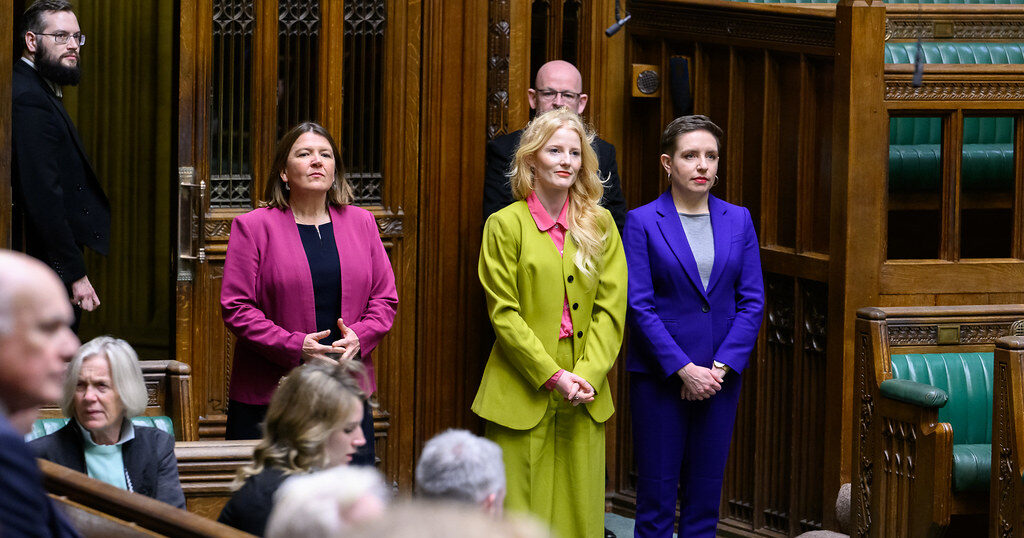
The Green leadership has given only a qualified defence of the conference policy. Polanski, who missed the vote to campaign in the Holborn and St Pancras by-election, subsequently said he would have voted against it. He objected in particular to the commitment to one state, arguing that it was not for a Green Party conference in Brighton to decide the future of the region.
Of course nobody is suggesting that a Brighton party conference can decide Palestine’s future. But British politicians have spent decades defending the fruits of Lord Balfour’s declaration and telling Palestinians that a two-state settlement is their only option. It’s convenient that Polanski’s objection to telling Palestinians what their future should be disappears when the proposal leaves the Israeli state intact.
He and the party’s MPs issued a joint statement saying there was ‘no conflict between supporting the rights of Palestinians and the rights of Jewish people’, without defending the actual decision. Parliamentary leader Ellie Chowns has since warned that the party must avoid being captured by ‘extremists and racists’. So much for respecting the democratic decisions of party members.
The fury over the vote reflects the increasing difficulty of maintaining the established consensus on Israel after three years of genocide in Gaza and a mass Palestine solidarity movement. For the first time, the demand for a single democratic state has broken into the official policy of a parliamentary party. The pressure to reverse that decision shows how much the establishment wants to close up the breach. The task now is to defend the political principle behind the vote — equal rights for everyone in historic Palestine — and turn the growing opposition to Zionism into a struggle against Britain’s military, economic and diplomatic support for Israel.