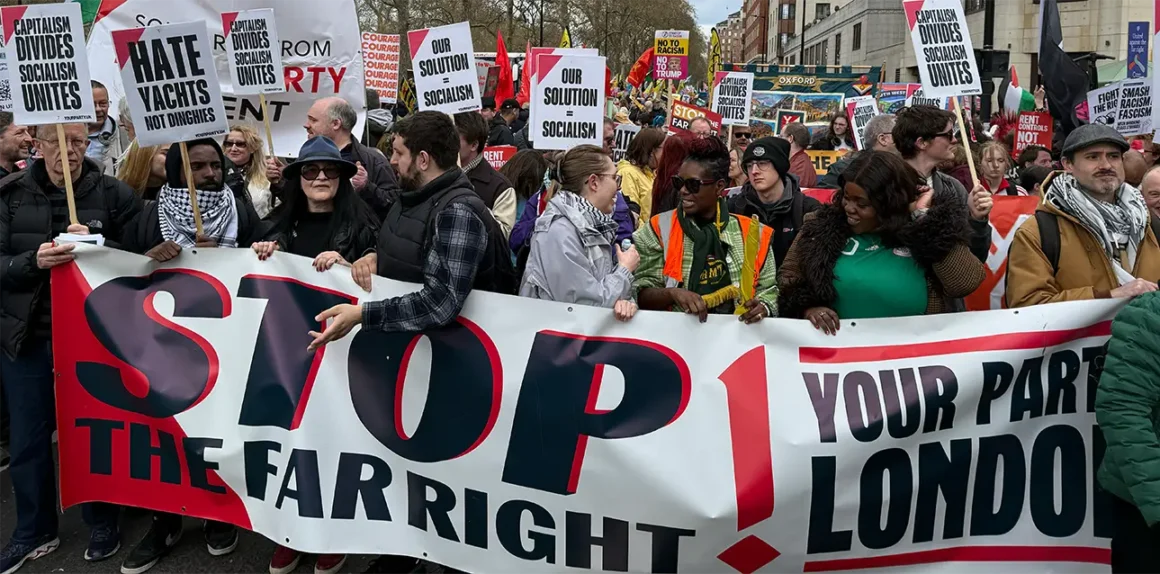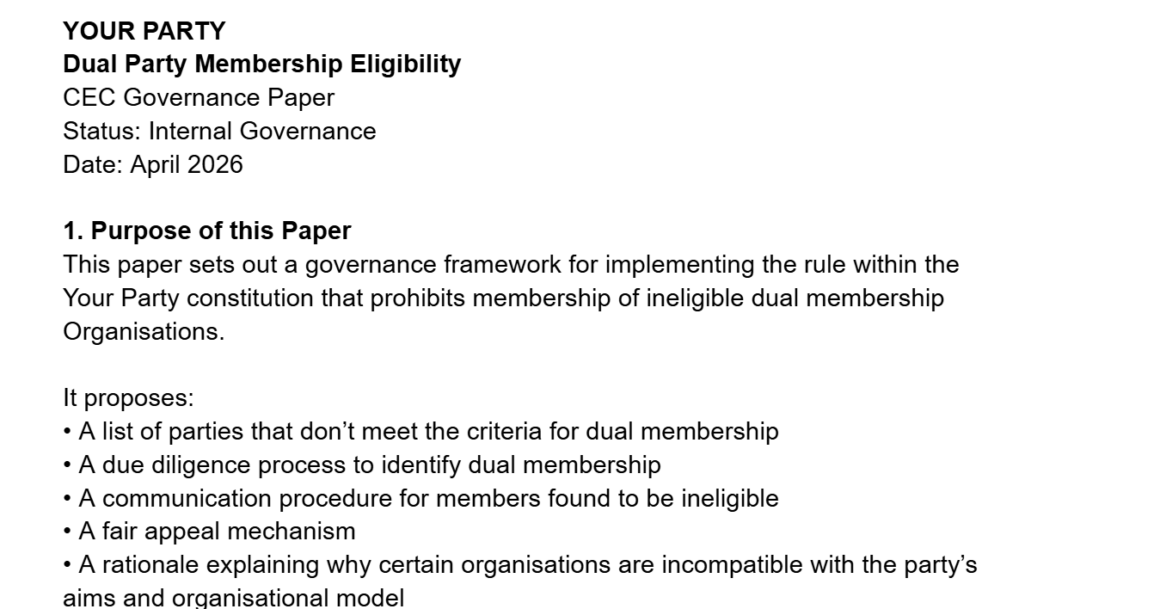

HANNAH Spencer’s victory in Gorton and Denton has changed the terms of the debate on the British left. A 34 year old plumber won a seat Labour held since 1931, with a 12-point majority over Reform, in one of the most deprived constituencies in England. Labour was driven into third place, its vote halved. The ‘wasted vote’ argument that has dogged the Greens for decades was demolished in a single night.
The result ought to concentrate minds inside Your Party. Should we have stood a candidate? Was Zarah Sultana right to offer critical support? The Grassroots Left refused unconditional endorsement but offered no alternative. Corbyn rushed to congratulate Polanski. The gravitational pull towards the Greens will swallow up Your Party unless we can urgently establish the essentially different character of our project. The Green Party starts from the premise: what progressive programme can win elections? A socialist party has to answer the question: what kind of party can the working class use to fight for its interests and ultimately for power?
Stopping Reform starts with class politics
The most emotionally powerful argument for backing the Greens comes wrapped in anti-fascism. Sultana put it bluntly: ‘As a young Muslim woman, I understand viscerally what it would mean for the far-right to gain power in this country’. James Meadway, former adviser to Labour Shadow Chancellor John McDonnell, writing in the Morning Star on the eve of the by-election, frames the whole strategic debate as ‘four years to stop Reform winning an election’. Now Spencer’s victory over Goodwin will be cited as proof that the Greens have the answer to Reform.
We take the threat of Reform seriously. But Reform is not growing because ‘the left’ lacks electoral unity. It is growing in the vacuum left by the absence of a working class alternative to austerity. Working class communities abandoned by Labour offered no means of mobilising their own power, facing collapsing services, stagnant wages and a housing catastrophe: these are the conditions the far right feeds on. But the Green Party is a machine to elect politicians, not a party rooted in the working class and its unions organising for power.
Meadway points to the French New Popular Front as his model. The NFP won a parliamentary plurality, failed to form a government, was outmanoeuvred by Macron, and left every social condition fuelling Le Pen’s support intact. The French left’s discredited strategy to ‘vote against the FN’ for three decades is not a serious answer to the rise of the far right in Britain.
The only force that can mount a consistent struggle against fascism is the organised working class, through strikes, self-defence, international solidarity, and organs of workers’ power that offer a real fighting alternative to both the decaying capitalist system and populist demagogues. That means the question of what kind of party — what class base, what programme — is not an abstract debate. It is the strategic precondition for stopping the far right and austerity equally. The Greens fail both tests.
Green populism is Corbynism repainted
Polanski describes himself as an ‘eco-populist’. But strip away the ability to competently articulate a political message (not, admittedly, a minor consideration) and you are looking at a familiar programme: tax the wealthy, nationalise the utilities, control rents, fund public services, oppose wars. It is a restatement of left social democracy; the politics of Corbyn’s 2017 manifesto, repainted in green, delivered with more polish.
The question Marxists ask of any programme is not whether it sounds radical, but which class it serves, and whether it has any strategy for overcoming the resistance of the class it threatens.
Let’s take the centrepiece, a wealth tax raising £30 billion for the NHS, childcare and housing. This is the defining demand of left reformism: make the rich pay, redistribute the proceeds, leave the underlying property relations intact. But capital is mobile and the capitalist class does not sit still while you tax it. Every serious attempt to redistribute wealth within capitalism, from Mitterrand’s France to Syriza’s Greece, has been met with capital flight, market sabotage and investment strikes that forced the reforming government to reverse course. Without exchange controls, public ownership of the banks, and a willingness to expropriate — measures the Greens do not propose and would not survive proposing with their current class base — the Green programme is condemned to failure in advance.
Or take nationalisation. Green Party conference policy commits the party to bringing privatised utilities into public hands. We support public ownership. But on what terms, and under whose control? Buying back assets at market value means compensating the shareholders who profited from decades of extraction with public money. Where do the Greens propose to find the money for that with just a wealth tax? How will this differ from the old postwar model of state owned services bureaucratically managed in line with the market by the same executives? These were privatised precisely because this led these services into an underfunding crisis, and without workers’ control left the working class with no power to defend them. We argue for nationalisation without compensation, under the democratic control of elected committees of workers and service users, a different class project altogether.
The same pattern repeats across the programme. Rent controls without socialising housing leaves the landlord class intact. Polanski’s personal opposition to Nato sits beside official party policy supporting continued membership. Palestine solidarity is sincere but demands are only as serious as the forces prepared to impose them. Workers who refuse to load arms shipments can impose sanctions. A party rooted in the organised working class could make that happen. The Greens can’t, because they have no organised presence in the workplace. You need class politics to build a class base.
Michael Chessum, writing in Left Foot Forward, insists this is all ‘really class politics’. It isn’t. Class politics is the self-organisation of the working class through unions, workplace committees, and representative workers’ democracy. Naming billionaires as the enemy from a television studio is populism — addressing ‘the people’ as an undifferentiated mass, proposing state action from above as the solution.
A party’s class base determines what it does under pressure. In Brighton, the Green council broke a refuse workers’ strike and voted through an austerity budget. In Germany, a Green party stuffed with ex-Maoists ended up in coalition with the Conservatives. Chessum admits that when Green councils take power after May, they will implement cuts because ‘it will not have occurred to them that there might be an alternative’. Polanski bluntly rejected the idea at a World Transformed event in October 2025.
This immediately raises the most basic and glaring problem for the Green hype: it is a big stretch from winning a by-election to winning a national election. Even if they won a plurality, they would have to coalition with parties to their right, junking their radical rhetoric and left policies, like they have done wherever they control a council.
The labourism trap and how not to escape it
The obvious retort, that Labour imposes austerity in government and has a thoroughly dysfunctional relationship with the working class, is taken up by Meadway, who confronts the question of class character directly, and gets it exactly wrong.
The Greens’ distance from the labour movement, he argues, is not a weakness but the precondition for escaping the ‘labourism trap’. The institutional link between unions and Labour created a structural conservatism — bureaucratic, defensive, and wedded to managing capitalism. Trade union membership is declining. The Greens represent a ‘clear rupture’ with labourism. In passing, he writes off thousands of (often young, female and migrant) health workers at the forefront of a highly political, industrial struggle against Tory and Labour governments as unrepresentative relics.
In other words, Meadway has surveyed the wreckage of Labourism and concluded that the problem was the working class link itself. He states the unions ‘have limited reach into wider society, and this isn’t going to change any time soon’. If that is true, the potential for mass revolt, popular control of production and socialism itself is similarly limited. More immediately, it means the Greens have no mass power they can mobilise in defence of any of their measures except protests. As Palestine or any number of protest movements show, that can only deliver limited, temporary gains, if any.
Meadway goes even further and lauds Polanski’s speech at the Green conference, focusing on ‘the self-employed and the small businesses that make up the economy of daily life in Britain’, counterposing the petty bourgeoisie to the six million in unions, exaggerating their decline by selecting the figures for womens’ unionisation in the private sector when it is well known that the majority of trade unionists in Britain are women. Meadway’s argument is the best rebuttal to Chessum’s claims. The Greens are a cross-class party, absorbing workers as individuals, with a populist programme.
The problem with Labourism is not the connection to the working class. It is the bureaucratic mediation of that connection, the officialdom that polices the membership, the parliamentary caste that treats conference as a rubber stamp or an irrelevance. The reason Labour betrays the working class isn’t because it’s linked to unions. The union bureaucracy, a social layer with its own material interests in mediating between capital and labour, controls the link and disciplines the rank and file, in cahoots with the parliamentary leadership.
The answer is not to abandon the class link. It is for the unions to exert their power to fight Starmer, through the fight for rank-and-file democracy in the unions, workplace organisation built from below, accountability to the class rather than the officialdom. Meadway has it back to front: the working class was failed by its own institutions, so build a party that doesn’t need them. We say: the working class was betrayed by the bureaucratic leadership of its institutions, so fight for democratically-controlled, combative ones, and build a new party to drive that struggle. Rebuilding and extending union organisation into the unorganised private sector, using a militant rank-and-file approach is a central task for a serious socialist party. Meadway treats it as a historical curiosity.
The words ‘workplace’ and ‘strike’ do not appear in Chessum and Meadway. Class is replaced by ‘the people’, and ‘the people’ are replaced by the electorate. In this liquidationist schema, the ‘rupture with labourism’ doesn’t produce a new working class party free of labourism. It produces a populist party that addresses ‘the people’ through parliament and the ballot box, exactly as the old Labourism addressed ‘the nation’. The method is essentially identical and the outcome will be no better.
You can’t make the Greens socialist
The logical response for socialists attracted by the Green surge is to say — join the Greens and fight to push the programme further left. Get conference to adopt anticapitalist policies. Build a socialist current and transform the party from within.
This misunderstands what a socialist party is. A socialist programme is not a more radical version of a reformist programme — the same policies turned up to eleven. It is a different class project, rooted in a different social force, aimed at a different objective. The point is not to get better policies adopted at conference and hope a future Green government implements them. The point is to organise the working class as the agent of its own liberation, through workplace struggle, rank-and-file union democracy, community self-organisation, and the construction of organs of workers’ power (councils and self-defence organisations) capable of building mass struggles defending our immediate interests now, up to confronting the capitalist state.
The Greens are structurally incapable of becoming a vehicle for this project, not because their members are insincere but because the party’s class composition, its organisational culture, and its entire strategic orientation are directed towards electoral representation and the management of the existing state. Revolutionaries inside the Greens would not be fighting to transform the party. They would be fighting the party’s entire reason for existing.
A crisis of leadership
Britain is in a serious crisis. Labour’s decomposing stranglehold on working class representation is the most significant development on the left in a generation. Gorton has no doubt accelerated it. But the working class faces not just a crisis of representation but a crisis of leadership. We need to build a party seeking to organise the class for the revolutionary struggle for its own emancipation. It has to be a party of struggle over electioneering, and committed to abolishing capitalism not managing it.
Writing in Novara Media before the by-election, two Grassroots Left candidates, Candi Williams and Anahita Zardoshti, made the clearest case for why the Greens are not enough: an exclusively electoral party, 190,000 members with no visible uptick in community organising, outnumbered on pickets and Palestine demos by a half-formed Your Party a third of their size. Their insistence that we need a fundamentally different type of party, organised in a different way because it fights for a different goal is exactly right. That’s why Grassroots Left emphasised the need for member democracy, branch autonomy, and a culture of organising rather than just canvassing. This was a necessary starting point for the debate we now need to take up in developing a programme, a strategy, for Your Party.
The Novara article doesn’t set out to outline a programme, but a lively debate is developing among Your Party’s activists and branches. In general on the left, and particularly among the Democratic Socialists of Your Party (DSYP)-influenced wing, ‘abolishing capitalism’ appears as an aspiration, not a strategic objective connected to concrete demands and a fighting strategy. ‘Community organising’ and ‘building class power’ need to be linked to a programme of concrete demands linking today’s defensive struggles to the fight for workers’ power, for instance organised self-defence against fascist marches and riots. That requires a class struggle party based on activist democracy, which Workers Power members argue for as active members in Your Party branches and in the Grassroots Left.
That is a different project from the Greens. It won’t be easy and there is no guarantee of success. Building a working class party consciously committed to the overturn of capitalism never is, and certainly not in the ruins of Labourism, against the pull of a Green surge that offers quick electoral victories. But it is necessary, because nothing else can answer the crisis. Yes the Greens can win elections by promising a fairer, greener capitalism. We want to win elections that reflect the growth of a conscious and combative working class movement in the advance towards socialism. That is the difference between a workers party and a populist party. Workers Power is organising in Your Party for a genuine workers’ party. If you agree – join us.