
From the archive: Workers Power, nos. 86 & 87, October 1986
In October and November of 1956, the workers and students of Hungary took up arms against two successive waves of Soviet military intervention. They toppled a hated Stalinist government. They created workers’ and revolutionary councils that became the real power in every factory and mine and most localities. Only after at least 20,000 had been killed and after the aerial bombardment of its major proletarian strongholds was the Hungarian revolution eventually drowned in blood.
The Hungarian uprising of 1956 contained the potential for the revolutionary destruction of Stalinism both within Hungary and beyond its borders. It opened the prospect of destroying the political rule of the Stalinist bureaucracy and replacing it with the direct political rule of the revolutionary proletariat.
Despite the ceaseless torrent of lies and slanders poured forth by international Stalinism, the Hungarian workers were neither agents of the restoration of capitalism nor the dupes of such agents. They were in their overwhelming majority determined to achieve two things. They wished to defend the socialised and planned economy against the restoration of the capitalists and landlords, and they were determined to destroy the filthy tyranny that denied the proletariat the slightest democracy, subjecting it to a caste of highly privileged and upstart bureaucrats.
The tragedy of the Hungarian revolution was that the workers were unable to create — in the time available — a leadership and a programme of action that could establish a government and the armed forces necessary to defend Hungary’s political revolution and to extend it to the rest of Eastern Europe and the USSR. That the potential for this existed is clear from every serious study or eyewitness account of the events of 1956.
The falsity of the Stalinists’ slanders breaks out of the vast majority of workers’ statements in this period:
“Soviet soldiers! We the workers from the railroad factory in Győr inform you that in our democratic state workers are the guardians of the socialist achievements. That means with all their might, they are speaking out against returning factories and banks to the capitalists. At the same time, we are against any Rákosite–Stalinist restoration.” (Quoted in M. J. Lasky (ed.), The Hungarian Revolution, p. 211)
The death of Stalin in March 1953 served to destabilise the whole political system he had ruled over in the USSR and in the “People’s Democracies” of Eastern Europe. In the highest ranks of the Kremlin there was a murderous struggle for power which, although eventually won by Khrushchev, extended over several years. Beria, Khrushchev, Malenkov and their rival cliques battled for power — occasionally being forced to take manoeuvres onto the terrain of international politics.
As part of this factional struggle, Khrushchev was obliged to denounce “the crimes of Stalin”. In fact, he carefully restricted himself to revealing the dictator’s crimes against the bureaucracy itself. The political opponents of Stalin — against whom the mass terror was unleashed — were not rehabilitated. In a laughable standing on its head of the personality cult, the slaughter and imprisonment of hundreds of thousands was passed off as the result of the evil genius or paranoia of one man. Promises were made to relax the police terror regime, to open the labour camps and improve living standards.
A ferment of revolt seethed through the whole Stalinist system. In the slave labour mines of Vorkuta there was a strike in the summer of 1953. In June 1953, strikes spread from East Berlin to all the major industrial centres of East Germany. The general strike was put down by Soviet troops. There were major strikes in Plzeň in Czechoslovakia and at the giant Mátyás Rákosi iron and steel plant in Csepel — the industrial centre of Budapest.
Stalin’s death, the gang warfare in the Kremlin and proletarian resistance provoked a political crisis in the ranks of Hungarian Stalinism. Since 1948, the “Hungarian Stalin” — Mátyás Rákosi — had set course to industrialise Hungary at breakneck speed along the lines pioneered by the USSR in the 1930s. Workers’ living standards were driven down. The peasantry were driven at gunpoint into collective farms. Political repression was probably more severe than anywhere else in Eastern Europe, with the apparatus of repression being in the hands of an extremely privileged, uniformed security force — the AVH. Rankers in the AVH received at least three times the average industrial wage; officers received twelve times that wage. In addition, the newly established Hungarian People’s Democracy was obliged to pay massive reparations to the USSR for the war that the Horthy regime had waged alongside Hitler. In 1948, 25.4% of Hungarian national expenditure went on reparations. That figure dropped to 10% in 1949.
Little wonder then that the Rákosi regime was amongst the most hated by its own people in Eastern Europe. Fully aware of this and fearful of the consequences, the Kremlin — and Malenkov in particular — moved to improve the image of the regime in 1953. Rákosi had to stay as Party Secretary, but there was to be a new Prime Minister in the person of Imre Nagy, who was given the green light to inaugurate a “New Course” in Hungary.
Nagy’s New Course
Given his role in 1956 and his popularity with large sections of workers and with oppositional intellectuals in the party, it is necessary to characterise Nagy’s politics. By training, Nagy was a loyal Stalinist. He had spent 15 years of his life as a Comintern functionary in the USSR. On Stalin’s death, he delivered the standard eulogy to Stalin as “the great leader of humanity”.
However, within the spectrum of Stalinist politics Nagy was also decidedly a Rightist. His “New Course” was aimed at achieving a slower pace of transition along the lines of Russia’s New Economic Policy (NEP) of the 1920s. He attacked the politics of the Rákosi era for having more in common with the programme of the Left Opposition than with the actions of Stalin during the NEP. He was an ardent devotee of the Popular Front alliance that the Hungarian CP had maintained with peasant, social democratic and outright reactionary parties from 1944 to 1948. To that end, he attempted to breathe life into the corpse of the still existent People’s Patriotic Front, attempting to turn it into a mass organisation. Nagy talked openly of Hungary as having its own national road to socialism and mused in 1955 on:
“… the possibility of neutralising Hungary on the Austrian pattern.”
Nagy stands in the tradition of Bukharin and Rightist strands within Stalinism. More recently, the model for his policy was Tito. However, during his time in power, writers and journalists were less restricted by censorship, real wages were increased, peasants were freed to leave collective farms and the grossest trappings of Rákosi’s dictatorship were scrapped.
If this alone were not sufficient to give Nagy a degree of popularity, his ousting from power by a resurgent Rákosi in April 1955, and his subsequent expulsion from the Central Committee and Party, served to provide him with the mantle of the courageous foe of the workers’ and intellectuals’ number one enemy — Mátyás Rákosi. This explains why, throughout 1955 and 1956, most oppositional currents in Hungary looked initially to Imre Nagy for political leadership.
Despite his best intentions, Rákosi found that he was not able to turn the clock back to the political norms of his old regime. In May 1955, Khrushchev travelled to Yugoslavia to embrace and rehabilitate Tito. This immediately opened once again the cases of those thousands who had perished as the “Titoite Fascists” in the various “People’s Democracies”.
In Hungary, it reopened the case of László Rajk, a prominent party leader who was shot after “confessing” that he was an imperialist agent. The grisly story behind this was that Rajk had bravely resisted repeated torture, refusing to confess, until none other than János Kádár (now Thatcher’s favourite “communist”) went to see him and pleaded with him to confess to save hundreds of other lives and offered him a deal — secret exile in the USSR. The confession having been made, the Stalinist gangsters kept their word as only they know how to!
In February 1956, however, the 20th Congress of the Soviet Communist Party (CPSU) heard the most detailed denunciations of Stalin that Khrushchev had delivered. Of necessity, this fortified all opponents of the various “little Stalins” who had ruled in Eastern Europe. Opposition to Rákosi continued within the lower ranks of the Party. In 1956, members of the Communist Party’s youth organisation (DISZ) reactivated a discussion circle established in 1954 under the name of the Hungarian national democratic poet of 1840 — Petőfi.
The leaders of the Petőfi Circle included pre-war and wartime CP members as well as young party intellectuals such as Balázs Nagy who was deputy secretary of its provisional bureau. (In exile, Balázs Nagy was later to become better known in Trotskyist circles as Michel Varga.)
In June 1956, the Petőfi Circle held a series of meetings attended by thousands which heard Júlia Rajk demand the full and wholehearted rehabilitation of her husband and which endorsed a programme primarily demanding the freedom of the press and the return to power of Nagy. Rákosi ordered the Petőfi Circle to be closed and seems to have been prepared for a new wave of arrests.
Workers on the Move
The workers of the People’s Democracies were to prevent him. The indignation of the Hungarian proletariat was about to boil over. In June and July, there was a series of strikes in Csepel and Greater Budapest. Workers were reported to be expressing their hatred of privileged bureaucrats by openly spitting at their limousines in the streets. On 28 June, in Poland, the workers of Poznań struck, demonstrated and were brutally fired on by the internal security forces who killed 54 and wounded at least 300. In the aftermath, the oppositional Stalinist, Gomułka, rode to power promising reforms and a break with the methods of the past.
Both incensed and terrified, Rákosi fulminated against the meetings of the Petőfi Circle as being “Hungary’s Poznań” but he was unable to stop them. Neither were his Kremlin patrons convinced that he was any longer able to hold the line for the bureaucracy. In July, the Soviet leader Mikoyan visited Budapest and engineered the resignation of Rákosi, but foolishly installed as his replacement one of Rákosi’s most trusted clique members, Ernő Gerő.
Squeezed between the restive workers, the Kremlin’s desire for a less harsh face for Hungarian Stalinism and the Nagyite intellectual opposition, the Hungarian bureaucracy began to crack under the strain. Sharp criticism of Party policy and demands for change became increasingly vocal in the Party cells in the working-class districts.
The Party press became increasingly open and — within its own terms — critical. On 6 October, over 200,000 people attended the public reburial of Rajk in Budapest. Students with red flags and national banners first raised a slogan that was to be heard much more frequently in the weeks ahead:
“We won’t stop halfway, Stalinism must be destroyed.”
Destabilisation and disorientation in the Stalinist ranks first opened the road for the student youth to organise. In mid-October, student youth in Szeged demanded the right to form their own organisation independent of party control. They also struck against the compulsory learning of the Russian language. The students of Budapest’s Technological University followed suit by calling a demonstration for 23 October in solidarity with Poland, where Gomułka was now firmly in power and had faced down Kremlin pressure.
The 23 October demonstration was the spark that lit the Hungarian revolution. The authorities were not strong enough to ban it. Instead, they asked the Party members of the Petőfi Circle to lead the demonstration — the Stalinist Antal Apró begged wartime CP militant Tánczos to assist him:
“You must lead the demonstrators … and save the situation.” (Balázs Nagy: quoted in The Truth About the Nagy Affair, 1959)
At this time, the Petőfi Circle, composed as it was of critical Stalinists, was indeed very anxious to avoid any serious confrontation with the regime. As Balázs Nagy put it later:
“At this time, and subsequently also, the Petőfi Circle curbed rather than encouraged the movement, considering that the hastening of events could lead to a catastrophe.”
The demonstration had an extraordinary flavour. Its members sang the Marseillaise, the Kossuth national song and the Internationale. Participants from the Party school marched with enormous portraits of Lenin and Marx. The major slogans of the day were for “Nagy to power, Rákosi to the Danube!” and for Soviet troops to go home.
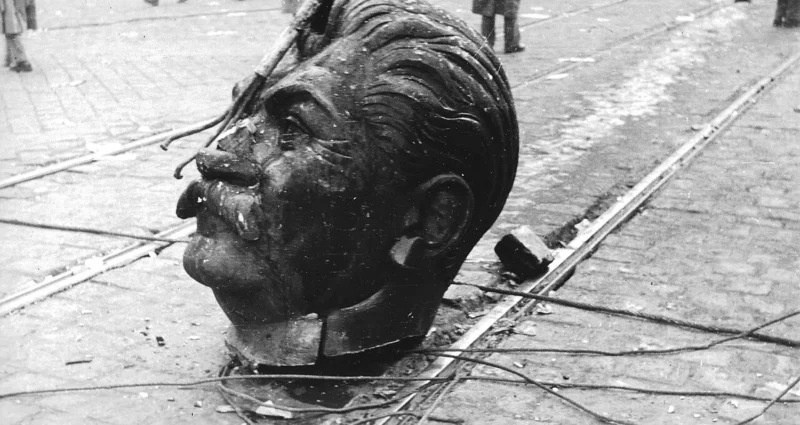
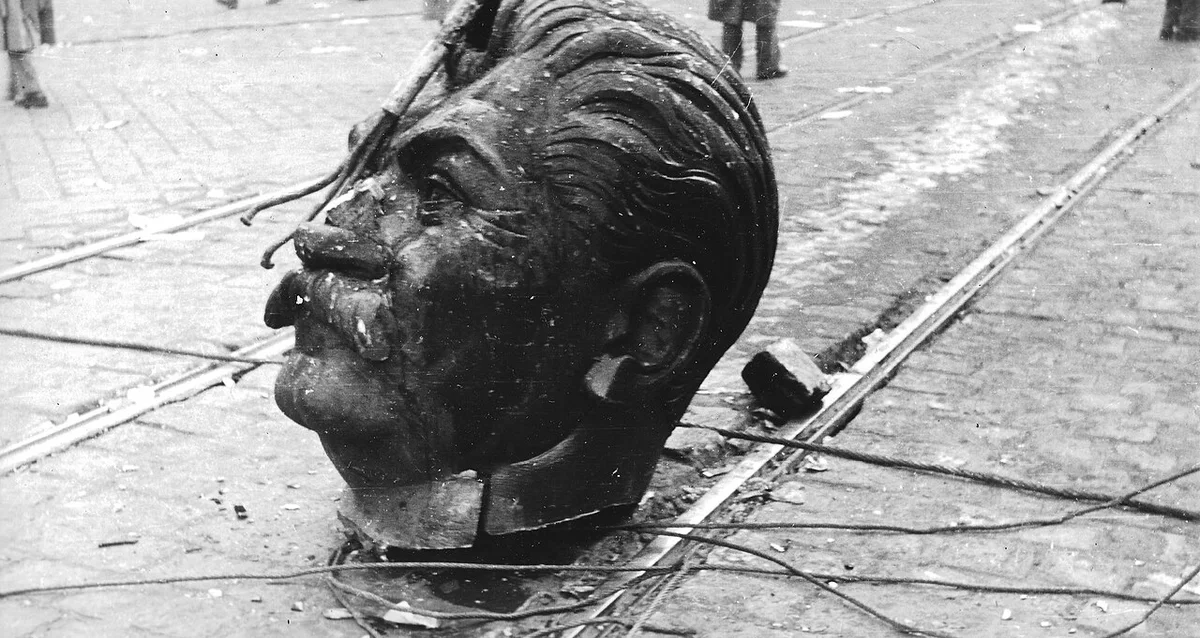
As they became more emboldened, demonstrators pulled down red stars from the top of public buildings and ripped out the People’s Democracy emblems from the centre of the Hungarian national flag. Eventually, welding workers hauled down a giant statue of Stalin and dragged it round the city behind a dustcart, eventually leaving its head outside the national theatre inscribed with the internationally understood W.C. As workers left factory shifts and joined the demonstration, its ranks spread throughout the city. Troops joined the crowds and, in many cases, distributed arms.
On day one of the Hungarian revolution, the demonstrators wrapped themselves in national colours. This was denounced over the radio by Party chief Gerő and by subsequent Stalinists as evidence of the chauvinist character of the Hungarian revolution. As the demonstrators took the streets of Budapest, Gerő declared on the radio:
“We condemn those who wish to spread the poison of chauvinism among our youth and have used the democratic freedom assured to the working people by the state to organise a demonstration of a nationalist character.” (Quoted in M. Molnár, Budapest 1956)
The First Shots
In its turn, Gerő’s attack served to render the crowds more angry and increased their resolve to hear their demands and arguments broadcast by the radio station. The first serious fighting took place at the radio station where AVH guards opened fire on demonstrators who returned fire from arms provided by fraternising Hungarian troops.
In general, the political horizons of the increasingly proletarian demonstration were fixed on the return to power of Imre Nagy. He had refused an invitation to attend the demonstration and only belatedly agreed to address the thousands who had marched to Parliament Square calling for him to take power. His initial speech to the crowd showed just how alien his bureaucratic outlook was from that of the students and workers:
“It is by negotiation in the bosom of the Party and by the discussion of problems that we will travel the road that leads toward the settlement of our conflicts. We want to safeguard constitutional order and discipline. The government will not delay in arriving at its decisions.” (Quoted in T. Méray, Thirteen Days That Shook the Kremlin)
Yet one such speech was not sufficient to disabuse the masses of their illusions in Nagy.
Faced with a massive demonstration, active fraternisation between workers and soldiers and armed clashes with the AVH, the Gerő regime attempted a policy of using the carrot and stick. On the one hand, it called for Soviet troops to restore order in Budapest and declared martial law. On the other, it called on Nagy to head the government. It thereby hoped Nagy would be able to head off the mass movement. And indeed he dutifully attempted to do just that by supporting martial law, calling for order and promising, in reply, a return to his 1953 policies. Meanwhile, groups of workers were already doing battle with Soviet tanks on the streets of Budapest.
Throughout the length and breadth of Hungary, the workers replied to the Soviet intervention with strike action. By 26 October, virtually all work had stopped. Moreover, these first days saw the formation of workers’ councils in every factory and mine and also the link-up of those councils into regional revolutionary committees in major industrial centres such as Győr and Miskolc.
The impact of the upheaval on the bureaucracy, the security forces and the ranks of the Communist Party was immediate. In general, the officers of the hated AVH attempted to defend themselves and their barracks from the insurgents with the utmost brutality. Most dramatically at Mosonmagyaróvár the AVH let loose a hail of machine-gun bullets at an unarmed and peaceful demonstration killing around one hundred. For the British CP’s Daily Worker correspondent Peter Fryer it was a shattering experience to see the dead and the mourners on his arrival across the Austrian frontier:
“After eleven years of ‘People’s Democracy’ it had come to this: that the security police was so remote from the people, so alien to them, so vicious and so brutal that it turned its weapons on a defenceless crowd and murdered the people who were supposed to be masters of their own country.” (P. Fryer, Hungarian Tragedy)
Little wonder then that insurgent workers showed the least mercy for the AVH officers and in most towns had to fight a bloody battle with them. In Miskolc, for example, the AVH attacked a proletarian crowd on 26 October. The local police handed their weapons to insurgent miners who finished off the AVH chief and the officers. In many cases the workers made a strict distinction between the AVH officers and the younger rank and filers who were shown more mercy.
In many instances, the more hated Party officials in the localities simply disappeared or hid. However, Party members also played a leading role in the uprising itself at every level. In the factories and mines, CP workers were active in initiating workers’ councils. The leading figure in the Budapest workers’ council movement — Sándor Bali — had been a Party member since 1945. In proletarian Miskolc and the surrounding Borsod county, CP militants played a leading role in organising the workers’ councils and in framing their demands. By 27 October, the Trade Union Council called on all workers to elect councils that would take over the tasks of management.
In addition, there were several instances of individual members from the highest ranks of the bureaucracy going directly and actively over to the side of those who were doing battle with the Soviet troops. Pál Maléter is the best known example. An army major and CP member since 1945, Maléter proudly sported a Soviet military decoration he received in 1944. On 24 October, he was ordered to capture the Kilián barracks which was holding out against Soviet tanks. He described the events on Radio Budapest:
“When I got there, I discovered that the fighters for freedom were not bandits but loyal children of the Hungarian people. I therefore informed the Ministry of Defence that I was joining the insurgents.”
Yet Maléter always insisted that his struggle was for socialism. He told foreign correspondents:
“If we get rid of the Russians don’t think we’re going back to the old days. And if there’s people who do want to go back, we’ll see.”
Reassuringly clutching his revolver he added:
“We don’t mean to go back to capitalism. We want socialism in Hungary.”
While the proletarian base of the party and certain elements of its apparatus went over to the insurrection, its leading circles sought desperately to defuse the crisis and restabilise bureaucratic rule. In late October, as workers’ councils mushroomed and the security forces melted away, this was a task they attempted to do behind Soviet tanks. However, the Nagy government was to find it impossible to restore an order to its liking so long as it was shielded by Soviet troops. And in turn those very Soviet troops were proving unreliable in this task.
Fraternisation with Soviet Troops
Initially, the Soviet troops believed, to some extent, that they were being sent in to fight fascists. This meant that fraternisation by workers and students was capable of having a devastating effect on Soviet troop morale. A worker recounted to Time magazine a typical instance of fraternisation:
“Our people were not afraid of the Russians and talked to them. Some of the Russians thought they were in East Germany and that they would soon meet American ‘fascists’ who had invaded the country. Other troops thought they were in the Suez Canal zone.”
The workers proceeded to explain who they really were, at which point the Soviet troops began to fraternise, with their captain throwing down his hat and affirming that the Kremlin leaders:
“Bulganin and Khrushchev would rape their own mothers.” (Quoted by Lasky, p. 103)
Győr and Miskolc radios — in the hands of their revolutionary committees — broadcast messages of solidarity to the Soviet troops. Miskolc declared:
“Our people did not revolt against you, but for the achievement of legal demands. Our interests are identical. We and you are all fighting together for a better socialist life.” (Ibid., p. 116)
In Győr, the Soviet commander even went on the air to declare:
“We will not interfere with your national political affairs … I think that the rising of the Hungarian people against the oppressive leaders is just.” (Ibid., p. 112)
The authorities had to act to prevent the spread of fraternisation. On 25 October, Soviet tanks accompanied a jubilant crowd to a demonstration in Parliament Square. That demonstration was fired on from the surrounding rooftops; Soviet tanks returned the fire. When the firing stopped, according to Bill Lomax, over 100 were killed including Soviet troops. Either the AVH or crack Soviet security units had taken the action to stop the drift towards fraternisation. In fact, fighting between the two sides became far more severe as a result of the slaughter — which both Hungarian workers and Soviet soldiers saw as the others’ responsibility.
The wave of fraternisation showed that the political revolution — whilst necessarily raising certain legitimate national grievances — held the potential for becoming international and indeed internationalist by spreading to the Soviet Armed Forces. The bloody outcome of the Hungarian revolution underlines just how vital that internationalism is if the political revolution is not to be crushed in national isolation.
Despite this enormous potential, the actual politics of the workers’ movement in the last days of October were those of sceptical Nagyism. The complete inadequacy of these politics was to be tragically revealed. In most areas the workers’ councils busied themselves with local or factory problems involved in maintaining the general strike and gave different forms of critical support to Nagy. The leaders of the councils saw them as potential organs of management in the plants. They saw their committees as potential alternative local government but blindly ceded central political power to Nagy.
This was well expressed recently by a Budapest Workers’ Council militant in Sándor Rácz who explained that it wasn’t until moves were made against Nagy by Kádár that council activists began to think about national politics or governmental power as a question that concerned them directly:
“Up ’til then we hadn’t intervened in politics, because we trusted Imre Nagy. We saw him as the political guarantee of the revolution.” (Interview from Beszélő, no. 7; in Labour Focus, Summer 1984)
This meant that, while the councils pressed demands on Nagy, most importantly for Soviet withdrawal, a new government, the right to strike and an amnesty (the four-point programme of Miskolc in the first days of the revolution) — and while the councils maintained the strike action until they thought they had wrung serious concessions from Nagy, they remained hidebound by a variety of syndicalism that saw the factories as the property of the workers and the government as the property of the national politicians. Thus, a decisive struggle for workers’ power, at a time when Soviet troops were in many instances unwilling to fight and when the Nagy government was very weak indeed, was excluded from the agenda. There was in fact an acute crisis of leadership in the Hungarian revolution.
How did Nagy use the political initiative that the workers’ movement ceded to him? Initially, the authority of his government barely ran beyond the ministry buildings in Budapest. Cast in his Stalinist mould, there was no question of him conceiving of the workers’ councils as an alternative base of power.
The history of Stalinism shows it to be resolutely opposed to all manifestations of healthy workers’ democracy, so much so that it will always ally itself with reactionary and bourgeois forces in order to subvert and destroy the potential organs of a healthy workers’ state.
The form that alliance took in Hungary during and after the war (in common with other People’s Democracies) was a coalition with bourgeois parties within which the Stalinists would keep a hold on the organs of security and repression. Nagy’s means of defusing the political revolutionary crisis was to attempt to piece such a coalition together once again.
Nagy’s Coalition Government
On 27 October, Nagy announced the formation of a new coalition government including representatives of the historic Smallholders’ Party and the National Peasants’ Party. Two points must be underlined about this move. Firstly, those parties barely existed except as motley collections of ex-party leaders. Secondly, if we look at the demands being voiced in Miskolc and Győr, while it was the case that some ex-Social Democrats were joining in the fray, calls for a coalition government or for parliamentary-type elections were rarely posed in the initial documents of struggle. It was in fact those around Nagy who reached for the old parties and the trappings of a coalition with the ex-leaders of the bourgeois parties. This was a trusted tactic for deflecting the working class from the fight for its own political power.
In turn, as the old parties were reconstituted from the top downwards, and as horse-trading for office recommenced, so the call for genuine free elections was increasingly raised from within the workers’ councils. After all, the Stalinists had maintained the charade of parliamentarism, without the substance of a multiplicity of competing parties. Stalinism could never pose the political alternative to parliament of genuine soviet power.
The workers’ movement posed the potential of workers’ council power. Its predominant demands included the public trial of the most murderous bureaucrats of the Rákosi regime, the replacement of those responsible for faults in the planned economy, the publication and revision of foreign trade agreements as well as wage rises and management rights for workers’ councils. Nagy and co. tried to divert this movement into the channels of a bogus popular front coalition. In that coalition, key figures of the old Stalinist apparatus — Apró, Münnich, Horváth and Kossa — were to keep their positions. And they were to use those positions to murderous effect later.
Many of the Stalinists around Nagy were resigned to a very significant Rightist retreat as the road out of the crisis and a means of aborting the political revolution. The literary theorist Georg Lukács was Minister of Popular Culture in the Nagy government. Wiktor Woroszylski, a Polish CP journalist from Nowa Kultura, describes a conversation he had with Lukács at the time. He reports Lukács as saying:
“Communism in Hungary has been totally disgraced … The working class will prefer to follow the Social Democrats. In free elections the Communists will obtain five per cent of the vote, ten per cent at the most. It is possible that they won’t be in Government, that they will go into opposition. But the party will continue to exist; it will save the Idea; it will be an intellectual centre and after some years or decades from now, who knows.” (Quoted in Lasky, op. cit., p. 159)
As the political organs of a healthy workers’ state were making their appearance throughout Hungary, our Marxist philosopher preferred saving the “idea” of being an opposition in a bourgeois parliament. And what idea did he want to save? The idea that he and his bureaucratic centre could get their hands back on power one day, once the political revolution of the Hungarian workers had exhausted itself.
Playing on the political weaknesses of the spontaneous workers’ movement, Nagy was able to temporarily regain some of the political initiative. On 28 October, he requested a Soviet troop withdrawal from Hungary and an immediate ceasefire. He announced the dissolution of the AVH. On 30 October, he announced the recreation of the 1945 coalition by inviting the Social Democrats to delegate a minister even though that party had not yet effectively re-formed itself at a national level. The Minister of the Interior was Ferenc Münnich, one-time Ambassador to Moscow of Rákosi’s regime. At the same time, Soviet troops left the major industrial centres of Hungary.
The troop withdrawals were negotiated by the Soviet Ambassador, one Yuri Andropov. He had good reason to pull back the troops since they had been infected with many of the liberatory slogans of the Hungarian revolution. At the very same time, he liaised with Khrushchev to organise the entry of fresh Soviet troops into Hungary. While Nagy’s new popular front coalition was holding back the workers from a decisive showdown with Stalinism, the Kremlin was preparing a deadly second strike.
The revolution drowned in blood
In the period from October 23rd to the first announced withdrawal of Soviet troops, the Hungarian working class had shown enormous strengths and a capacity for revolutionary struggle. Its councils and militia controlled the major industrial centres. Its fighting spirit and its efforts at fraternisation had undermined the morale of the Soviet troops. Yet the mobilisations of the Hungarian working class were not without their fatal weaknesses.
The councils had the potential to become organs of direct working-class power. Yet they concerned themselves with local and factory matters and ceded central power to Nagy. Also, the fraternisation never succeeded in bringing whole units of the Soviet armed forces over to the side of the insurrection. Neither did it win Soviet soldiers to a fight to form their own soldiers’ councils. The failure to achieve these things seriously weakened the vital struggle to internationalise the Hungarian political revolution via the ranks of the Soviet army.
It is not to belittle the heroism of the Hungarian working class to argue that its fundamental weakness was its lack of a revolutionary party. Only such a party could have led the challenge for workers’ power
In general, at this time, militants either opposed the idea of parties as being divisive or had illusions in one or another of the 1945 governmental parties, or they favoured a coalition of such parties. Against these tendencies, revolutionary Marxists fighting for political revolution would have fought for the councils to centralise their forces and for a government that was directly accountable to those councils.
Such a call would have mobilised serious support among sections of the council militants. For example, Kiss, president of the Miskolc workers’ council, condemned the role of the newly organised political parties and demanded on November 2nd that: “the government shall propose the formation of a national revolutionary council to be supported by the departmental workers’ councils of Budapest and composed of democratically elected delegates. At the same time, they shall pronounce the dissolution of the National Assembly”. [Quoted in Budapest 1956, M Molner]
In the vital stages of the revolution, such voices were in a minority in the leadership of the councils. The key task was to win that minority to the fight for political revolution and to organise them into a revolutionary party.
The initial stance of the councils handed Nagy and remnants of the old parties’ leaderships all the political initiative. This was to prove fatal for the course of the Hungarian political revolution.
In an immediate sense, the party leaders drawn into the Nagy coalition did not demand the restoration of capitalism. On day- release from his sanatorium, Smallholders’ leader Kovacs declared that, “no one must dream of going back to the world of counts, bankers and capitalists, that world is definitely over”.
But, while he suggested that the party’s old programmes were now outmoded, he refrained from advancing an alternative. For the Social Democrats, Anna Kethly made a similar declaration against the restoration of the old order: “Freed from one prison, let us not allow the country to become a prison of another colour. Let us watch over the factories, the mines and the land, which must remain in the hands of the people”.
The National Peasant Party, which was to rename itself the Petőfi Party, comprised activists who had historically been prepared to work with the CP.
Yet, in offering the leaders of these partly reconstituted parties a governmental majority, Nagy was certainly creating a potential rallying point for capitalist restoration. The Smallholders’ Party was a traditionally rightist party based on the richer peasants. The Social Democrats used the freedom delivered to them by the political revolutionary crisis to dispatch Kethly to Vienna to discuss with the leaders of the Second International. Whatever its orientation to the poorer peasants, the Petőfi Party soon announced that it, “believes in private property and advocates free production and marketing”. [quoted in The Hungarian Revolution, MJ Lasky P218)
In the medium and longer term, each of these party leaderships would have used their power to dismantle the monopoly of foreign trade and the planning mechanisms in the direction of restoring capitalism. For Nagy, Lukacs and company this was a lesser evil compared with the proletarian political revolution. The trajectory of these rightist Stalinists confirmed Trotsky’s analysis of the nature of the Stalinist bureaucracy. The Hungarian leadership shared the characteristic that Trotsky had identified in the Soviet bureaucracy, namely, a tendency to fragment under pressure, with sections of it willing to: “… overthrow the new forms of property and plunge the country back into capitalism”. [The Transitional Programme]
But many of the Stalinists who connived in the coalition project as an expedient means of robbing the workers of political power, Kadar, for example, were also to accuse the Hungarian revolutionaries of having become the tools of counter revolution. They were to order the slaughter of thousands of Hungarian workers on this pretext.
Jubilant and thankful ideologists of capitalism were quick to seize on every meagre piece of evidence offered up by the Stalinists to prove their own version of the story that the Hungarian revolution was a capitalist, pro-Western revolution.
The forces of reaction
Reactionaries did take advantage of the revolutionary crisis to show their faces once again. In Győr, one Samogyvari argued for the formation of a separate government which, with him at its head, would wage a Christian crusade against the USSR. Workers from the railway waggon works ran him out of town.
In Budapest, the anti-communist Dudas occupied the printing presses and presented himself as the president of a National Revolutionary Council. He impressed Western journalists far more than he did the Hungarian workers. There is no evidence that any real delegates ever attended his council but the Kadar regime was to hold him up as evidence of the mounting threat of counter revolution.
The old fascist Arrow Cross did make some reappearance most notably in Győr which was near to exile organisations over the Austrian border. There are no substantiated accounts of the Arrow Cross playing an organised or systematic role in events. A meeting on November 1st in Budapest, which was called to reconstitute the Arrow Cross seems to have been poorly attended and chaotic.
However, ex-Arrow Cross members do seem to have played a role in the slaughter of Communist Party officials at their Budapest HQ on October 30th. Along with lumpens and criminals, they killed over 25 communists and AVH conscripts and savagely mutilated their bodies. The political revolution had as one of its tasks the brutal suppression of all such reactionary forces. The Hungarian workers were more than capable of fulfilling this task. Fascists got short shrift from the workers.
The activities and slogans of the reactionary forces must not be confused with the seemingly nationalist slogans advanced at the earliest stages of the revolution by the workers. The initial slogans of the October fighting were not consciously those of political revolution against the Stalinist bureaucracy. The revolution tended to express itself in the language of destroying the symbols of Soviet sponsored power and of national independence.
The historic gain of nationalised industry had not been the work of the workers themselves but rather that of the regime which stamped out every manifestation of proletarian democracy. The collective farms appeared to the majority of peasants as an alien imposition. Given that the red stars and the hammers and sickles that accompanied these gains were seen as symbols of Hungary’s national oppression, it is little wonder that the early revolt often expressed itself simply in terms of removing such symbols.
It would have been impossible to expect otherwise in a world where “socialism” meant both the expropriation of the old owners and the imposition of a local Stalinist variant of the oppressive Russian bureaucracy.
However, the political drift of the major workers’ organisations was not in the direction of unleashing capitalist counter revolution. They initially saw themselves as pressure points on Nagy. All the major councils were so content with the Nagy government and with promises of Soviet troop withdrawal that they called for a return to work from November 5th.
The Stalinists fight back
The Hungarian workers had been lulled into a sense of false confidence. By the first days of November, Soviet troops had left the major industrial centres for their barracks. Most organisations were now prepared to back Nagy’s coalition government. Janus Kadar announced on November 1st that the old Hungarian Communist Party had been dissolved and that a new Hungarian Socialist Workers’ Party was to be formed, purged of the most hated Stalinists. He announced his full backing for Nagy and the revolution: “In a glorious uprising, the people have overthrown the Rakosi regime. It has won for our country the freedom and independence without which there can be no socialism”.
Of the insurgents, he declared: “We are proud of you, for you took your proper place in the armed uprising. You were imbued with true patriotism and loyalty towards socialism”. However, there was mounting evidence that fresh Soviet troops were entering Hungary, despite explicit denials of this by ambassador Andropov. On November 1st, the Nagy government publicly protested at the troop movements and repeated its demand for the withdrawal of all Soviet troops. It also announced that it was renouncing the Warsaw Pact, which the Soviet bureaucracy was using as their pretext for positioning their troops. It declared that, like Austria, Hungary was now “neutral”.
These were dramatic steps for a Stalinist to take. Neutrality had been mooted by Soviet leaders as a model for central Europe beyond their “buffer zone”. The idea did not fall from the sky and had been accepted as a status for Austria in 1955. However, for a Communist Party-led government to declare itself neutral between imperialism and the USSR was evidence of its righteous course, a course that was being backed by the Social Democrats.
A proletarian political revolution would, quite justifiably, break with the Warsaw Pact, which is an instrument of political repression. It licences the Kremlin bureaucracy to trample on proletarian democracy anywhere in its sphere of influence. But the political revolution would commit itself from the outset to defending all the workers’ states against imperialism. Failure to do so would always cut the ground under attempts to internationalise the political revolution. In a purely “national” or “neutral” guise, the proletarian uprising of a small individual state is rendered powerless to effectively neutralise the superior military might of the Soviet armed forces.
With tragic but typical naivety, the Nagy government reached for the United Nations as the means of defending itself, asking the next General Assembly to debate “Hungarian neutrality”. At the same time, it announced itself prepared to negotiate a troop withdrawal and nominated a Commission led by Pal Maléter to carry out the preparations. At a time when the armed working class, fighting under the banner of internationalism, was the only means of defence against the USSR, Nagy chose the path of neutralism and appeals to the United Nations.
The Soviet bureaucracy had made all its preparations for a second attack. On November 2, key Stalinist “supporters” of Nagy, Kadar and Munnich, slipped away in secret. On November 3, Maléter started negotiations with his Soviet counterparts. Agreement was reached immediately that all Soviet troops would withdraw with military honours. Only the date of departure was left to be negotiated over dinner at the Soviet HQ.
At 11:00 PM Maléter phoned to say the negotiations were going well. After that, contact with him was broken. At dawn on November 4, a fresh wave of Soviet troops went into all the major industrial centres. Kadar and Munnich announced that they had formed a “revolutionary workers’ and peasants’ government” and that “acting in the interests of our people, working class and country” they had: “requested the Soviet army command to help our nation smash the sinister forces of reaction and restore order and calm in the country”.
Nagy took cover in the Yugoslav embassy, urging the workers not to resist this new onslaught. The much-vaunted leaders of the coalition parties were nowhere to be seen. Yet the workers replied again with a general strike and organised military resistance. The second phase of the Hungarian revolution had begun. The workers, arms in hand, now confronted the invasion of a new wave of Soviet troops who had not been affected by the previous efforts at fraternisation.
At the head of the bogus “workers’ and peasants’ government” were key Stalinist figures who had remained in Nagy’s government, Horvath, Munnich, Apro, Kossa and Kadar himself. In giving time to Nagy, the workers had also given time to their future executioners. Kadar now denounced the workers’ rising as a fascist-inspired counter revolution that, with the help of fraternal troops, they were suppressing in order to save socialist Hungary! The clique around Kadar cut no ice with the Hungarian workers
The revolution drowned in blood
Posters at the giant Csepel works replied defiantly, “The 40,000 aristocrats and fascists of the Csepel works strike on” and “the general strike is a weapon which can only be used when the entire working class is unanimous, so don’t call us fascists!” [quoted in Lasky op.cit.]
Radio Rajk announced on November 5th: “Comrades! The place of every true Hungarian communist today is on the barricades”.
Attacked from all sides by Soviet troops and aircraft, the Dunapentele workers’ council announced: “Dunapentele is the leading socialist town in Hungary. In this town all the inhabitants are workers and they hold power in their hands, the population of the town is under arms. They will not give in because they have erected the factories and homes of the town with their own hands. The workers will defend the town against fascism but also against the Soviet troops”. [quoted in B Lomax, Hungary 1956]
The Soviet troops met the fiercest resistance in the proletarian strongholds of Hungary. It was iron and steel towns like Miskolc and Dunapentele, as well as mining areas like Borsod, Pecs, Dorog and Tatabanya that held out the longest. It took the Soviet armed forces three days to take the centre of Budapest and it was not until November 10 that Soviet troops could be fully deployed against the capital’s proletarian bastion of Csepel. Even when the Soviet troops had crushed the insurrection, a total general strike continued against the occupation and its “workers’ and peasants’ government”.
During the initial days of the second invasion, workers’ councils coordinated the defence of the factories on a local basis. It was not until after most of the fighting had subsided that delegates assembled to form a Central Workers’ Council of Greater Budapest. Its leading figure was a pre-war Social Democrat turned Communist Party member in 1945, Sandor Bali.
The initial intention of Bali and his supporters was that the Council should be a representative negotiating force for the working class, forcing maximum concessions from the Kadar regime. The general strike was seen as the most potent means of securing such concessions. Accordingly, the council’s first meeting drew up a list of demands and sent a delegation to press those demands on Kadar.
The politics of the workers’ councils
The politics of the leaders of the Hungarian workers in this period were highly contradictory. A political programme was adopted at the November 12 meeting. It came from the pen of Istvan Bibo a member of the peasant Petőfi party and one time member of Nagy’s government. It gives a sharp insight into the pressures towards the restoration of capitalism that the Nagy coalition would inevitably have come under.
It called for a multi-party system, for the restoration of the Nagy government and the withdrawal of Soviet troops from Hungary which, in turn, would leave the Warsaw Pact. While calling for “legislation to secure the existence of socialism and protection of communists”, it also called for freedom of private ownership in land. While it defended social ownership of the banks, mines and large enterprises, it argued for the remaining factories to be taken into common ownership through workers’ management, workers’ shareholders and a profit sharing system.
As immediate demands, the council informed Kadar that it negotiated on behalf of the workers and took upon itself the right to call strikes. It protested at the reappearance of armed AVH units and demanded the reinstatement of Nagy, an amnesty, the withdrawal of Soviet troops and free elections. The majority of the council were for parleying with Kadar to restore Nagy to power from his bolthole in the Yugoslav embassy. Only a minority agreed with the view expressed at the time by the council’s President, Sandor Racz: “We do not need the cabinet. We are and will be the leaders of Hungary”.
Kadar played for time, stringing the council leaders along for rounds of negotiations. He informed the first council delegation: “we want a multi-party system and an honest election we [communists] might be thoroughly beaten in the elections, but if we take on an election challenge, the Communist Party may regain its strength and obtain the confidence of the working masses.” [Quoted from the party paper, Nepazabadsag November 15, in Lasky op.cit]
But, in the meantime, in exchange for such assurances, the workers’ leaders were urged by Kadar to call off the general strike and use any influence they had to urge Nagy to leave the Yugoslav embassy in order to negotiate.
While the central workers’ council was formally adopting resolutions in favour of parliamentary democratic forms and a mixed economy, there was a vital aspect of their politics, standing in potential contradiction to these bourgeois democratic illusions, that a revolutionary Trotskyist party would have sought to relate to and extend. The front-line role of the workers and their councils convinced proletarians and nonproletarians alike that the working class was the leading force in the Hungarian revolution.
In the first phase of resistance, it was common to read declarations from the workers announcing that the factories were theirs while the government or “nation” should be ruled by others. But, faced with the second invasion, the workers’ leaders saw themselves as representatives of the proletariat negotiating with an alien government. In mid-November, the duplicity of Kadar and his negotiators concentrated the minds of many more militants on the question of fighting for an alternative governmental power.
In early and mid-November, there was a clear situation of dual power in Hungary. No tram could run and no factory could open without the say so of the workers’ councils. The Stalinists recognised this fact. Kadar regularly negotiated with council leaders. The Soviet High Command issued those same leaders with the right to carry arms and break the curfew. The Soviet command even sent an observing liaison officer to the Budapest council meetings.
There were, however, three key preconditions for resolving this dual power through a victory of workers’ power over the Stalinist armed forces. First, a party was needed to lead the fight for such a resolution to the crisis. Secondly, the councils would have to centralise their forces into a clear and open governmental alternative. Last, but by no means least, that governmental challenge would have to project itself into an international struggle to spread the politics of the revolution.
Despite the absence of a revolutionary party, the councils did, hesitatingly and belatedly, move in the direction of centralising their power and challenging the governmental power of Kadar. On November 19, the Budapest workers’ council called for all provincial councils to elect delegates to a Workers’ Parliament, due to meet on November 21.
It proposed the formation of a permanent Workers’ Parliament of 156 delegates from the provinces and some of the larger factories. In turn, this was to elect a 30 strong Executive from its ranks and co-opt 20 individuals from the parties, the armed forces, the police and the intellectuals. It did lay down that only parties accepting socialism could be admitted into the Executive. The Soviet high command and Janos Kadar acted quickly to smash this challenge. On November 21, Soviet troops ringed the stadium where the Workers’ Parliament was due to meet.
In order to remove a symbol rather than a vital force, Nagy and his supporters were issued with safe conduct passes from the Yugoslav embassy on November 22. On leaving, their sanctuary they were duly arrested and immediately deported to Romania. They were later to be hanged.
On November 25, the workers’ council leaders were offered a conference in the parliament building with the leading Hungarian Stalinists in the government. At the conference, the working class was attacked for being “confused” and the council leaders for having nothing to do with the working class. “Workers’ and Peasants’ Minister, Marrsan, rounded on the delegates who defended the actions of the Hungarian workers: “You ruffians! Do you think you can give us a lecture! You call yourselves prolots but what have you in common with the workers?” [quoted in Lomax op.cit]
Thus spoke a rude and arrogant satrap who, scenting victory, could now afford to publicly vent his fury against the insubordination of the working class and its delegates against the bureaucratic regime of which he was a well-paid agent!
Such rude treatment at the hands of the Kadar government hardened the stance of the council leaders at a time when the government and the Soviet troops obviously had the upper hand on the streets. The council leaders pressed ahead with their plans to create a National Workers’ Parliament which was to meet until the October 23, 1957 [the anniversary of the first fighting in Budapest] when free national elections were to be held. For well on a year, the workers’ council delegates were to assume national authority until elections took place.
The Budapest council took this stance when the balance of forces was already strongly against the workers. Their plans were not to come to fruition; but a revolutionary party would have had to take a stance on such proposals at whatever stage they were advanced in a political revolutionary crisis. It would have supported the formation of a government responsible to the councils. It would have opposed the eventual ceding of power from the councils to a parliamentary body.
Given that the workers’ illusions in parliamentary democracy had been strengthened as a direct result of Stalinist tyranny, and the workers therefore still called for parliamentary elections, revolutionaries would have fought for any election to be held under the direct scrutiny of the councils themselves and with the exclusion of all parties that did not support those councils. Should the scheduled National Assembly have met, it would have been faced with the choice of ratifying the Central Workers’ Council as the source of power or of being sent packing as soon as possible.
The best elements of the Hungarian proletariat had, unfortunately, attempted to pose a council-based government far too late in the struggle. The all-encompassing repression meant that it was difficult for these self-same leaders to envisage any form of resistance in favour of their new project beyond silent demonstrations that turned Budapest into a ghost town or symbolic demonstrations of wreath-bearing women.
Despite the more militant political stance of the Budapest council leaders, the attempt to pose a form of workers’ government as an alternative to the Kadar government came far too late. On December 9, the government arrested as many council leaders as it could. The workers of the Beloiannis factory protected Bali and Racz from arrest. But these two accepted an offer on December 11 to leave the factory in order to meet Kadar. They were arrested in the parliament building. Despite a short lived renewed general strike against the arrests, the Stalinist regime of Kadar was now firmly in the saddle. It cracked down with special courts and extended the death penalty to those who struck or even incited others to strike. In the face of such victorious, barbaric reaction and with its principal leaders in gaol, the workers’ movement came to terms with its defeat. The Central Workers’ Council, now called for passive resistance, on January 15, 1957 it issued its final appeal to the Hungarian workers: “Because of the terror, however, and the death penalty even for distributing leaflets, the council exhorts the workers to spread all news concerning the underground by word of mouth. Sabotage and passive resistance are the order of the day”.