
“We, the RCP, are seeking to establish ourselves as the revolutionary wing of the anti-racist movement, and to become a leading force in anti-racist struggles in Britain, where we have the forces to do so.” (“Why the SWP gets everything wrong on racism”, Jack Tye Wilson).
This is the bold ambition of the Revolutionary Communist Party, which has hardly a good track record, as the RCP or its forerunner Socialist Appeal, of fighting racism. But the group has kicked off its campaign in the pompous style they have made their hallmark.
The RCP has attacked the Socialist Workers Party (SWP) and its campaign Stand Up To Racism (SUTR) in forthright terms. SUTR’s slogan ‘refugees are welcome here’ is dismissed as ‘moralism and lefty-liberalism’; its strategy, the RCP argues, ‘actively demobilises the anti-racist movement’. After decades of dominating anti-racist campaigning, the SWP supposedly has ‘nothing to show’ for it.
Some of these criticisms echo arguments Workers Power has made for years, particularly that the SWP’s reliance on cross-class alliances involving trade union leaders, clergymen and celebrities is no substitute for a workers’ united front. But the RCP rejects an explicit defence of refugees in favour of ‘working class’ slogans that evade a central political question. It attacks SUTR’s methods without explaining how to build a united front among the organisations and activists already fighting the far right.
The SWP, meanwhile, has mobilised large numbers against racism, but its reliance on trade union leaders and liberal figures limits the movement’s politics and independence. Neither party offers an adequate strategy.
‘Refugees are welcome here’
The dispute began in Leeds, where SWP and RCP contingents at an anti-fascist demonstration competed to make their slogans heard. The RCP followed up with a polemic, “Five reasons why chanting ‘refugees are welcome here doesn’t work” (Maya Khan, communist.org).
Its first argument is that ‘it’s not just refugees’ under racist attack, but also Muslims and black people. Yet later in the polemic, it lists the slogans used in Leeds, none of which name these groups either! The truth is the far right has centred much of its agitation on migrants and asylum seekers, and anti-fascists have to defend them.
Nor is it true that SUTR ignores Islamophobia and other forms of racism. It also does not completely leave out slogans relating the scapegoating of migrants to class and capitalism: ‘Unemployment and inflation are not caused by immigration … the enemy is profit!’ Placards declare: ‘The enemy arrives in big yachts, not small boats.’
The problem is not the complete absence of class arguments, but the domination of apolitical slogans such as ‘Whose streets? Our streets!’ and ‘There are many more of us than you’, which just ring hollow as the left is often outnumbered.
Where the RCP is right, is in insisting anti-fascist demonstrations should also be used to challenge racist explanations of workers’ problems and win people to class politics, rather than preach ‘Love, Hope, Unity’.
But the RCP is wrong to portray ‘refugees are welcome here’ as a slogan borrowed from liberal European politicians. This is a lazy smear. Yes, German centre-right politicians borrowed (then dropped) the slogan in 2015, but the left in Britain was using the slogan for more than a decade earlier in the struggle against Blair’s anti-immigration laws. It is an internationalist slogan and remains valid today to mobilise migrant workers and oppressed communities.
Then the RCP goes further, calling the slogan ‘counter-productive, actively harming the struggle’. This is allegedly because there are ‘understandable concerns that some working-class people may have over the migration crisis, which under capitalism leads to a race to the bottom in terms of housing, wages, and conditions’.
Who uses migration to lead a ‘race to the bottom’? Certainly not migrants, who lose that race nine times out of 10, it’s the bosses. Communists should not make any concessions to the argument asserting a link between such ‘concerns’ and migration. We need to answer these reactionary ‘solutions’ to social problems, straight from the billionaire-owned press and politicians including Labour, with class solutions.
Taken in isolation the RCP’s line of argument leads straight back to there being a ‘migration crisis’ and anti-migrant racism being ‘understandable’. How this creates unity against capitalism is mystical indeed.
Culture war or class war?
But Khan doubles down on taking a right-wing view of the SWP’s slogans: ‘The “leaders” of the so-called left even have a chant which goes, “Welcome all the refugees, throw the Nazis in the sea”. With this, they are essentially saying, “Give all the resources to refugees, and screw the left-behind white British communities.”’
This ill-judged ‘blow’ against SUTR equates poor working class communities with the Nazis, which the slogan does not.
We agree and have argued that SUTR’s practice of calling every reactionary a Nazi on protests, even the right-populist Farage, is crude and dysfunctional – we need different tactics and arguments to defeat them. And the RCP’s alternative slogans do make useful class arguments: ‘Who cuts our jobs to save their profits? Not the migrants, it’s the bosses!’ and ‘It’s not the boats that raise our rents; it’s the landlords, time they went!’ Skilfully used, especially in the context where anti-racists have the time and space to develop their arguments, these slogans can divide the racists and isolate the far right.
But they evade a question. A worker can accept that bosses cut wages and landlords raise rents, and still insist that too many migrants are arriving. Some militant workers think exactly that. If asked whether we support letting the small boats in, what do we say?
Communists say refugees and migrants are welcome here. We oppose immigration controls that divide and discipline workers. Economic arguments are necessary but cannot substitute for a clear political answer. Otherwise we leave the central claim of the anti-migrant movement unanswered.
The housing crisis, for example, is caused by landlords, developers and governments, not migrants, but a demand for more council housing is no answer to the direct question of whether a refugee has an equal right to housing.
That requires a political answer. We have more in common with our migrant neighbour or workmate, than we do with the landlord or employer. One is our potential ally, the other our common enemy. That’s not the same as believing both are enemies, but one is the direct cause of the problem.
There is also a sleight of hand when the RCP claim to use class demands, instead of liberal ones. Yes, calling all the racist right ‘Nazis’ is moralistic and obscures the class content of the enemy. But the RCP constantly refers to Robinson and Farage as part of the ‘Epstein class’, a populist argument that does the same.
Migrants and transgender people are small, deeply oppressed minorities targeted by the right to build a mass reactionary movement. Attacks on them prepare the way for wider attacks on women and black, Asian and Muslim communities, and popularise demands for ‘remigration’ and ‘family values’. We would not abandon ‘defend trans rights’ as a slogan, but connect it to class demands and a socialist programme, why not do the same with ‘refugees are welcome here’?
Refugees and migrants must be welcomed into the labour movement, our trade unions, political parties and anti-racist and anti-fascist campaigns, as fellow fighters against the bosses, racists and fascists. At the same time, we must challenge the racist ideas spread by the popular press that blame migrants for unemployment, the housing crisis and deteriorating schools and hospitals, including where these ideas have gained ground among our fellow workers. Preaching love, tolerance and kindness is no answer to racism, but neither can we assume that working-class solidarity will overcome racist prejudices automatically. These ideas must be confronted and fought politically.
Racism and capitalism
In fact racism, like other forms of oppression, is a product of capitalism. Lenin argued that revolutionaries must be ‘tribunes of the people’, taking up every instance of oppression. Workers become conscious of their common class interests through these political struggles, not by being offered economic slogans alone.
Militant struggles over pay and the cost of living can help workers develop class consciousness, especially where revolutionaries are active in organising them and drawing out their political lessons. But such struggles are far from universal. It is no accident that Reform and the far right have found an audience in former industrial areas where militant trade unionism has all but disappeared, as well as in run-down seaside towns.
Those who take up the defence of the most oppressed can win the confidence of workers whom a narrow appeal to wages and prices will never reach. They also confront the prejudices within the labour movement itself. That is an essential part of raising class consciousness, not a concession to liberalism.
Effectively what the RCP is saying is you cannot use anti-racist slogans at the forefront of your agitation. Wilson claims that ‘liberal anti-racism [i.e. refugees are welcome] is entirely counter-productive, actively harming the struggle against the right’ because it makes the left ‘indistinguishable [from the liberal] hated establishment—which is responsible for attacking the jobs, wages, and conditions of both native and migrant workers’.
This comes to a head when the RCP attempts to put a left gloss on the populist racist movement: ‘In the vast majority of cases, anxieties about migration clearly stem from underlying concerns about the economy and the state of society: a lack of jobs, housing, and public services; social decay and a rise in petty crime—and yes, national decline.’ MAGA and Reform, they say, are ‘rooted in a deep anti-establishment anger, driven by decades of austerity and attacks on the working class’.
Those mobilised behind Trump, Farage and Robinson may well feel the sharp edge of austerity, low wages and inadequate housing. Some compare their circumstances unfavourably with those of their parents, who enjoyed more secure and better-paid jobs. But their aggressive flag-waving nationalism reflects the belief that these problems stem from Britain’s decline, brought about by a liberal establishment that allowed in too many migrants. This was a central message of the Brexit campaign, on which Socialist Appeal abstained while Workers Power opposed Brexit in the interests of international working-class unity.
The purpose of the far-right demonstrations is to intimidate and drive out Black and Brown families. To present this simply as anger at ‘national decline’ is to adopt the language of racists and chauvinists rather than expose the deterioration in living standards of workers internationally. Poverty, war and climate change are major forces driving migration, and British imperialism has played a central role in creating these conditions. Racist explanations of social problems are a barrier to class consciousness that revolutionaries have to fight, including when they have a hearing among otherwise militant workers. To change the topic, to austerity and poverty, things they are already prepared to hear, does not aid in overcoming these ideas. And in reality, a class analysis shows that these ideas are rooted in the more backward sections of the working class, dragged behind the petty bourgeoisie—also hit by austerity and reacting to hikes in taxes and even workers’ rights by Labour. It is false to equate the right’s base first and foremost with workers.
Persuading a handful of demonstrators on the far right to change sides, a rare or unlikely event, is not the measure of an anti-fascist strategy. The task is to organise youth and workers, particularly the most oppressed sections, draw the unions into their defence, and mobilise against fascist intimidation.
Anti-racist slogans do not divide us; the class is already divided by racism. The idea that class unity can be built by ignoring racism and sexism, homophobia, etc. is an old, Second International one. In truth it leaves the class divided, alienates the most oppressed section, while pandering to the prejudices of often more privileged sections by not challenging them.
Party front or united front
RCP writer Jack Tye Wilson calls on the SWP to “bow out quietly” and “wind up SUTR”. But whatever SUTR’s faults, it has built a network of local activists, trade union affiliates and campaigning organisations. The RCP cannot replace that by decree. Its task should be to fight for a better policy among the forces already mobilised.
The RCP’s growing intervention into the anti-fascist movement sometimes offers sharper class slogans than SUTR’s. But what is its strategy for common action with organisations whose politics differ from its own? People confronting fascist marches need ways to coordinate actions and hold organisers to account, not a choice between instructions from SUTR stewards and conversations with RCP recruiters.
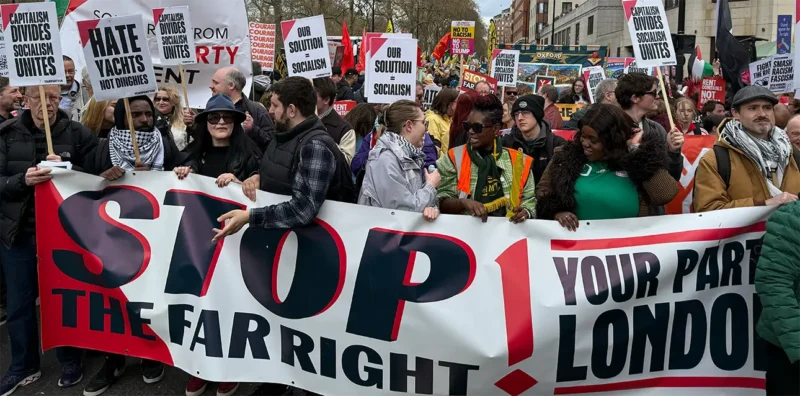
Nor has SUTR simply ‘demobilised’ anti-racism. It has sustained counter-protests outside asylum hotels and helped organise major national mobilisations, including the 28 March Together Alliance demonstration. Their political limitations are real; so is the fact that the RCP could not organise mobilisations on that scale.
Wilson rightly criticises the SWP for cosying up to trade union leaders who endorse SUTR while failing to mobilise union members. But how does the RCP propose to involve the unions’ millions? Condemning general secretaries is not enough. Revolutionaries must make demands on those leaders while organising the rank and file independently.
The SWP’s problem is different. It has used the support of trade union leaders and liberal celebrities to build a national anti-racist campaign, but that support sets the limits of SUTR’s political demands and methods. Union endorsements are not enough, we need to demand they mobilise branches and workplaces too, and fight Labour’s anti-migrant policies.
The Together Alliance’s ‘Love. Hope. Unity.’ offered a convenient platform for broad endorsements, but little direction for those confronting racist intimidation on the ground. Indeed the uselessness of Together is that when the far right reared their ugly head in May 2026, the Alliance was conspicuously absent from the list of counter-demo sponsors. Once a year is enough for Sir Lenny Henry!
There is a political reason for this. The SWP’s ‘united front of a special type’, developed through the Anti-Nazi League, Unite Against Fascism and SUTR, seeks union leaders, Labour politicians, celebrities and community or religious figures as sponsors of broad campaigns. Their support comes with political limits.
The communist conception of the united front is completely different. It is aimed at common action with reformist workers’ organisations – with the aim of both achieving fighting unity and exposing the timid and vacillating reformist leaders.
Trotsky’s injunction to ‘march separately, strike together’ means freedom of criticism alongside unity in action. The aim is to win workers from their reformist leaders to more determined action, not corral the workers into reformist ranks towards a dead-end.
The SWP’s method resembles the old popular front: subordinating workers’ independent politics to the requirements of a wider alliance. The question of who sets the limits of the campaign and who takes its decisions is quickly tested. Either the working class bends the knee, with disastrous consequences, or the middle classes desert the struggle.
The movement we need
The immediate task is to build militant, democratic local anti-fascist coalitions rooted in the working class and oppressed communities. Trade union branches, shop stewards, trades councils, tenants’ organisations and community groups should be drawn into common action. Local meetings should decide strategy, elect organisers and prepare self-defence.
Self-defence is an urgent necessity. Twenty masked fascists attempted to storm an SWP meeting in Glasgow on 22 October, a follow up from the 200-strong Unite the Clans demo in July. The SWP has notoriously refused to organise self-defence, while Tye claims that it exaggerates the danger of the far right to corral people into SUTR.
Both are utterly wrong. To push back the tide of reaction, which is strengthening across Europe, we need to promote organised self-defence as an immediate task facing the working class.
Local anti-fascist coalitions should work with SUTR wherever it mobilises against the far right, while pressing for democratic control and a more effective strategy. Flexibility on the day and independence from the SUTR leadership are key.
Local campaigns already developing in places such as Manchester, Brighton and Bristol point towards the possibilities of cooperation between militants from different organisations. As these initiatives develop roots, they can link up nationally.
Their authority must come from the organisations and activists who do the work, not from a party office or honorary backers. That requires regular open meetings, agreed mandates for delegates, report-backs and the ability to replace organisers who do not carry out decisions.
Now the fascists’ threat to march through Longsight, Manchester on 30th October shows the possibility of becoming less reactive with a turn to consistent work in these multiracial communities, to build a base among the youth and workers of these communities including immigrants.
At the same time, anti-fascists must demand that union leaders mobilise their members, provide resources and support workplace campaigning against racism. Rank and file militants can win over workers who are taken in by the far right’s agitation, with patient but firm conversations. Defending refugees, migrants and other oppressed groups must go together with demands over pay, housing and public services.
We welcome the fact that the RCP has taken a turn to anti-racist and anti-fascist work. We share with them many of their criticisms of the SWP and SUTR. However, the RCP are currently let down by their disdain for clear anti-racist messaging, and their complacency for the threat posed by the far right. Both say the answer for anti-fascist activists who see the need for more militant policies is to join them. The RCP hasn’t set up an alternative campaign to the SWP, but if it does, it is likely to be even more of a front than SUTR given its sectarianism towards the rest of the left.
For the RCP the threat of fascism is a distant one. Wilson writes: ‘Think, for one second, what would happen if a Farage or Le Pen government were to try and enact a fascist or Bonapartist programme, which would mean attempting to annihilate or heavily repress parliamentary democracy, trade unions, and all left-wing organisations. This would provoke revolutionary convulsions.’
As always with the Ted Grant tradition, the historical process means the working class will wake up to the threat just in time. History has shown this is often not the case. This complacency replaces the responsibility on revolutionaries to prepare the working class both for revolution and counter-revolution. In the stormy times ahead, we will need to shoulder our revolutionary responsibility.