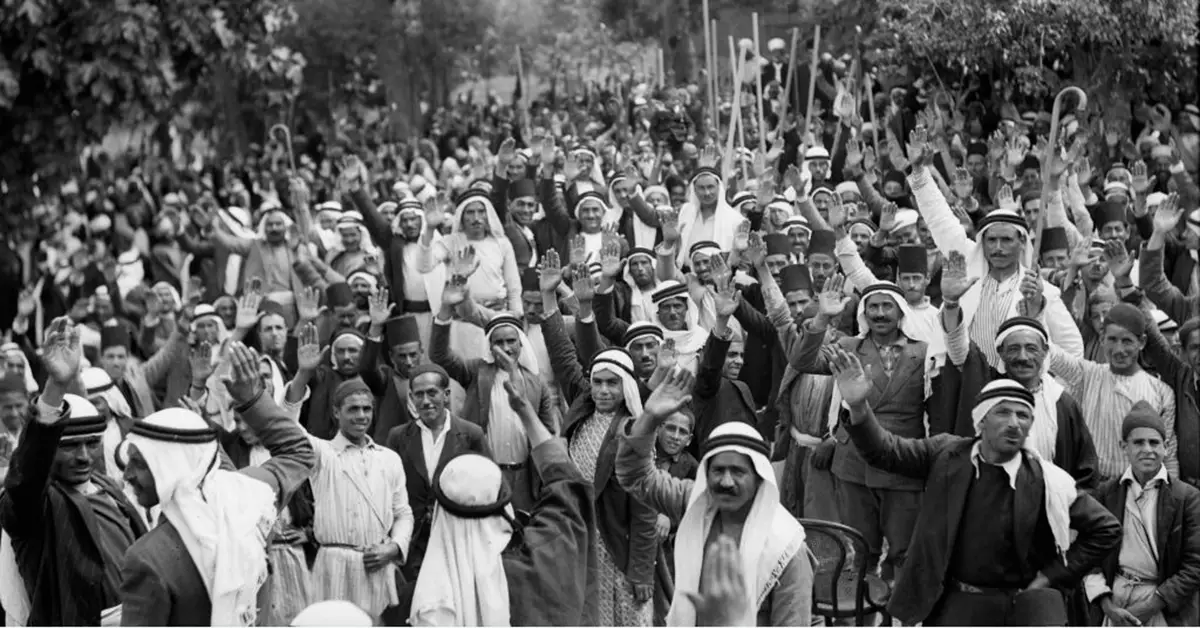
In 1936, Palestinian workers, peasants and nationalists launched a 175-day general strike against British rule and Zionist settlement. Its defeat exposed the limits of the nationalist notables and opened the road to armed rural revolt. First of a two-part series.
The Great Revolt, al-Thawra al-Kubra, from 1936 to 1939, was among the largest anti-colonial rebellions before the Second World War, and the most sustained in the Arab world until the Algerian War of Independence. At its height, Britain was forced to transfer troops from across the empire to suppress it. By 1939, tens of thousands of British soldiers and police were deployed in Palestine.
The first phase was a general strike lasting 175 days. Arab workers, the urban poor and the Palestinian national movement tried to grind the machinery of British rule to a halt, as part of a wider revolt to stop Zionist settlement and win independence.
Unlike many other anti-colonial struggles, Palestinians faced a second, dangerous and powerful foe: the Zionist movement. Zionist institutions organised strike-breaking labour under British protection. In return, the British armed and organised Zionist police and paramilitaries to help suppress the insurgency.
The strike ultimately failed. But it was not the end of the revolt. The focus shifted to the peasantry and armed struggle, which at one point saw the British lose control of much of the country.
Perfidious Albion
Britain issued the Balfour Declaration in 1917, promising a ‘national home’ for Jews in Palestine, then less than a tenth of the population. Palestinians were reduced to ‘existing non-Jewish communities’, without equal national rights.
At the same time, Britain and France carved up the Middle East after the First World War to preserve control over oil, trade routes and the Suez Canal. The result was an increasingly intense Palestinian nationalism, emerging within a broader Arab nationalism.
The Balfour Declaration was a grossly undemocratic, divide-and-rule tactic aimed at building, in the words of Palestine’s first military governor, ‘a little loyal Jewish Ulster in a sea of potentially hostile Arabism’. Given a League of Nations Mandate in 1920, Britain protected mass Jewish immigration, settlement and the development of the Yishuv: the Jewish quasi-state in Palestine. This colonisation was organised and funded on a mass scale by the international Zionist movement, rooted above all in Europe and the United States.
Zionist leaders hardly hid their plans for ‘transfer’ of the Arab population. Their project of creating a Jewish-majority state in Palestine meant expelling, not exploiting, the native population. That was the distinctive feature of Zionist colonialism and the existential threat it posed to Palestinians.
The deteriorating position of Palestinian farmers, workers and youth under the Mandate made the threat material. Land sales to Zionist companies and organisations meant the mass eviction of Arab peasants to make way for growing Jewish settlements. By 1931, about 20,000 peasants had been evicted, while up to a third of village dwellers had become landless. Thousands of the rural dispossessed swelled the slums and shantytowns around Haifa, Jaffa and other cities.
The Great Depression, combined with an aggressive Labour Zionist campaign for the boycott of Arab labour and products, deepened unemployment and politicised Arab workers, peasants and small traders. Clashes with armed settlers and far-right Zionist groups increased, while British police enforced evictions from the land. It became clear to workers and fellahin alike that defending their most basic class interests meant stopping Zionist immigration and settlement, and waging a national struggle against the British state that protected both.
Palestine’s official leadership was dominated by urban landlord families, the ‘notables’, who had monopolised politics under the Ottomans and continued to do so under the British. They were co-opted through lucrative positions in the Mandate. Formally united in the Arab Executive Committee, they spent most of their energy on political infighting or fruitless negotiations with the High Commissioner over Jewish immigration and settlement. Many were themselves implicated in land sales.
In the 1930s this status quo continued, despite more radical public rhetoric. At the top of the Arab hierarchy was Mohammed Amin al-Husseini, the Grand Mufti of Jerusalem and president of the Supreme Muslim Council, both posts created under the Mandate. His family’s main rivals, the Nashashibis, were even more moderate.
Disillusionment with the Jerusalem notables saw the rise of the short-lived anti-British Istiqlal, or Independence, party in 1932 in the northern towns. Though damaged by its leader’s links to land sales, it reflected a younger, more radical generation that had grown up under the Mandate and continued to organise. Scouts groups, sports clubs, youth and women’s associations and trade unions sprang up in the decade before the revolt.
Then, in 1933, Hitler came to power in Germany, bringing Palestine’s tensions to a head. US and British immigration restrictions blocked large numbers of desperate Jewish refugees from entering their countries. Many went instead to Palestine. Between 1933 and 1936, the Jewish population rose towards 30 per cent. Haifa became a majority-Jewish city and Tel Aviv outstripped its Arab neighbour, Jaffa.
The Jewish sector boomed with the influx of capital, further driving up land sales and inflation, while the campaign against Arab labour intensified. The Yishuv expanded into the fertile coastal areas, the Jezreel Valley and Galilee, pushing out Arab peasants and threatening to bisect and marginalise Arab areas. The danger of Palestine becoming a Jewish state was now a foreseeable future.
Get The Spark in your inbox
Workers Power’s weekly newsletter
Al-Qassam: the spark
The spark came in late 1935. On 16 October, dockers in Jaffa discovered a secret arms shipment to the Zionist Haganah militia, including 25 machine guns, hundreds of rifles and large quantities of ammunition. It confirmed widespread fears that the Zionists were preparing to take the country by force. Protests swept Palestine and spread across the Arab world.
Then, on 20 November, British troops and police ambushed a small armed band near Ya’bad village, killing its leader, Sheikh ‘Izz al-Din al-Qassam. A popular Haifa imam, al-Qassam preached jihad against Zionism and British occupation. He also served as an itinerant sharia judge and president of the Young Men’s Muslim Association. Both roles enabled him to agitate and organise across northern Palestine, where he built an underground armed organisation.
Dismissed by the British as a bandit, al-Qassam became a public symbol of militancy, sacrifice and national resistance, in contrast to the notables. The British were shocked when thousands joined his funeral march the next day and Haifa went on strike. None of the major party leaders attended.
The tension continued with mass rallies on al-Qassam’s remembrance day on 5 January 1936. By then the political parties were in attendance, trying to catch up with a movement moving beyond them.
Meanwhile, a student revolt in Egypt at the end of 1935 had forced elections, leading to victory for the nationalist Wafd party. In Syria, a general strike in early 1936 forced the French to negotiate concessions. Across the Arab world, movements were pushing back against colonial rule. Palestine, by contrast, was moving towards a more direct clash.
On 15 April, near Tulkarem, a small Qassamite band killed two Jews. In retaliation, Revisionist Zionist activists murdered two Arab workers near a kibbutz. At the Tel Aviv funeral for one of the Jewish victims, Arabs were attacked and an attempted march on Jaffa led to clashes. Scores were injured and houses burnt. The British declared a curfew and martial law across Palestine. These small, tit-for-tat incidents lit the Great Revolt.
The general strike
According to the British High Commissioner, Arthur Wauchope, ‘the strike was begun independently and spontaneously in various places by various committees and groups’. In Jaffa, a strike was called on 19 April and a strike committee set up in the port. That same evening activists in Nablus formed a National Committee and called on Palestinians to launch a general strike, withhold taxes and boycott Jewish goods until Arab demands were met: an end to Zionist immigration, a ban on land sales and a democratic representative assembly. The strike spread like wildfire.
All this took place without the notables’ leadership. Public meetings and the press piled pressure on the Mufti, the notables and their parties to support the strike and lead a united struggle. The Mufti, meanwhile, continued assuring the authorities that sermons would be non-political.
On 25 April, representatives from the national committees met in Jerusalem to establish a national leadership. The leaders of the elite parties agreed to join it, otherwise they would lose all credibility, but insisted it should not be an elected body. The Arab Higher Committee was formed, composed of these party leaders with the Mufti as president. It adopted the strikers’ three demands.
As one biographer of the Mufti put it, the committee was ‘the child of the spontaneous revolt’. For the first months, it did not lead the revolt so much as follow it. Actual leadership lay more with semi-independent national committees controlled by young radicals.
Nevertheless, with its authority and funds, the Arab Higher Committee could enforce its will when needed. More fundamentally, it blocked the movement from generating its own leadership under popular control, preserving the notables’ ability to broker deals with the British behind closed doors. It also meant the land question and the crushing debt crisis, owed overwhelmingly to the same Arab elite, remained unaddressed until the later phase of the revolt, when control shifted further to the grassroots.
The general strike lasted 175 days and stood at the centre of a wider popular revolt that brought Palestinian areas to a standstill. The drivers’ association called a nationwide transport strike even before the general strike, effectively closing the roads. Jaffa, second port to Haifa and heart of the fledgling trade union movement, became a leading centre of revolt.
In Haifa, the Palestine Arab Workers Society, founded in 1925 and the first serious Arab union in the country, joined the struggle to shut down the city, though with less success. Construction across Palestine, including in the Jewish sector, halted because it relied on Palestinian quarries for gravel. Arab labourers stayed away from building sites, farms and citrus groves. May Day rallies denounced the Mandatory government for the ‘Judaization of this Arab country, depriving the worker of his job and the peasant of his land’.
Villages and major enterprises, such as the Nesher quarry and cement plant near Haifa, became hotbeds of nationalist activity and struggle. The semi-proletarian layer eking out a living in the shantytowns was a key source of the strike’s radicalism, alongside its landless counterparts in the countryside. Together with workers, they policed the weakest links in the strike: small merchants, transport firms and labour contractors. Nationalist youth groups patrolled the cities.
For months, workers and rebels struggled to stop lorries and trains reaching the harbours, oil depots, quarries and construction sites. The British and the Yishuv were equally determined to keep them open, for fear that Jewish labour would re-emigrate, the drain on British finances would become too great, and the solidarity movement across the region would grow.
Labour Zionism
Here the Zionist movement showed its worth to the imperialists. The Histadrut, a Labour Zionist institution created in 1920, was unique. It was an economic combine, a labour contractor and, only lastly, a trade union. It channelled capital from abroad to become the industrial heart and foremost employer of the Jewish Yishuv, and later of the Israeli state.
The Histadrut dominated the economy under the Mapai Labour Zionist party, whose leader David Ben-Gurion also headed the Jewish Agency, the central institution organising immigration and settlement in Palestine. Mapai made all important decisions affecting the Histadrut before they were ratified by the organisation’s own leadership bodies.
The Histadrut’s trade union functions were subordinate to its colonial Zionist aims. Its purpose was to ensure that no independent trade unions uniting Jewish and Arab workers took off, to block communist influence, and to sell Zionism to the international labour movement by cloaking its aims in socialist rhetoric.
Without this apparatus, the Yishuv bourgeoisie would have been too weak, fragmented and dependent on cheap Arab labour to construct a new state, even with British support.
The Histadrut led the campaign for Hebrew labour and Hebrew products, and scabbed on Arab strikes, at times violently. Before the revolt, Mandatory authorities were sometimes cautious about the Histadrut’s campaign for Hebrew labour because they feared an Arab reaction. Public works maintained discriminatory wage scales, paying Jewish workers up to twice Arab wages, yet still hired Arabs and Jews in equal numbers. That effectively reserved well-paid places for Jewish labour, but it remained an obstacle to complete ‘Hebrew labour’.
Now, with full police protection, the Histadrut mobilised Jewish workers and kibbutzniks to scab on a mass scale and replace Arab labour in the Jewish economy.
Strikes, struggles and scabs
The biggest breach in the strike was Haifa, a mixed city with a Jewish majority after recent immigration, which placed intense pressure on the Arab workforce and its unions. There the main Arab contractor supplying labour for the port refused to support the general strike. About 100 of the 250 Arab port workers did refuse to work in April and were confined under police supervision at the port, while Jewish and Syrian migrant workers organised by the Histadrut took their jobs.
The nationalist movement applied pressure on the contractors and workers, offering strike pay as well as threats, but to no avail. The city remained a major breach in the strike until August, a fact Histadrut-published Arabic leaflets used to undermine strikers’ morale elsewhere.
At the Nesher cement plant, the biggest Jewish-owned enterprise in the country and crucial to its construction industry, quarry workers struck solidly in April, while the quarry’s Arab operator fled the country under nationalist pressure. Nesher’s management transferred his contract to the Histadrut, which arrived on 4 May with 50 Jewish workers from a local kibbutz under police escort. They were accompanied by Palestine Arab Workers Society leader Sami Taha, who had bowed to the pressure.
The priority was to keep the plant open. The Histadrut promised that Arab workers would keep their jobs and pay if the quarry reopened and if they accepted the Jewish workers. Perhaps the failure of the Haifa strike had influenced the strikers’ leaders. But it meant breaking the strike and accepting the thin end of the wedge. Arab labour dwindled, and so did pay, in the months that followed.
Where workers stood firm, colonial police and troops proved decisive, tipping the balance in the Histadrut’s favour. The Majdal Yaba quarry workers, near Tel Aviv, had resisted attempts to break them in 1934 and again in April 1936. But at the end of 1936 all 400 were fired under Histadrut pressure and replaced by a Jewish workforce, backed by a large police contingent and numerous arrests.
This injustice, and the loss of hundreds of jobs and wages crucial to the local economy, left deep bitterness. A historian later noted that villagers from the area joined the derailment of a train near Ras al-Ain station in October 1937. They came from villages that had direct experience of what Zionists meant by the ‘conquest of labour’.
The Arab Higher Committee also compromised the strike’s cohesion by refusing to demand that Arab civil servants in the Mandatory government walk out. The Mufti feared that such a demand would apply to the Supreme Muslim Council, which he headed, and that the British would strip him of his posts. Yet a government workers’ strike could have brought the Palestinian administration almost to a standstill and increased pressure on railway and public works employees to join the strike.
As the strike wore on without breaking Haifa port or key infrastructure such as the railways, desperation grew and pressure to compromise mounted. Against that stood the nationalist movement, the shantytowns and the insurgent villages. The Arab Higher Committee and national committees set up bodies for food supply and finance, offered strike pay to Arab and even Jewish workers, and would later support the armed rural insurgents.
In August the situation came to a head. For a short time it looked as if the deadlock might be broken in Haifa. As the struggle sharpened, some Arab dockers struck, along with workers at Palestine Railways, the Iraq Petroleum Company, the municipal administration and the Public Works Department.
Now, if ever, was the time to bring the whole public sector out and combine it with an upsurge across every wing of the struggle. The Arab Higher Committee did not. By the end of the week, British troops had effectively occupied Haifa, allowing Histadrut strike-breakers to scab while army engineers ran the locomotives. This strategic battle was lost. After Haifa, the general strike was living on borrowed time.
The Arab working class had grown quickly, along with industry and the economy, because of the influx of Jewish capital. But this was combined with a step backwards. Competing Jewish labour, protected and privileged by the Histadrut, the Yishuv and the British, limited and undermined Arab workers’ development, confining many to smaller workshops and more insecure, seasonal and marginal forms of work.
Zionism strengthened Britain’s colonial grip until it turned on its master and conquered the Palestinians. From small economic questions to existential political ones, Zionism was a disaster for the Palestinian people.
Mass revolt
As the strike reached its limits and tensions grew, workers became desperate and the movement radicalised, seeking other outlets. Mid-May saw a wave of bombings in Haifa and Jaffa, and shots fired at Jews and police in Jerusalem. The narrow streets and alleys of old Jaffa became a no-go area for the British. Local armed bands based in villages and the countryside began targeting British and Jewish installations, transport and property. This was the beginning of an elemental rural revolt that would spread before exploding into a countrywide anti-colonial insurrection in 1937-38.
The colonial authorities launched a wave of arrests and deported 60 young radical leaders and activists at the end of May. In response, revolt erupted in the major towns, with dozens of attacks a day on British forces. Wauchope warned the Colonial Office that Palestine was in a ‘state of incipient revolution’. Palestinian towns turned into battlegrounds as soldiers, armoured cars and tanks sent to restore order met barricades, stone throwers and snipers.
The colonial authorities then launched the punitive measures that would become systematic counter-insurgency in the later phase of the revolt. The peak of the campaign to retake the towns was the demolition of a large swathe of central Jaffa, officially on public health grounds, in reality to divide the city with an access road for the military. Thousands were left homeless. The countryside remained in ferment throughout the summer.
In September, the British government decided to ‘crush Arab resistance’ and sent in another division, taking the number of troops in Palestine to more than 20,000. The Arab Higher Committee leaders were forced to meet Wauchope and hear his ultimatums. They indicated that they would call off the strike if requested to do so by Arab rulers, whose mediation they would accept. A delegation began a tour of the region’s capitals. Those rulers had already conferred with the British and wanted the revolt ended before it spilled over into their own states.
For two decades, the notables had clung to leadership without confronting the growing threat of Zionist settlement. They had set up the Arab Higher Committee and contained the general strike at key points. They had demanded no material solidarity from the Arab rulers. Now, at the rulers’ request and without concessions from the British, the committee called off the general strike on 10 October 1936. Its statement, dictated by the rulers of Saudi Arabia, Transjordan and Iraq, called on Palestinians to rely on negotiations and the ‘good intentions of our friend Great Britain, who has declared that she will do justice’.
The British promised another commission, led by Lord Peel, to examine the issues behind the revolt. They took no chances: armed groups were allowed to disband without arrest and volunteers from outside Palestine were permitted to leave peacefully. The rebellion sank to a simmer as the people watched and waited.
By then, 37 British troops and police had been killed, alongside around 80 Jewish settlers and more than a thousand Palestinians.
Months later, the bombshell hit. The Peel report of July 1937 proposed the partition of Palestine, with the forced transfer of up to 225,000 Arabs to create a Jewish-majority state covering some of the most fertile territory. Palestinians would be attached to Transjordan. Outrage at this betrayal, the greatest yet, saw the Palestinian rebellion rise to even greater heights in 1937-39, the second phase of the Great Revolt.