
By Ian Elcoate
I got involved in Stand Up to Racism (SUtR) shortly before the racist pogroms across England in the summer of 2024. Locally, on Teesside, people were coming together via personal connections and on social media channels. With SUtR being the most visible national anti-racist organisation at the time, we decided to form SUtR Teesside, elect a Steering Committee, create WhatsApp groups and build something locally.
A public meeting was arranged, with support from some local unions and members of the Muslim community. The SUtR Regional Convenor insisted that we have an SUtR national figure on the platform for the meeting. We reluctantly agreed, but the consensus was that the local speakers and historian Taj Ali had a lot more to say that was worth listening to. This was also a foretaste of the bureaucratic nature of the organisation and its poor politics.
SutR and Palestine
Building the group was hindered by SUtR having no position on Palestine. We passed a motion opposing the genocide, publicised this and shared it across SUtR regionally. The SUtR Regional Convenor responded that we couldn’t do that, and that there was no mechanism of proposing this at a regional or national level.
We made common cause with individuals within SUtR North-East who agreed with us. Among these were younger Asian comrades, active in both the anti-racist movement and Palestine Solidarity Campaign. It also quickly became apparent that all dissenting voices in SUtR were being shut down, debate was made very difficult and there was no means of changing policy.
A regional ‘clear the air’ meeting was called, with most of the work done by former Corbyn Shadow Cabinet member Laura Pidcock, who was excellent in trying to democratise the organisation. The call for this meeting was not supported by the Regional Convenor but was forced on them and attended by Samira Ali (SUtR National Organiser and SWP member), Lewis Neilsen (SUtR National Antifascist Officer and now SWP National Secretary) and, via Zoom, Weyman Bennett (Co-Convenor of SUtR and SWP).
At this meeting we heard that we couldn’t have a policy on Palestine as we had Jewish supporters, and it would cause problems with the trade unions (read bureaucrats) who provide the funding. Then we also witnessed first-hand how younger Asian comrades were dismissed by SWP members as not knowing how to tackle racism!
SUtR supporters in the region left in numbers and we removed the regional convenor from our Teesside chat groups, after a member vote. We got veiled threats of ‘possibly being removed from SutR’. Yet we, and others in the region continued to argue for democracy but increasingly were called disruptors, splitters and worse.
UKIP march
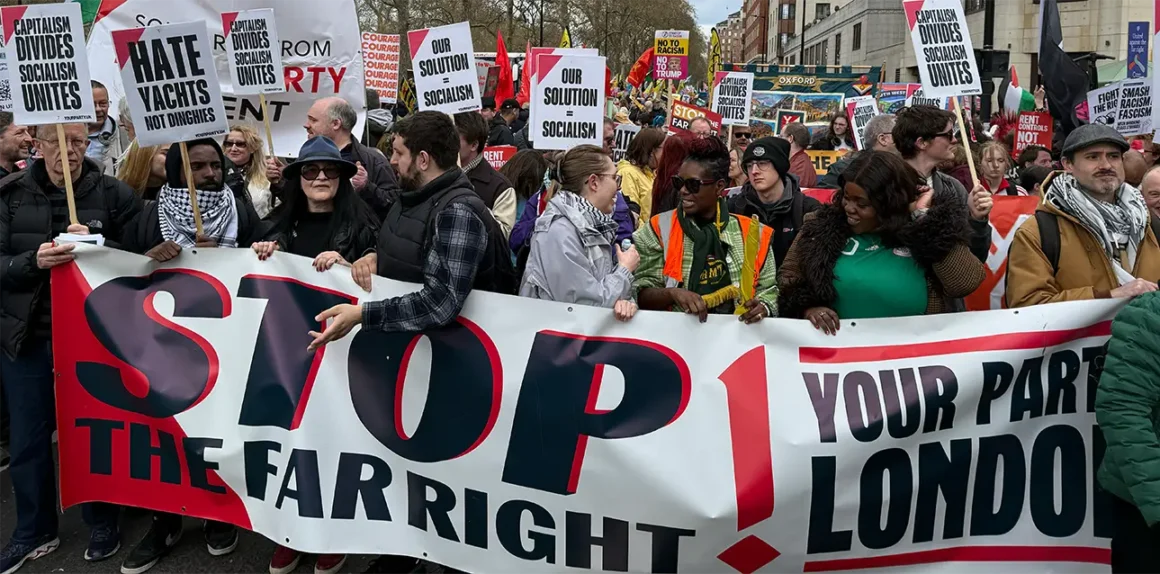
Things really came to a head in the run up to fascists coming to Newcastle on 27 September, a UKIP march and a founding conference for Advance UK in the region with Yaxley-Lennon publicly declaring his support. A number of groups called for a physical counter to stop the UKIP march. SUtR and their allies in Newcastle Unites (NU) called a rally with a plethora of speakers, well away from the fascists.
Those of us calling for physical opposition on the official SUtR chat groups were again being called splitters. It was even suggested that one comrade from Teesside was little more than a coked-up football hooligan looking for trouble (it was a pensioner not in the best of health – who did join the physical opposition nonetheless).
As a result, a coalition of groups, ranging from the Green Party, Majority, SUtR Teesside, women’s groups, communists, anarchists and others, called the counter demonstration. A couple of days before the event, a meeting with SUtR regional and national leaders and NU leaders in attendance agreed that the physical opposition would be the focus. Whilst this meeting was on, NU pushed out further calls for a rally away from the fascists and SUtR continued to build that rather than the counter.
On the day, there were around 2-3,000 at the SUtR/NU rally, a clear indication of people’s willingness to oppose fascism (and SUtR’s superior funds) but many were unaware of the real counter a mile or so away, which had around 4-500 on it.
Despite being kettled initially, the counter forced UKIP away from their planned route through Newcastle centre and into side streets where they continued to be harassed all the way to their final destination, the hotel housing asylum seekers, where they were met by around 1,000 counter protestors.
We pulled a number of people from the rally to join us at the hotel despite NU leaders on the platform shouting, ‘We’re not moving!’. The counter was a success, but we were lucky that the fascists had not pulled large numbers, and by the lack of police organisation.
The regional SUtR group has further disintegrated in the last month. The Regional Convenor has imposed new rules on all chat groups, that came from national level, which has led to huge numbers of people being kicked out of chats for ‘not supporting the aims of SUtR’ by which they mean any criticism of strategy or tactics. This includes many who are mildly critical of the SWP’s line and lack of democracy and most of the Teesside and Darlington comrades who have now decided to pull away from SUtR.
My analysis of SUtR is pretty straightforward.
- It is impossible to be an anti-racist organisation without explicitly opposing the genocide in Palestine.
- Physically countering fascists is vital, a nice rally some miles away isn’t.
- Just calling a counter-demonstration is not enough. Successful ones in the region have largely got the numbers out due to the work of Asian comrades and student groups that are distanced from SUtR due to its politics. We need to build links on the basis of anti-racism and an open and democratic structure that allows debate on the politics and actions we take.
- Just putting out a leaflet against Reform near election time is an ineffective strategy in countering their appeal. Large numbers of working class people voting Reform are doing so because they feel abandoned by a neoliberal consensus in all major parties. We need to be out in those communities now arguing for an alternative.
Despite the SWP’s statements that SUtR is a united front, it’s a popular front, undemocratic internally, and tightly controlled by the SWP and their fellow travellers. Their politics mean there is no challenge to the trade union bureaucracy and only a very limited calling out of the racism of this Labour government.
It allows the ‘left’ union leaders, both nationally and locally, to have an appearance of fighting racism as they outsource this to the SWP by funding SUtR and appearing on their platforms. The SWP, in return, can pay their leading members to be full-time staff at SUtR and, therefore, will not say anything that may challenge those funds.
There are now lots of discussions going on behind the scenes between people involved in the physical counter in September to build a new anti-racist coalition in the region, one that is built as a real united front, allowing for debate and politics but coming together to physically counter fascists when they appear. We will see what comes out of that.