On 29 April 2026, Essa Suleiman allegedly carried out a series of knife attacks in London. Two Jewish men were stabbed in Golders Green; prosecutors also say a third man, Ishmail Hussein, was attacked earlier the same day in Southwark.
The Metropolitan Police are treating the Golders Green attack as a terrorist incident and are investigating a possible antisemitic motive. But the full motive has not yet been established, and the earlier Southwark attack complicates the attempt to present the case as a simple story of ideological violence.
The suspect has been reported to have had serious mental health issues. Yet before the facts had been established, much of the political and media establishment seized on the attack to advance a familiar argument: that the Palestine solidarity movement is responsible for rising antisemitism.
Rather than ask what happened, how the victims and the wider community should be protected, and what role failing mental health services may have played, most pundits chose to frame the tragedy for political ends.
Antisemitism
In the name of ‘protecting British Jews’, Keir Starmer used the aftermath of the attack to threaten prosecutions against people using the slogan ‘Globalise the Intifada’, long a target of pro-Israel lobby groups. Ministers and commentators then attempted to shift blame onto pro-Palestine marches and anti-genocide activists.
Politicians and media outlets did not wait for the attacker’s history or motivations to be established before using the tragedy to score political points and justify a more repressive state response. Whatever further investigation may reveal, this is an example of a familiar tactic: capitalising on fear to present anti-Zionism as antisemitism.
The attack itself was deeply shocking and traumatising for the community, and must be condemned without qualification. Given the recent spate of attacks against Jewish people and institutions, including a Manchester synagogue attack and several arson attacks, it is impossible to deny that violent antisemitism is rising in Britain.
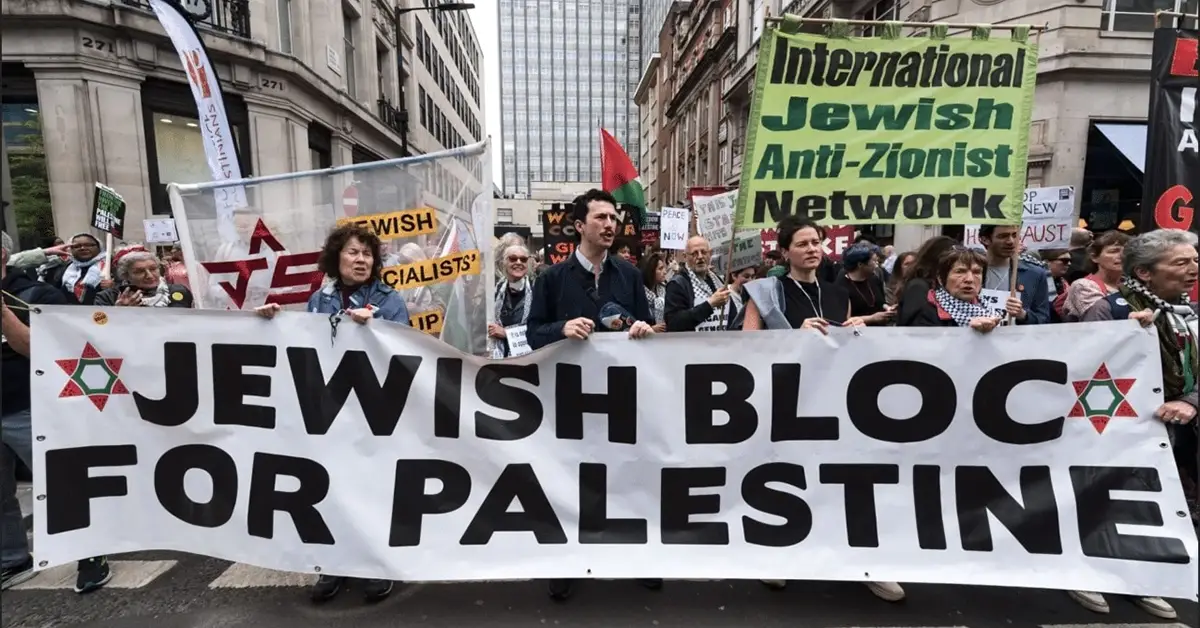
But blaming that rise on the movement for Palestinian liberation is a distortion. Palestine marches have been widely attended by Jewish people, many of whom risk ostracism from families and communities to oppose the genocide being committed in their name. Jews have a long history of participating in struggles against imperialism, oppression and exploitation. Anti-Zionism has been part of Jewish life, religious and secular, for as long as Zionism has existed.
One driver of contemporary antisemitism is the brutality of the Israeli state, which claims to represent all Jews, and the genocidal ethnonationalist project it is carrying out in Palestine. The confusion is deepened by the constant conflation of opposition to apartheid and genocide with antisemitism, leading some to conclude wrongly that antisemitism itself must be fictional or exaggerated.
Historically, Zionist politics has drawn strength from antisemitism. Fear and persecution have been used as recruitment arguments for settlement and as justification for atrocities committed in the name of building a supposed ‘safe homeland’ for Jewish people on the land of the indigenous population of Palestine.
Antisemitism and Zionism are therefore politically entangled. Zionism rests on the premise that Jews cannot live safely as equal citizens in other societies and must therefore have an ethnically exclusive state of their own. Without antisemitism, Zionism would lose one of its central justifications.
Get The Spark in your inbox
Workers Power’s weekly newsletter
Authoritarianism
Shortly after the attack, Green Party leader Zack Polanski, one of the few Jewish leaders of a major British party, reposted criticism of the police response. The post alleged that officers repeatedly kicked the suspect in the head after he had been Tasered and was on the ground.
That provoked a highly unusual public intervention from Metropolitan Police Commissioner Mark Rowley, who defended the police and accused Polanski of fuelling tensions. The criticism was then echoed by the media and by Starmer. Under pressure, Polanski retracted the post and apologised – a retreat that must have given many former Corbyn supporters a sense of déjà vu.
The incident shows that the machinery of state is far from neutral when questions central to British imperialism are involved. Capitalist democracy claims to defend free speech, democratic rights and personal autonomy. In reality, those rights are conditional, and can be narrowed rapidly when they obstruct the interests of the state.
The selective framing of the Golders Green attack comes amid a wider authoritarian turn against the Palestine movement. The clearest example has been the proscription of Palestine Action.
The High Court ruled the ban unlawful. The government has appealed. Yet thousands have been arrested under terror legislation after holding signs saying, ‘I oppose genocide. I support Palestine Action’. The legal fight continues, but the political message is already clear: solidarity with Palestine is being treated as a threat to public order and national security.
In the same period, the government has pushed through new anti-protest powers allowing police to take the ‘cumulative impact’ of repeated demonstrations into account when deciding whether to impose restrictions. This is one of the most repressive recent curbs on protest in Britain, and it is plainly aimed above all at sustained Palestine demonstrations.
Zionism and imperialism
Israel has long functioned as a gendarme of European and US imperialism in West Asia. From the Balfour Declaration to the present, British imperialism has used Zionism as a prop for its regional strategy while allowing Jews to be made a scapegoat for crimes committed by Western states.
The Nazi Holocaust is rightly remembered as one of history’s greatest crimes. But in British bourgeois mythology, that memory is used selectively. It is invoked to present Israel as permanent victim rather than colonial power, while the crimes of British and Western colonialism are minimised or displaced.
As Israel’s atrocities in Gaza become impossible to conceal, the contradiction sharpens. The state and media identify Israel with Jews as a whole, then accuse all opposition to Israel of antisemitism. This does not protect Jews. It encourages the very confusion on which antisemitism feeds, by telling people that Jewish safety depends on defending Israel.
This is especially dangerous in a period of imperialist decline. As Western capitalism becomes less able to guarantee rising living standards, the ideological justification for imperialism becomes harder to sustain. State institutions are questioned. British claims to liberal tolerance are exposed by the export of war, repression and devastation abroad, and by the restriction of protest at home.
Since the Gaza genocide began, successive governments have been alarmed by growing sympathy for Palestine and disaffection with Israel. A mass protest movement, disruptive direct action and widespread opposition to Zionism, including among British Jews, threaten the West’s material and ideological support for Israel.
That is why the British state is using propaganda, policing and the law to reverse the trend and silence dissent. It is not defending Jews from antisemitism. It is defending an imperialist alliance.
That is also why these repressive laws must be denounced and defied. The thousands arrested for displaying placards in support of Palestine Action have taken an important stand. Their action defends the right to protest, pushes back against authoritarian legislation and adds to the pressure to isolate the Zionist state.