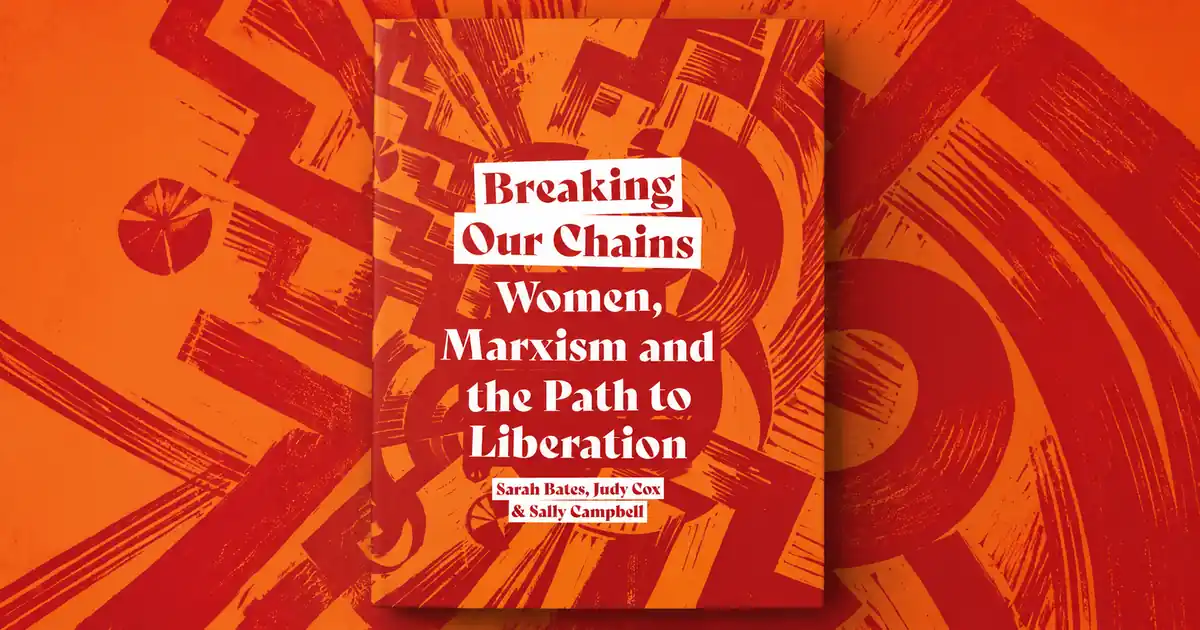
Breaking Our Chains: Women, Marxism and the Path to Liberation, by Sarah Bates, Judy Cox and Sally Campbell, Bookmarks, 2026, 142pp.
This is a well-researched and clearly written book, with useful historical material as well as coverage of contemporary issues including the manosphere, intersectionality and transphobia.
The early chapters cover how, with the development of private property which could be inherited by children, usually male children, women became oppressed and the so-called nuclear family, within which women were monogamous, became increasingly common. The woman’s children had to be those of the man who owned the property, so that accumulated surplus production remained within the family and did not become a communal resource.
This evolved over a long period of time, unevenly in different parts of the world, through economic stages including slavery, feudalism and then capitalism. This is argued in Friedrich Engels’ classic Marxist text The Origin of the Family, Private Property and the State (1884).
The book’s authors deal with feminist critiques of Engels, rejecting various forms of feminism and saying that they themselves are not socialist feminists or Marxist feminists but Marxists.
I cannot go into every detail of the book, but will discuss various issues which I feel are not dealt with adequately.
Feeding your baby and class
For example, there is a rather under-developed section on motherhood and breastfeeding. The authors say that ‘breastfeeding outcomes represent access to extended maternity leave, lactation consultations, expensive breast pumps and breastfeeding clothes’, and so working-class women are less likely to be able to do this, especially unmarried women (pp.39-40). They rightly say that women should be supported in feeding their children in the ways they want to.
This point needs more careful handling. Class plainly shapes feeding choices through maternity leave, workplace control, housing, health services and the availability of support. But it does not map neatly onto the individual decision to breastfeed or use formula. Capitalism commodifies both sides: formula companies market breast-milk substitutes, while a whole consumer niche has grown around pumps, clothing and paid advice.
A straightforward Marxist treatment would insist both on defending women against moral pressure and on demanding the collective provision that makes real choice possible: properly paid maternity and parental leave, free and accessible health care and feeding support, workplace nurseries, and clean water and safe infant nutrition in emergencies. In some situations worldwide, contaminated water can make formula feeding dangerous for babies.
Get The Spark in your inbox
Workers Power’s weekly newsletter
Women’s participation in struggle
The book goes on to describe important struggles by women, in the utopian socialist movement and in women’s support for Chartism, mentioning several women killed in the Peterloo massacre of 1819, including a heavily pregnant mother of six called Mary Heys and a mother of seven, Sarah James (p.55).
Women workers’ resistance is also discussed, for example the famous matchgirls’ strike of 1888. They had previously, in 1882, protested against one shilling being deducted from their wages to fund a statue of the then prime minister, Gladstone, pelting the statue with stones, red paint and their own blood during the unveiling ceremony (p.59). The class differences in the women’s campaign for the vote are explored, as are the splits in the suffrage movement when some prominent suffrage campaigners supported the First World War. Interestingly, the figures quoted in the book show that since 2004 more women have been union members than men.
Sexism and hatred of women
Chapter four, ‘Who is to blame for sexual violence?’, describes how the far right, which claims to protect women and girls from ‘violent asylum seekers’, is very likely to be anti-women and even to include domestic abusers. However, I feel the authors downplay the importance of education in countering misogynist ideas from the so-called manosphere.
Of course education needs to be vastly improved in order to help young people understand women’s oppression, class society, the climate crisis, imperialism and all the other issues we face. But to say ‘education alone cannot undermine misogyny’ (p.44) is true but insufficient. The authors continue by saying that fighting together and striking together is more effective. But struggle in itself is also not enough. Trade unions can contain right-wing misogynists, too.
That is why revolutionaries need a programme of transitional demands to turn economic and trade union disputes into forms of organisation and consciousness far beyond the confines of particular strikes. This happened to a large extent during the miners’ strike of 1984-85 in Britain, where sexism and racism were discussed alongside the question of how to win.
What are transitional demands? They start from where people are now and point beyond the immediate limits of a strike or campaign, towards undermining a society based on profit-making and the oppression and exploitation it requires. For example, during a strike, this could mean raising workers’ control of the business, whether transport, a factory or water companies, including representatives of workers’ families and demands for workplace childcare.
‘Struggle’ is not enough
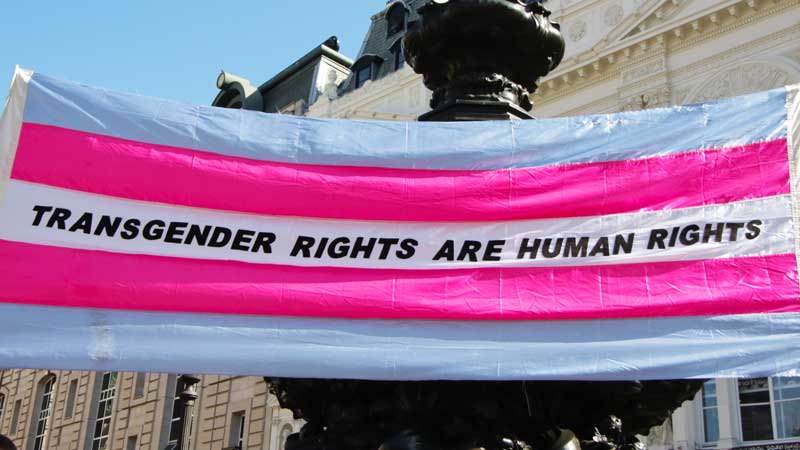
The section on trans rights is mostly good on gender fluidity, against rigid notions of ‘maleness’ and ‘femaleness’, and against the assaults on intersex babies whose parents are asked to decide what ‘sex’ their baby is before surgery to ‘correct’ them. However, the authors claim that ‘most trans and non-binary men and women are working class’ (p.85). This is probably true, given that working-class people are the majority in the world, but no numbers or evidence are given for the statement.
The answer we are given is, again, struggle: organise together in trade unions and protest movements. More politics is needed here. Struggle in itself is not always going to convince people to support trans rights.
On page 86, we are told that the Contagious Diseases Acts (1864, 1866, 1869) were ‘a criminalisation of working-class women’s sexuality’. This legislation was oppressive and unjust, since it targeted women, not the men in the armed forces it was supposedly protecting. Many working-class women were arrested under these laws, whether they were engaged in prostitution or merely in the wrong place at the wrong time.
But the phrase risks blurring sexual repression with the commodification and coercion of sex under poverty. The Acts were aimed primarily at women in prostitution. Most of the women targeted needed money, not sexual pleasure; the state was policing poor women’s bodies for the benefit of the army and navy.
Men, class and women’s oppression
Then comes a serious problem. The authors write: ‘Male workers do not benefit from their female partners being paid less or doing unpaid work in the home or fearing sexual violence’ and ‘The ruling class does not sustain the family to benefit the working-class men they throw on the scrap heap’ (p.101). The answer once again is ‘collective action’ to break the hold of reactionary ideas.
So men may have reactionary ideas about women, but they do not benefit from women doing unpaid housework, cooking and child-rearing? Where, then, is the material basis for the reactionary ideas, if men do not benefit at all? If many men did not receive any material advantage from the domestic labour of women, it would be much easier to change the ideas in their heads.
Similarly, I have heard the argument from Socialist Worker comrades at their annual Marxism event that working-class men do not benefit from any kind of oppression. But what about colonialism, or the imperialist plunder of other countries? Does not a layer of the Israeli working class receive real material and political advantages from the oppression of Palestinians, however much Zionism also binds it to its own ruling class and war machine?
On page 113, the authors summarise that ‘movements against oppression can weaken the hold of capitalist ideas, can raise the confidence and unity of the working class as a whole, but it is the fight against exploitation in the workplace that gives workers the power to challenge capitalism and the organisation to create an alternative to it.’
Yes, it is true that organised workers can bring the economy to a standstill and raise the question of who controls production: the workers or the bosses. But the question is how to link mass protest movements such as Black Lives Matter or the Poll Tax Rebellion to workplaces, so that protests can really hit capitalists where it hurts. It is not enough just to say workplaces are key and leave it at that.
For example, Black Lives Matter protests could organise democratic self-defence in localities in coordination with local workplaces, forming local organisations to keep neighbourhoods safe from racist and domestic violence, police and army attacks, and other threats. They could organise alternatives to the police alongside demands to defund the police, challenging the state’s right to control and oppress.
Again, this means that a party and a programme of demands arguing for revolutionary politics within protest movements is crucial. A significant example of what happens without revolutionary parties with a programme to take struggles further and organise for power can be seen in the Arab revolutions of 2011, where women of all ages played a massively important role but saw their aspirations, and those of the men alongside them, come to nothing.
I cannot deal with all aspects of this book. Suffice it to say that on historical topics, critiques of scientific ‘evidence’ of women’s different character and mental capacities from men, and the defence of trans rights, the book is useful and well researched. What is lacking is a developed political programme to liberate women and all oppressed and exploited people from capitalism and its appalling destruction of humanity and nature.
A working-class women’s movement
This brings me to the issue of the demand for a working-class women’s movement. What is this and why is it important? The book mentions examples from the period of the Russian Revolution, but what does it mean and look like today, nationally and internationally?
The need to build such a movement is sometimes raised by revolutionaries, though not always. A working-class women’s movement would aspire to be a mass movement, not limited to women who would be sociologically described as working class. After all, Marx and Engels were revolutionaries because of their class consciousness, not their social backgrounds.
All women could join such a movement as long as they accepted that it would put politics based on the needs of working-class women first. Why? Because the working class, together with its allies, has the power and the potential to weaken and finally destroy the capitalist system, which needs the oppression and exploitation of women, LGBT+ people and racially oppressed people in order to function.
This last sentence is basically what Breaking Our Chains says. But the book says nothing about a working-class women’s movement today, or how a revolutionary organisation with a programme would relate to it. Revolutionaries would argue their politics and the way forward within such a women’s movement. The movement would not be controlled by one particular party, but would be democratically organised while ensuring working-class women played a leading role.
A working-class women’s movement would campaign and organise in support of women who are not in a position to protest and self-organise themselves, for example women under siege in Gaza, where UN Women has estimated that more than 28,000 women and girls have been killed since October 2023.
We would point to what is needed to liberate women and other oppressed groups: 24-hour free nurseries, which would also benefit male family members; free social care, with care workers paid much more; better-paid and longer maternity leave; equal pay; free travel; and better housing. Maternity units and women’s health services, indeed all health services, should be under the control of those who work in the NHS, many of whom are women, and private companies should be thrown out of the NHS.
Women facing oppression worldwide should be supported by whatever means possible: protests, strike action against exploiting companies and arms manufacturers, free and safe contraception, and opposition to forced sterilisations, such as the Chinese state’s repression of Uyghur women. Meaningful links designed for action need to be built with workers, whether organised in trade unions or not.
It is also essential to say that capitalists will not give up their power easily. The struggle for liberation and the opening up of the possibility of a new kind of society, free of oppression of all kinds, must be internationalist or fail. The capitalist state will use weapons, the violence of police and army, torture, online sabotage and more. Recent events in Iran against protesters, both male and female, demonstrate this clearly. This is an honest outline of what a fight against capitalism would come up against. I did not find it in this book.
A working-class women’s movement is not going to spring up fully formed in ideal conditions. When women’s struggles arise, revolutionaries should raise the need for such a movement as one tactic among many to take our struggles forward, further politicise them and organise for what lies ahead.