In September, Ai Weiwei’s biggest exhibition to date, ‘Button Up!’, came to a close at Aviva Studios in Manchester. The artist is renowned for critiquing censorship, imperialism and government corruption; his latest exhibition in the North was no exception.
Ai Weiwei, a Chinese contemporary artist and activist, told the BBC: ‘I’ve never experienced a similar space in my life and that was a challenge, so I studied the history of Manchester, including its role as the world’s first industrial city.’
Manchester is the cradle of the industrial revolution and the city where Frederick Engels studied the rise of industrial capitalism, a system whose competition for resources and markets runs from its cotton mills to contemporary global conflicts. It is this that Ai Weiwei examines in his work.
Persecution
Ai Weiwei has a long history of creating provocative art and has been one of the most outspoken critics of China’s ‘communist’ regime. He has spoken out against corruption in China since the mid-2000s, but state persecution began after the 2008 Sichuan earthquake, when he helped launch a citizens’ investigation into the tragedy. He was due to testify at the trial of a fellow campaigner who had carried out his own private investigation of the disaster.
In 2010, municipal authorities shut down his art studio for lacking formal planning approval, even though local officials had invited him to build it there before his activism began. The mock protest he organised in response led to a few days of house arrest.
In 2011, the Chinese authorities cracked down on the Jasmine Revolution movement, which had been inspired by the Arab Spring. Ai Weiwei was the most high-profile person arrested in the crackdown, even though he did not organise the movement. After his arrest, Amnesty International issued a statement saying, ‘authorities are trying to broadcast the message that China’s time for open dissent has come to an end’.
The arrest was followed by 81 days of detention and, upon his release, allegations of tax evasion. After the court case, the artist was placed under house arrest and constant surveillance. During this period he launched WeiweiCam, a 24-hour live stream of his home and studio that mocked state surveillance. The broadcast attracted about 5 million views before the authorities shut it down after 46 hours. After years of house arrest and surveillance, Ai finally had his passport returned and left for Europe.
In 2017, Ai produced and directed the documentary Human Flow, which examined the refugee ‘crisis’ through the personal stories of people affected by it.
War and refugees
The exhibition featured new versions of some of Ai Weiwei’s earlier works, such as ‘History of Bombs’. This massive mosaic, made from 3.5 million Lego-style toy bricks, depicts bombs from the First World War to modern conflicts, made by countries such as the UK, USA, Russia, Germany, Italy and Israel. ‘History of Bombs’ was first presented in 2020 at the Imperial War Museum, but in a different medium: vinyl covering the walls and floor. The new mosaic took 11 months to build with the help of more than 300 volunteers.
Because the work is a reconstruction of the original, it appears largely unchanged, with the weapons ending in 2019, so it does not depict the latest missiles used by Israel, Russia or the US. When it was first shown, the world was shaken by the pandemic, and countries showed solidarity in developing vaccines and coordinating lockdowns.
In 2026, Ai Weiwei’s work hits differently, with the ongoing genocide in Gaza, the Russia-Ukraine war and America’s bombing of Iran. What should have been a lesson feels different as we look at the world stage and realise that no lessons have been learned, and that the military-industrial complex is rising in a way it hasn’t for years.
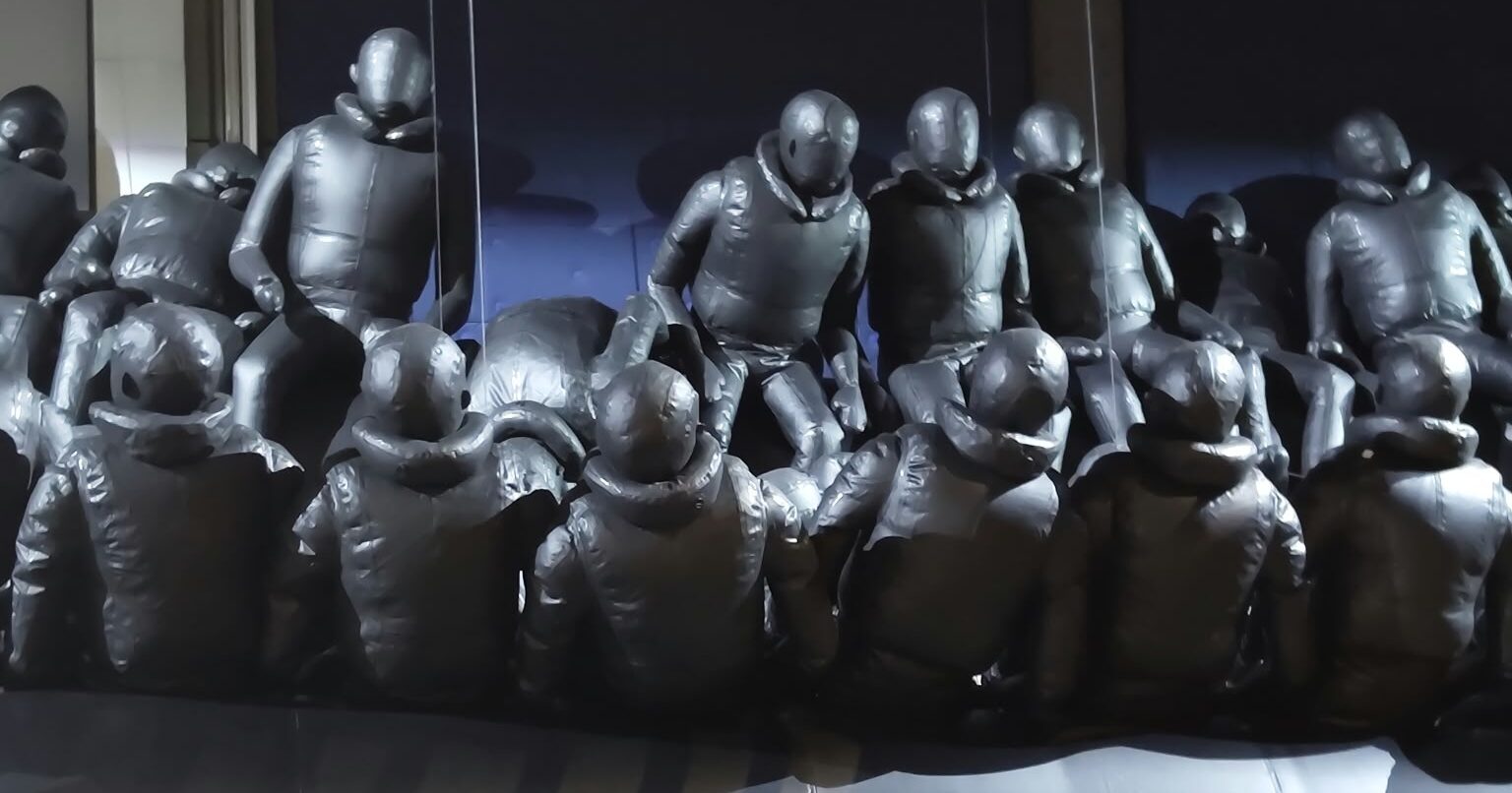
Another work on display was ‘Law of the Journey’. First unveiled in 2017, it is a massive, 50-metre long black PVC inflatable boat, filled to the brim with anonymous refugee figures, with some depicted drowning nearby.
The work appeared in the same year as Ai’s documentary on refugees. Ai has rightly said that there is no refugee crisis, only a human crisis. The people on the boat are dark, anonymous figures stripped of their humanity, a mass rather than real people, each with their own story of hardship and escape from war.
Like ‘History of Bombs’, ‘Law of the Journey’ hits differently in Britain in 2026, with the populist right attacking hotels housing refugees, and using migrants as scapegoats for all of Britain’s social problems. Ignorance of refugees’ hardships has turned into outright hatred, fuelled by state propaganda, further stripping people, who have survived some of the worst hardships imaginable, of their humanity.
As a result, the message Ai is trying to convey does not land as strongly as it might. Beyond humanising refugees and preventing the wars that put people in these situations, we also need to confront the role of British capitalism and a corrupt media in turning the public against refugees.
‘Porcelain Pillar with Refugee Motif’ (2017) is another work depicting the refugee experience. Painted in the style of traditional blue-and-white Chinese porcelain, it shows different stages of the refugee journey, including war, crossing the sea, refugee camps and demonstrations.
Imperialism
‘Eight-Nation Alliance Flags’ (2026) was a completely new work, created for Manchester. The installation consists of eight large flags representing the nations of the Eight-Nation Alliance: Britain, France, Germany, Japan, Russia, Italy, the United States and Austria-Hungary, which invaded northern China in 1900–1901 to crush the Boxer Rebellion and keep its ports open to foreign trade.
In 2019, Ai bought 30 tonnes of buttons from a closing British button factory. He hired a team of 33 artisans to stitch them into the flags. The work is deeply ironic: British trade was once forced on China, but now the leftovers of British manufacturing return to Manchester as Chinese handiwork, a reversal Ai underlined by saying the flags could only have been made in China. The flags are not just a memory of the British Empire but a picture of the changing development of geopolitical forces.
‘Circle of Animals/Zodiac Heads’ (2010) recreates the twelve bronze heads of a famous water-clock fountain at the Old Summer Palace in Beijing, which were seized by British and French troops during the Second Opium War in 1860. Seven have since been found; five are still missing, so Ai reimagined those from scratch.
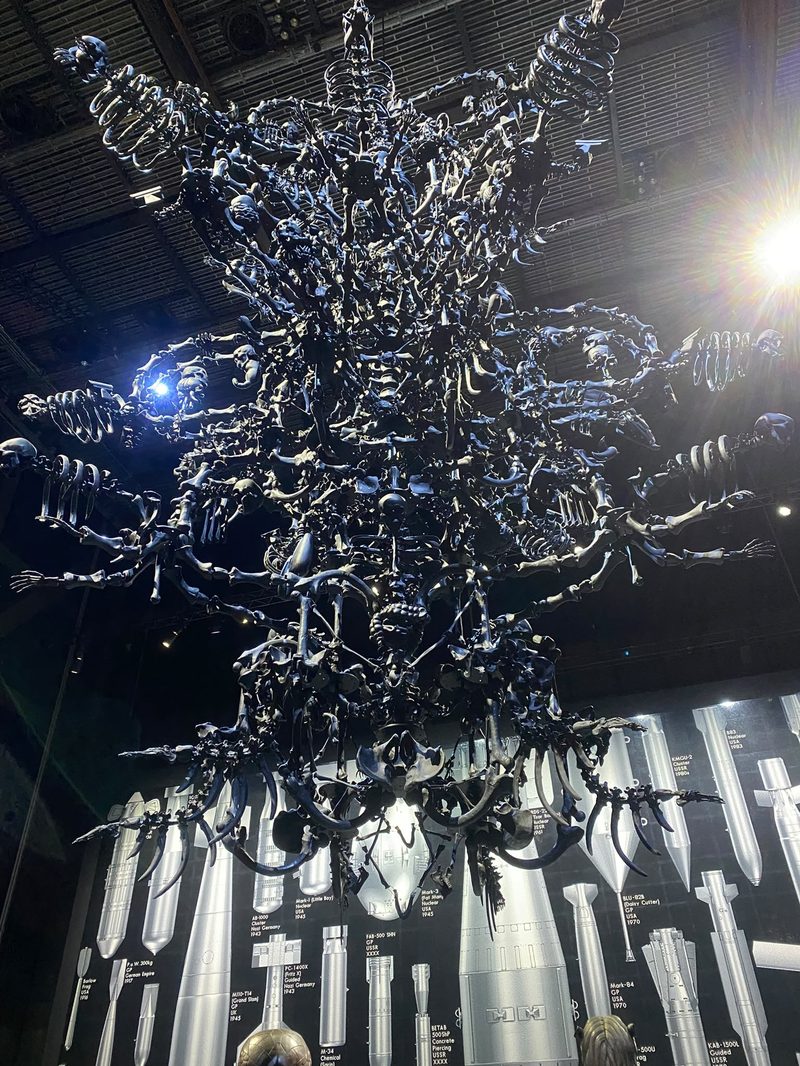
The recovered heads are treated as national treasures by the Chinese government, and the work is a reminder of Britain’s looting of the countries it occupied. But are the heads treasures because they were recovered, or do they genuinely carry that value? In the middle of the zodiac heads hangs a vast black chandelier made from the skeletons of humans, animals and mythical creatures, with surveillance cameras placed across its layers.
‘Button Up!’ is a powerful exhibition, but its power has limits. Ai Weiwei draws the lines between Manchester’s cotton mills, the looting of Beijing, the bombs and the refugee boats, yet he never quite names the system connecting them. The bones, flags and boats speak of suffering in universal terms, a humanist, liberal language that invites sympathy rather than accountability and solidarity.
Some will say it isn’t the artist’s job to spell it out, and perhaps it isn’t. But it is worth asking why. For decades, Ai’s fame in the West rested on his criticism of Chinese censorship and surveillance, a message Western audiences were happy to applaud because it pointed elsewhere.
That comfort is now harder to sustain. After a London gallery postponed his show in 2023 over a post about Gaza, Ai began arguing that Western censorship is no better than China’s, and in January this year he said the West is in no position to lecture Beijing on human rights.
‘Button Up!’ sits in a very strange place between these two different Ai Weiwei personas: the dissident the West embraced, and the critic now turning his gaze on the West itself. The second perspective is much harder to portray, while remaining an ‘international treasure’ for Western propaganda to feast on, without watering down the messages.