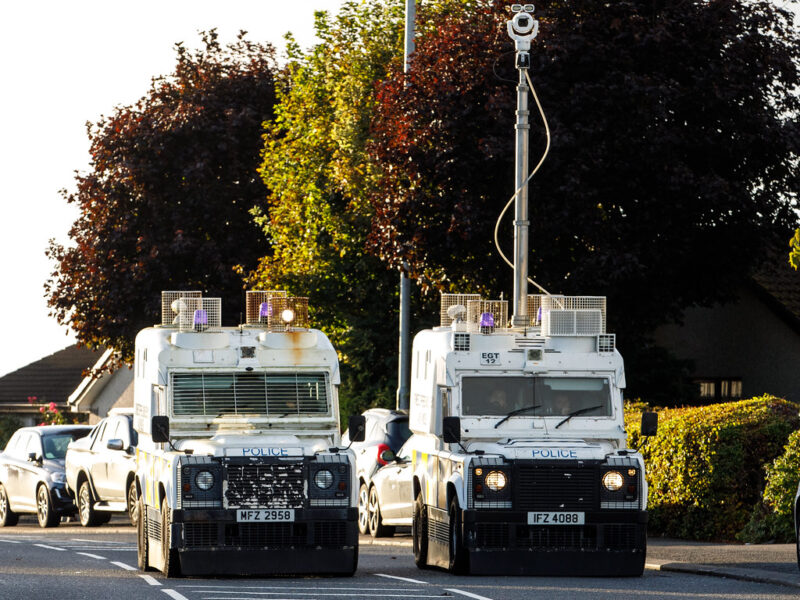
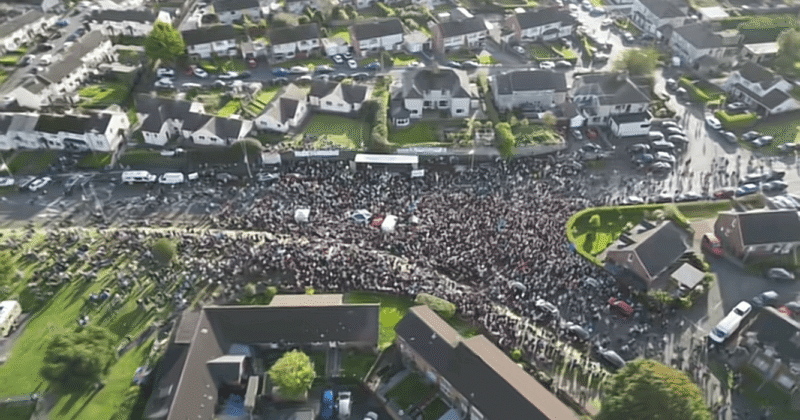
The residents of the Garvaghy Road area in Portadown scored a famous victory in stopping the sectarian Orange Order march through their area from Drumcree Church. In this they drew on widespread support from across Ireland and the palpable feeling of incredulity at the Parades Commission’s decision to permit it. The British Secretary of State Chris Bryant, on realizing the Pandora’s box opened by his initial acceptance, backtracked when it was patently obvious that the Police Service of Northern Ireland (PSNI) could not and did not want to force through a march which would have resulted in widespread disorder and an ensuing political crisis.
The level of absurdity was raised with the PSNI now investigating so-called law breaking from Sinn Fein and People before Profit leaders for helping to block a legal march which the PSNI at first approved only to change their minds! No doubt the desperate cries from the Orange Order (OO) and other Unionists for some form of consolation inform the PSNI’s attempt at a balancing act. Clearly it was the overwhelming solidarity of the Garvaghy community that stopped the march, not a few Stormont MLAs.
But the crisis has not gone away. Certainly, to have persisted in the march would have put Sinn Fein and their First Minister Michelle O’Neill in an impossible position. She had already condemned the march and said it, ‘brings into question how this whole peace process works’. Sinn Fein, even in its modern constitutional nationalist guise, had no option but to mobilise their supporters on the streets in support of Garvaghy. The Good Friday Agreement (GFA) was in peril as many nationalists wondered, was it worth it?
The British government eventually came round to banning the march and defused the crisis but how would a fragmented Unionism deal with it? Even before Drumcree, Unionism was going through a credibility crisis. Its largest party, the Democratic Unionist Party (DUP), was still reeling after their ex leader Jeffrey Donaldson’s child abuse convictions. As always, when elections appear on the horizon, the ‘Orange Card’ will be played and the Parades Commission’s bungling saw them, alongside the more hardline Jim Allister from the Traditional Unionist Voice (TUV) and loyalist crank Jamie Bryson, swing behind the OO’s march.
The TUV, who have always been anti-GFA, are now demanding the DUP’s Deputy First Minister Little-Pengelly withdraw from the Executive. They want to collapse the GFA institutions and return to Direct Rule by Westminster and sense their time has come as they whittle away DUP votes. The DUP possibly face internal opposition from Carla Lockhart, who has been publicly courted by the TUV. No doubt the TUV can play the ‘Orange Card’ more convincingly than the DUP!
Armed with their new Parades Commission legitimacy, Bryson and the OO will continue to press for marches in other nationalist areas and insist that the PSNI force through these processions of hate. But Unionism continues to fracture and the hardliners could not pull out more than 200 in a rally in Edgarstown in support of the OO, at the same time as 15,000 rallied around the Garvaghy residents.
Significantly, a petition from over 1,500 people from a Protestant background bravely called on the OO to desist. There is widespread resentment within the Protestant community against the loyalist knuckle draggers. Unionism is no longer a homogeneous bloc but loyalism with its sectarian and racist history is still a physical threat as migrants found to their cost in the summer pogroms. That is why there is a burning need for well organised defence by communities in vulnerable areas.
So the crisis rumbles on and a precariously placed power sharing Executive continues to administer the six counties on behalf of Westminster. The farce which is Stormont has already broken down or been suspended six times since 1998. Right now neither Sinn Fein nor the DUP can agree to the budget funding from Westminster which will amount to huge cuts in public services. This hasn’t stopped them from implementing such measures in the past but is another factor in destabilising the northern state.
The Orange State?
The northern state or ‘Northern Ireland’ has oft times been referred to by Irish nationalists as the Orange state. The term refers to the Orange Order which was a powerful organisation dedicated to upholding the Protestant faith and the Union with Britain. They wielded immense political power in the government of ‘Northern Ireland’ with most ministers including prime ministers as members of the Order. The first prime minister James Craig famously called the Orange state ‘a Protestant state for a Protestant people’!
The Orange state was built on Protestant ascendancy where Catholics suffered from systematic social oppression. When Britain created the state there was a significant minority of Catholics around 33%, they are now just over 42%, the largest religious group. They were the ‘enemy within’ and the object of wide ranging discrimination in housing, education, employment as well as a draconian Special Powers Act, the envy of Apartheid South Africa.
The holding of Orange Order marches was a vital test of Orange supremacy. There are thousands of these marches every year and the marches through Catholic/nationalist areas, which were deliberately provocative and supremacist, would be resented and resisted. The horrific spectacle of police forcing through an Orange march down Garvaghy Road, a Catholic area, year after year resulting in huge attacks on those nationalist areas, was a damning indictment of the Orange state.
After 30 years of mass resistance, which included armed struggle against the state’s forces, the formation of the Parades Commission and the Good Friday Agreement in 1998 was designed to sort out contentious parades and a power sharing agreement to usher in peace. Indeed, some supporters of the GFA might argue that the Orange state has disappeared, if not been smashed.
Of course, no state has been smashed and the same forces of the state that were in combat against the nationalist resistance are still in control. But the form of state rule has changed. Unlike pre-1998 the main Unionist parties have been dragged screaming to power sharing. There has been relative peace for 28 years, not just along the Garvaghy Road. The more obnoxious forms of state discrimination have been banished in public employment and housing as legal reforms and equality laws have been enacted.
However, this has not been a result of the Good Friday Agreement; it was the mass resistance of the nationalist community over 30 years that forced Britain to compromise. The GFA formalised this balancing act between the nationalists and Unionists and it heralded an imperialist backed peace that saw the disarmament of the IRA in return for a political collaboration in running the province. Even though the Union was safe, many Unionists like the DUP held out against the GFA for some time, a testament to their undying supremacist bigotry.
GFA: Hanging by a thread
In June 1998, after the Good Friday Agreement had been affirmed by referendums North and South of the Irish border, an article in Workers Power issue 223 presciently stated:
“The peace deal is a reactionary attempt to demobilise the 30 year long mass struggle by the anti unionist population in the only way possible: by engineering a sell out on Republicanism’s strategic aim—a united Ireland—in return for Unionist concessions”.
Workers Power and the Irish Workers Group urged a No vote, not out of any sympathy with Paisleyite Unionism’s pathetic attempts to preserve its privileges but because we believed, and still believe, that this deal solves nothing.
The border drawn in 1921 will stay in place, dividing the Irish working class and ensuring the survival of sectarianism. The Northern Ireland state will now be run by a power sharing executive where the ‘power’ to be shared can only be generated by religious based sectarian head counting.
The Agreement ensures that working class politics will remain subsumed in the confessional definitions—Nationalist, Unionist or ‘other’—built into the power sharing arrangements. Despite the fact that the Irish population went to the polls, North and South of the border, for the first time in 80 years, self-determination and democracy were not on the ballot paper.
This characterisation has been entirely vindicated 28 years later. The GFA has not challenged sectarianism, it has institutionalised a sectarian distribution of power and privilege. The resulting power sharing Executive rested on an elected and devolved Assembly at Stormont, based on a sectarian headcount and a sectarian hand out of resources that benefited the leading political and middle class elements in both communities.
In line with its anti-working class nature the GFA allows for the implementation of British government austerity measures in preference to Direct Rule. The uneasy lash up between reactionary DUP bigots and Sinn Fein in government guarantees a regime that stumbles from one crisis to another, unable to protect or improve the conditions of the working class.
Crucially the GFA acknowledged the northern state’s right to exist so long as the majority of the population in the six counties desire, so the Unionists had a built-in veto over a united Ireland. But Sinn Fein have sold the deal on a clause that might see a border poll if the British government believes a majority of the north’s people would vote for a united Ireland. There can be no reliance on this hope and every British government since the GFA has proven this and ruled against it.
Further, to believe that Britain would somehow agree to a simple majority vote of 50% plus one is pure fantasy. They would most probably go for a higher percentage threshold like 60%. To think that an Irish government of the current variety, i.e. one that is beholden to US multinationals, the EU and British imperialism, would embrace a united Ireland is even more fanciful!
The democratic deficit at the heart of the northern state is the denial of the right of the Irish people as a whole to determine the future of the north. This is the root of the unsolved national question and all the institutions of the GFA including Stormont and the Executive are attempts to sell a ‘devolved’ solution which denies that right. They are all ploys to prolong British occupation which has never had any progressive role to play in Ireland. That’s why Stormont, the Parades Commission, etc. should be abolished alongside all the other institutions of British rule in the north. Britain should withdraw unconditionally and immediately.
A united Ireland
In his response to the events at Drumcree, Owen Reidy, General Secretary of the Irish Congress of Trade Unions (ICTU) called “for hard won peace formalised in the Good Friday Agreement to be protected” and railed against those who would undermine it “as unwelcome echoes of the past”. Of course, all trade unionists should be against sectarian violence, but promoting faith in the GFA will never guarantee that outcome.
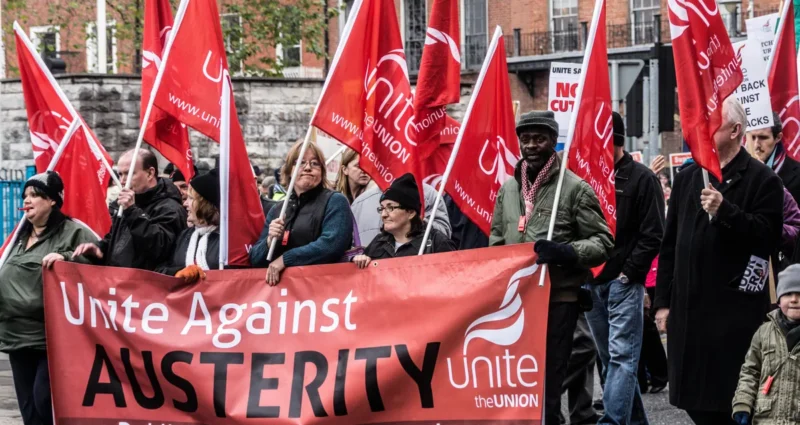
The GFA copper-fastens the sectarian state that presides over the north. The trade union leaders choose not to see this just as they chose to ignore discrimination let alone the repression of the nationalist community previously. It is also the reason why the GFA ‘peace’ is the excuse to never lead a decisive struggle in the fight against Westminster austerity. Now that would be the ideal way to unite Catholic and Protestant workers if they showed they were really serious about striking out against British government underfunding and cuts.
As the Garvaghy residents showed, there will be no progress or real gains for working class people until they are seen to be struggling on the streets and mobilising in the communities and workplaces. There can be no reliance on the Parades Commission or the GFA; they are the arms of the northern state and, like the PSNI and British troops they depend on, cannot resolve the concerns of residents, let alone the national question.
If the aim of a united Ireland is to be realised then the Irish working class has to be the main agency of change. For that to happen, the working class will need to be mobilised around a wide range of social, economic and political struggles. They must fight for an all-Ireland health service, an education system free of Church influence, a unified strategy to combat climate change, and to unify Catholic and Protestant workers against Westminster austerity.
Arising out of those battles will be new democratic organisations of struggle from the residents’ groups that are forced to mount defence of their areas through to the strike committees that will be needed to prosecute a struggle in defence of workers’ standard of living. It will ultimately involve the organisation of councils of action which can coordinate the struggles from the community to the workplace, elected and accountable to the working class. Only workers’ democracy can form the basis of Connolly’s vision of a workers’ republic.
A border poll cannot substitute for working class mobilisation and at best would summon a bourgeois constitutional arrangement. A 32-county constituent assembly might be a democratic demand useful in addressing the national question but if this is not based on working class organisations of struggle then it becomes another bourgeois capitalist institution. Similarly, the demand for a left government in Ireland, stripped of its organic connections to the working class and equivocation on rooting out capitalism, can only mean a reformist constitutional solution.
A genuine workers’ government would be based on democratic organs of working class control and dedicated to the overthrow of capitalism in Ireland. It is essential that a political organisation that promotes such a revolutionary answer to the crisis of capitalism be built in the struggles ahead—a revolutionary party charged with the task of formulating an action programme for workers’ power in Ireland.