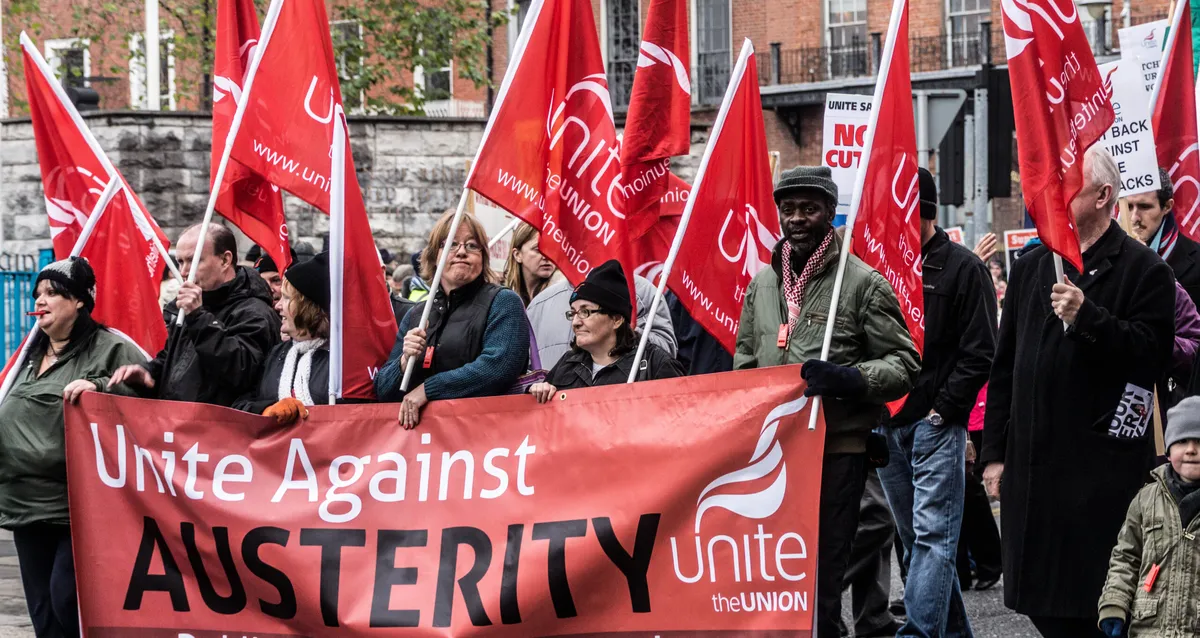
Over 300,000 public sector workers in the Republic of Ireland took 24-hour strike action on 14 October; at the time another strike was set for 21st. The strike has received overwhelming support across the country, with at least 2,000 picket lines and tens of thousands of pickets patrolling the streets and clustering around nearly every state run building.
Strike committees have also directed roaming pickets to monitor council transit points and vehicle depots to stop the movement of trucks. Picket shift rosters have ensured a fantastic turnout throughout the day. The National Bus and Rail Union instructed its members not to cross picket lines in an amazing show of solidarity. This was a massive shut down!
The three teachers’ unions, INTO, ASTI and TUI, alongside the main public sector unions SIPTU and FORSA escalated their action after winning overwhelming majorities in their ballots for work to rule and strikes, some with over 90% in favour.
This is the first time in 40 years that the government has allowed a pay deal to expire without a new agreement. It is also the first time since 2009 that public sector workers have organised cross-union action on this scale.
The action is against the failure of the Irish government to address their claims for fair pay and cost of living protections. The right-wing Fianna Fail/Fine Gael coalition has nonchalantly ignored their demands even for serious negotiations. The recent budget though has fully confirmed the government’s intention of facing down the unions by allocating a paltry sum of €1.2 billion for public pay and pensions in 2027.
This would not cover a double-digit pay rise at a time when a severe crisis in the cost of living continues to fuel rising anger throughout the country. The money is there, with the coalition government presiding over a budget surplus of €6.7 billion for 2026 and another €9.5 billion for 2027, the usual annual windfall they receive in corporation tax receipts.
Last year’s fuel protests and road blockades seem to have been the wake-up call for union leaders to launch their own campaign. Prior to the strikes, around 100,000 public sector workers, including teachers, civil servants, health staff and local authority employees, were engaged in ongoing and widespread work to rule action throughout Ireland.
Teachers are refusing to provide pre- and post-school supervision, or to attend after-school meetings. Similarly civil servants, local government officers and health workers are adhering to contracted hours and withdrawing goodwill.
Time to fight
So at last the trade union leaders have acted – but they do have a track record of inaction and viewing the government as ‘partners’ signing off deals that have allowed a dramatic decline in the living standards of the working class.
FORSA seemed to break this chain last year when they called the school secretaries and caretakers out on an all-out strike. But after only seven days the leaders announced a return to work for the offer of negotiations. These talks went on for a year. Surely an all-out strike has to be used as leverage in talks; it should be designed to apply maximum pressure to force the bosses’ hand!
Union leaders have just tried this tactic again and the 21 October strike was called off just two days after the magnificent display of solidarity and militancy, thus breaking the fantastic momentum generated by the first strike. Their excuse again was they have been offered for negotiations (in reality, a discussion about future negotiations, i.e. ‘talks about talks’). We have to say clearly – talks should not replace action; we strike to win!
But of course union leaders have not even formulated a percentage pay claim as yet. It is the elementary job of the trade union leadership to formulate a pay demand based on their measurement of how far workers’ pay has slipped behind and dialing in all the factors contributing to the cost of living crisis.
FORSA’s General Secretary and chief union negotiator, Kevin Callinan, referring to his union members, said, ‘We’re going to insist that their living standards are protected if there is going to be a multi-annual deal’. He is well aware that, if that is to happen, they must be given a percentage pay increase for this year, as well as the shortfall between wages and inflation for the years 2021 to 2025.
He rightly insists that if there is to be a multi-year increase then there should be a mechanism which would protect wages against price movement over the duration of that deal. So let us name a percentage, say between 10 and 20%, and fight for a sliding scale of wages – and let’s escalate the action from one-day to indefinite all-out strikes.
Get The Spark in your inbox
Workers Power’s weekly newsletter
Rank and file
Strike committees have ensured a massive and solid 24-hour strike and should continue to be set up in every workplace to rally members and stop any sell-out. They should organise mass workplace meetings or branch meetings, whichever is appropriate, to discuss the aims of the industrial action and pass motions condemning the calling off of the strikes. They should draw up demands and a plan of action that gives union members control of the action and makes the union leadership accountable to them.
The level of membership engagement is high, but the bureaucracy will naturally want to scale that back now they’ve made their point to the coalition government, so they can cut a deal behind their backs. Mass meetings that discuss the aims of the strike, how to prosecute the work to rule, how and when the action should be escalated, and how to actively involve the wider working class in the action can all cement an active membership that is harder for the bureaucrats to roll over. Demands arising from such meetings should be publicised and sent to union HQs.
If these proposals are implemented, it will facilitate a democratic outcome and not a bureaucratic behind the scenes deal that sells out the members. It is also an ideal opportunity for the left within the unions to build caucuses that promote union democracy as well as argue for a fighting strategy that can win.
Rank and file, or grassroots caucuses should coordinate such a campaign that places maximum pressure on the leaders. A rank and file movement within and across the unions should be the perspective, a movement that can build a new fighting leadership within the unions.
On the eve of the first strike, public service minister Jack Chambers cynically wrote to trade union leaders stating that ‘pay issues can and should be discussed as a priority alongside other matters as part of the pay talks’. All this within the limits of €1.2 billion, of course! And ‘other matters’ is no doubt shorthand for ramming through reforms, efficiencies and productivity deals to pay for any increase. Trade union leaders should reject this.
Trade union leaders should be bombarded with resolutions from members’ meetings calling on the resumption of strike action even whilst talks are ongoing. They should articulate a definite pay claim on its own merits, reflecting how far workers’ pay has fallen behind inflation. This should be accompanied by rapidly escalating action up to and including indefinite strikes. All out for victory!