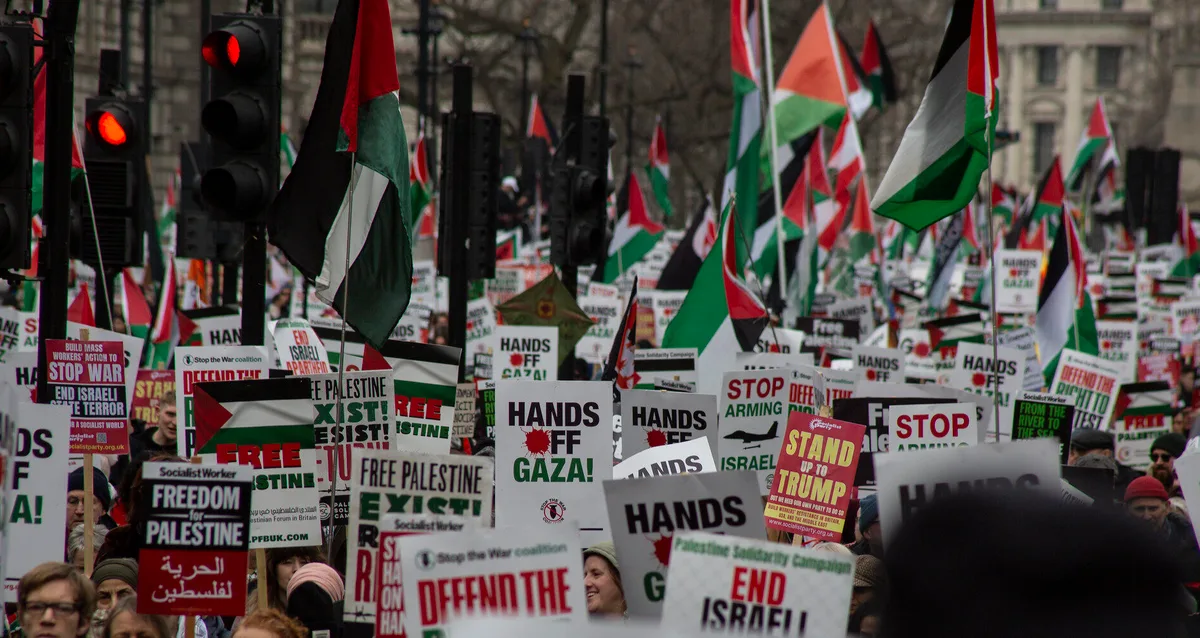
The latest national march for Palestine in London, on Saturday 10 October, drew a quarter of a million people onto the streets, according to organisers. It was certainly huge, stretching at one point from the Embankment, across Westminster Bridge and down to Waterloo, before looping back.
It was one of the biggest demonstrations since the so-called ceasefire announced, but never delivered, a year ago. The news seeping out of Gaza, where the Israeli military still controls most of the territory and Palestinians remain crowded into a shrinking area under constant threat of attack, together with the intensifying assault on the West Bank, has renewed the sense of urgency among the left and Muslim communities.
There was also a small Iranian contingent and a scattering of Lebanese flags along the demonstration, reflecting the wider context of Israel and the USA’s war to reshape the Middle East.
The importance of the turnout was also that it was a slap in the face of the establishment and its loyal media, which had spent the previous week denouncing anti-Zionism as racist or even ‘imperialist’.
One of the most popular chants on the march was ‘Zionism is racism!’ This was in support of the motion passed at the previous week’s Green Party conference, calling for a single democratic state in Palestine with equal rights for all and the right of return for Palestinian refugees.
The motion had provoked furious denunciations from politicians, the press and even the Green Party’s own MPs. As we argued last week, the controversy goes to the heart of Britain’s support for the Israeli state. But there was little sign that this backlash had intimidated the movement. Hundreds of thousands were still prepared to take to the streets.
State repression
The other significant feature of the march was the continuing campaign to criminalise Palestine solidarity.
This had been foreshadowed on Wednesday 7 October, when police arrested 11 people during demonstrations in London, including several student protesters. Five were arrested outside the Board of Deputies of British Jews on suspicion of inciting racial hatred, reportedly for chanting ‘intifada’. Police had already imposed restrictions on the student demonstrations, including prescribed routes and a ban on face coverings.
On Saturday, police also attacked the Revolutionary Communist Party contingent, arresting 11 protesters. The RCP reports that at least one suffered broken ribs during the confrontation. All 11 have since been released on bail without charge.
In total, the Metropolitan Police made 20 arrests during the demonstration, including two people arrested for displaying placards in support of the banned Palestine Action.
This stepping up of the campaign to criminalise protest is no accident. It comes at a time when juries have continued to acquit Palestine protesters, the latest significant victory being the unanimous acquittal on 18 September of Sarah Cotte of the Revolutionary Communist Group, one of the SOAS 2.
Meanwhile, the scale of the government’s use of anti-terrorism legislation against protesters is staggering. According to Home Office figures published on 8 October, there were 3,867 arrests for terrorism-related activity in Britain in the year to June 2026, a massive 1,553% increase on the previous year. Of these, 3,630, or 94%, were linked to expressions of support for Palestine Action.
The overwhelming majority of these protesters were arrested for holding placards proclaiming ‘I oppose genocide; I support Palestine Action’. Only a minority have so far been charged. The sheer number of cases shows the extraordinary lengths to which the state has gone to intimidate opponents of British complicity in Israel’s war.
Andy Burnham’s Labour government has signalled that it would like to retreat from some of the harshest and frankly ridiculous law-and-order positions of its predecessor, Keir Starmer. The principal proposal to curtail the right to trial by jury has been dropped, while sanctions against Israeli settlers and their financiers have been introduced.
But Palestine Action remains proscribed, and those arrested for supporting it still face prosecution. Nor has Burnham broken with British imperialist policy in the Middle East. His government has sent an RAF refuelling aircraft to support Saudi military operations in Yemen, while remaining committed to Britain’s military alliances and strategic interests in the region.
So long as Labour continues to defend those interests, its limited concessions will not remove the underlying conflict with the anti-war movement. The government’s willingness to use anti-terror laws against peaceful protesters shows how readily the machinery of repression can be turned against political opposition.
Get The Spark in your inbox
Workers Power’s weekly newsletter
Step up the action
The size of the London demonstration shows that the Palestine movement remains a mass force despite three years of war, repeated attempts to discredit it and the arrest of thousands of its supporters. But marching alone has not stopped Britain’s military and diplomatic support for Israel, let alone brought an end to the occupation and dispossession of the Palestinian people.
The answer cannot be to scale down the movement’s demands or retreat in the face of repression. We need to widen the struggle and step up the action.
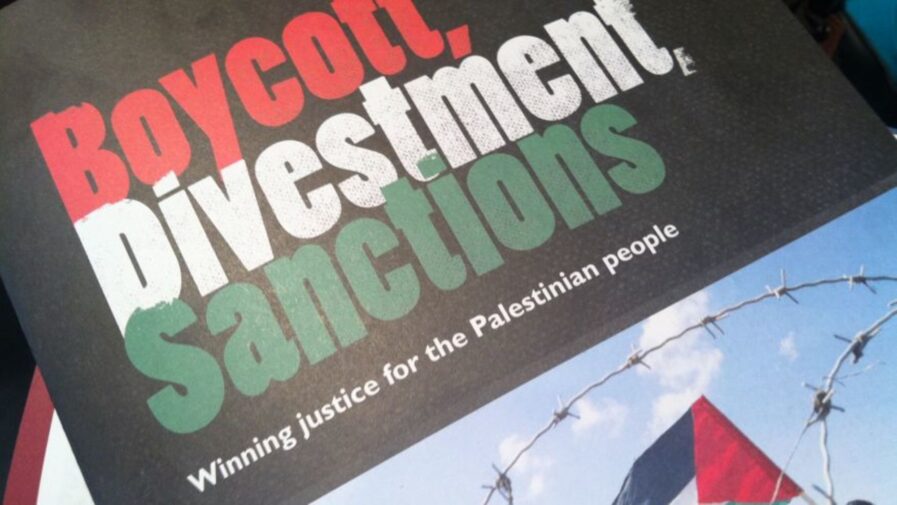
The mass demonstrations must continue, alongside campaigns for boycotts, divestment and sanctions. But the trade unions must also be brought into the fight, turning resolutions of solidarity into workplace meetings, demonstrations and industrial action against the production and transport of arms destined for Israel.
There are important opportunities ahead. The international youth strike against war and militarism on 20 November can bring a new generation of school students, university students and young workers into action. It should be used to build lasting organisation in schools, colleges and workplaces, linking the struggle for Palestine to opposition to rearmament, austerity and imperialist war.
At the same time, the movement must defend all those arrested or prosecuted for exercising their right to protest. In Liverpool, during Labour’s conference in September, 82 Defend Our Juries protesters were arrested and another 79 reported for summons. In France, thousands of young people have faced arrest and police violence during the recent school protests.
These struggles should not be treated as isolated cases. Police repression, anti-protest legislation and the criminalisation of political activity are being used against workers and young people in country after country.
We need a united, working-class-led campaign against the criminalisation of protest, involving the trade unions, student organisations, the Palestine solidarity movement and all those defending democratic rights. It must demand the dropping of charges against peaceful protesters, the lifting of the ban on Palestine Action and an end to the use of anti-terror legislation to suppress political opposition.
The International Socialist League has helped launch an international campaign against the criminalisation of protest, bringing together unions, social movements and activists facing repression across the world. We encourage our readers to support it and help link the struggles taking place in Britain with those internationally.
The hundreds of thousands who marched through London have shown that neither the political backlash nor the threat of arrest has silenced the movement. The task now is to build on that determination, extend the struggle into the workplaces and schools, and organise a united defence of everyone facing repression for standing with Palestine.