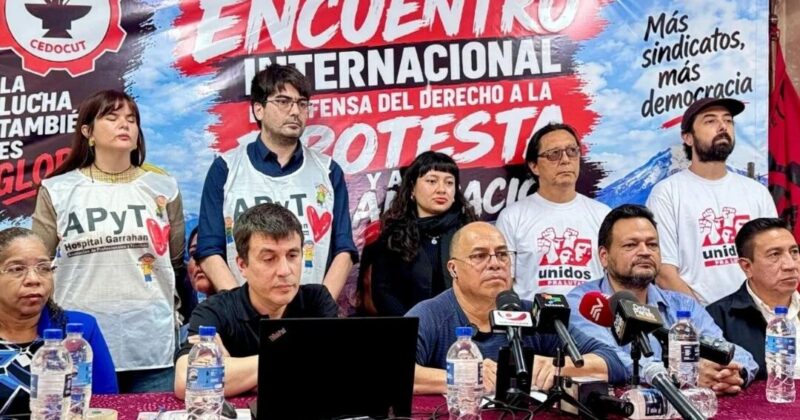
On 23–24 October, trade unionists, Indigenous and peasant organisations, human rights campaigners and socialists met in Quito, Ecuador, to establish an international network against the criminalisation of protest. They agreed to organise a global day of action on 10 December, International Human Rights Day.
The meeting was hosted by CEDOCUT, an independent Ecuadorian trade union confederation, and organised with the International Socialist League (ISL), of which Workers Power is a member, and Ecuador’s Workers’ Revolutionary Movement (MRT).
A union under attack
President Daniel Noboa’s government has refused to register CEDOCUT’s democratically elected leadership and those of some affiliated organisations. Without official recognition, unions struggle to conduct their ordinary business or defend members. CEDOCUT president Edwin Bedoya and Indigenous leader Guido Perugachi have also faced persecution.
Delegates described similar attacks elsewhere. In Argentina, Javier Milei’s government has targeted workers and representatives of Buenos Aires’ Garrahan children’s hospital, including union leader Norma Lezana. In Panama, teachers have been dismissed and construction and electrical workers pursued for protesting. In Venezuela, SITRAEMAS union leader Jean Mendoza faces prosecution under the government’s ‘Law Against Hatred’.
Delegates also raised cases from the United States and Pakistani-administered Kashmir.
The methods are familiar: dismiss organisers, deny unions recognition, prosecute protesters and use police and courts to intimidate opposition. Nor is repression confined to right-wing governments. The Quito declaration condemns attacks by governments claiming to be progressive or anti-imperialist too.
From declarations to action
Delegates launched the International Network Against the Criminalisation of Social Protest and Workers’ and Popular Organisations. It is open to trade unions, social movements, human rights organisations, youth and women’s groups, political organisations and individual activists.
Initial supporters include hospital workers in Argentina, teachers in Panama, trade unionists in Brazil and human rights groups in Ecuador. The network aims to bring together organisations with different political perspectives around the common defence of democratic rights.
A working group of lawyers will compile an international record of cases for submissions to the Inter-American Commission on Human Rights and the United Nations. The network demands an end to prosecutions and disciplinary persecution, reinstatement of dismissed workers and freedom for political prisoners.
Its first test is the 10 December mobilisation. International appeals alone cannot stop repression, but coordinated protests and trade union solidarity can put pressure on governments and employers.
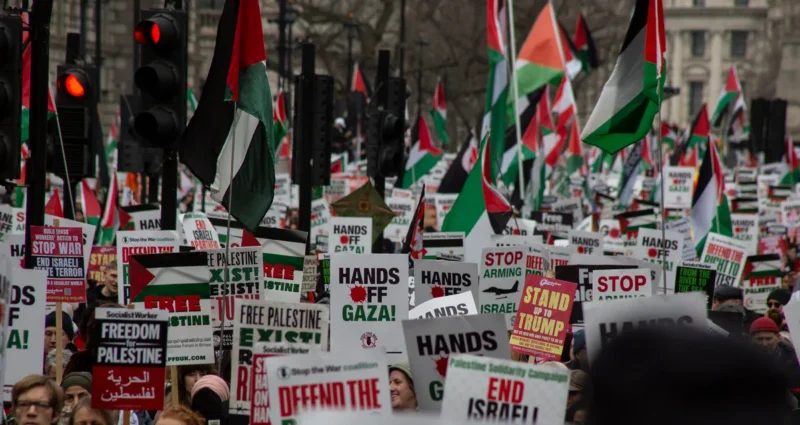
The relevance to Britain is immediate. Since Palestine Action was proscribed under anti-terrorism legislation, thousands have been arrested, many simply for holding placards supporting the organisation. On 31 October, police arrested 325 people at a Defend Our Juries demonstration outside the US embassy in London. Police had warned that even people organising or providing logistical support for the protest could face arrest.
The campaign against the ban is one struggle that could benefit from international coordination. The new network could publicise cases, organise protests at embassies, win union support for victimised workers and campaign for imprisoned activists.
The next step is to win support from unions and campaign groups in Britain and elsewhere, and turn the 10 December call into coordinated action. Its value will be judged by what it can organise, not simply by the declarations it adopts.