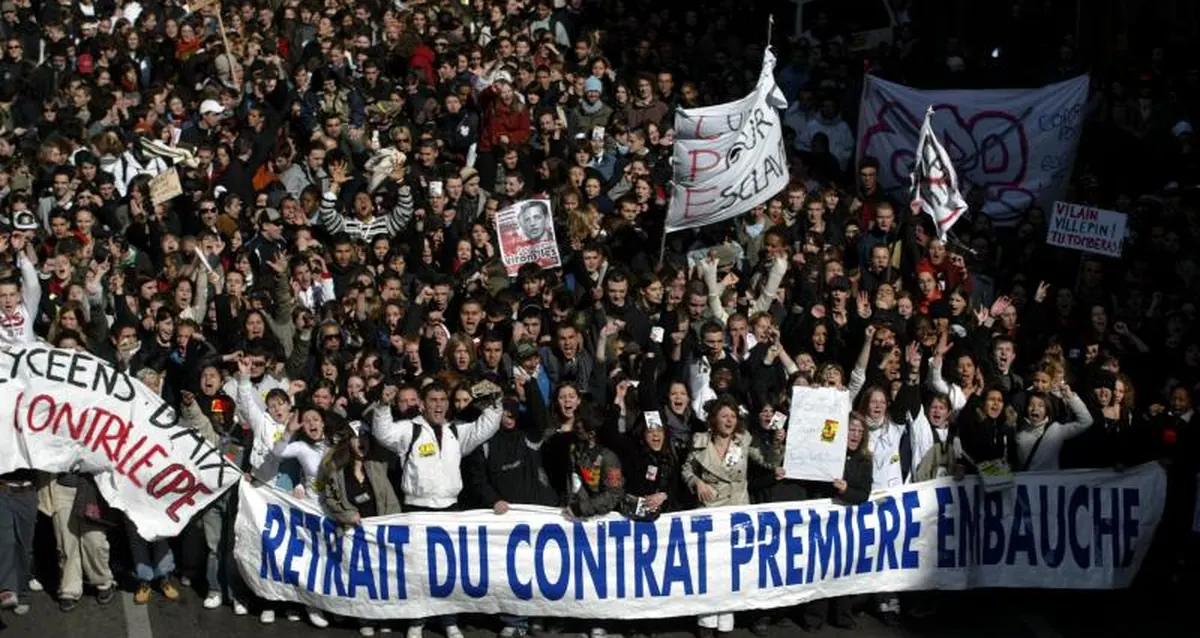
On Saturday 18 March a million and a half people – school and university students, workers and pensioners – demonstrated in France following weeks of mounting student unrest in the schools and universities. Naturally, the largest turnout was in Paris, where 350,000 took to the streets. In Marseille 130,000 marched, in Toulouse 50,000, in Nantes 45,000, in Rennes 35,000, and Lyon 25,000. Across France, there were 150 separate marches. The following week saw large student demonstrations, with many universities and secondary schools on strike, blockaded or occupied.
From the beginning of March, protests, occupations and other forms of direct action have been mounting, with school and university students plus unemployed youth from the banlieues taking action in ever-larger numbers. Railways have been blockaded, public transport and airports disrupted, as workers have taken action in solidarity with the youth. Clashes with the CRS riot police have occurred throughout the country. In Paris, on March 18, Cyril Ferez, a 39-year-old telecom worker and activist in the SUD trade union, was taken to hospital in a coma after being attacked by riot police in Paris.
On Thursday 16 March more than 500,000 youth took part in mass demonstrations across France. In Rennes, the town hall was occupied. In Paris up to 120,000 youth marched. The unions, particularly the CGT, provided a service d’ordre (stewards) for the demonstration and consequently the CRS remained in the side streets. But as the march ended there were clashes with police involving, according to reports, many working class and immigrant youth from the banlieues – commonly referred to as les casseurs. The police used tear gas, rubber bullets and water cannon. In Paris, 150 arrests were made and 300 nationally.
Chômage, précarité, exclusion
The protests centre on the CPE, the Contrat de Première Embauche (First Job Contract), dubbed “Chômage, Précarité, Exclusion” (unemployment, insecurity, exclusion) by the students. Key to the success of the demonstrations was the combativity and determination of the youth, both university students and lycéens/lycéennes.
The government introduced the law in the National Assembly during the period of examinations and holidays, hoping to push it through quickly and without reaction. That is what it did last summer, with the similar Contrat nouvelles embauches (New Job Contract), which slashed employment rights for workers in small companies.
But this time the students reacted promptly, went on strike in all the major universities, such as Rennes and Toulouse, and mobilised the students from the lycées. The youth mobilisations, in turn, are galvanising the trade unions into action. Indeed, the movement’s success in forcing the removal of this reactionary law will depend on whether militants in the unions, as well as the youth, can bring about mass working class strike action.
Workers have every interest in doing so. These measures are the thin end of the neoliberal wedge, aimed at weakening and destroying legal protection for jobs and conditions and, beyond that, bringing down real wage levels. The CPE, like the CNE before it, is no minor attack. They both introduce special job contracts: for the first two years the worker can be sacked without any notice and without any justification. The CNE restricted these contracts to small companies (less than 20 workers) while the CPE applies to young workers below 26, aiming, according to the prime minister, to increase youth access to their first job and so fight the high rates of unemployment among youth – 20 per cent, twice the national average.
Currently, French workers are hired, either indefinitely or on a fixed-term contract. In both cases, the employers’ “right to hire and fire” is restricted: employers have to give reasons and notice of two months. The real goal of the government is exploiting youth – giving employers freedom to pressurise young workers, to deny them basic rights, thus forcing them into precarious and unstable existence.
France, despite the international boom phase of the economic cycle, remains close to economic stagnation, with huge structural unemployment and mounting social inequality. The employers can afford (in terms of their profit rates) no lasting concessions. Quite the opposite, they must press ahead with a neoliberal revolution, if they are to catch up with the USA and Britain. Hence the deepening social crisis in France.
The employers dream of a totally flexible workforce, forced to accept whatever working conditions they offer, expendable without restraint by the bosses. Laurence Parisot, recently elected head of the French bosses’ association MEDEF, scornfully declared in a recent interview: “Précarité, but existence for all of us is précaire”. The youth in the banlieues should offer Parisot a swap: their précarité for his.
Prime minister Dominique de Villepin has declared open war against the Code du Travail (work protection regulations), denouncing it as a “restraint on freedom”. How neatly this remark shows that freedom for the bosses means slavery for the workers. If the CPE is applied, it will soon be extended to all workers and, step by step, the already weak regulations protecting workers will give way to freedom for the bosses to sack workers, lower wages, extend working hours and slash pensions. And the unemployed will continue to rot.
By forcing through CPE, Villepin reveals his real nature. He had been posing as a moderate, who cares about social issues, a man in the tradition of one nation Gaullism. This is just his pitch in his rivalry with Nicolas Sarkozy, minister of interior, an outspoken neoliberal and now openly courting racist National Front voters.
In a recent interview with Paris Match magazine, he indicated that he was worried that the youth of the banlieues might take to the streets again, encouraged by the mass movement of youth and workers. Well, he was right on that score. The deeply oppressed Arab and African descendant youth will of course be targeted by the CPE, and have gone on the rampage for several nights in a row, using the only weapon they have to fight off attacks: the riot.
In November, the youth of the suburban ghettoes, the banlieues, rose up against police racism and brutality, after two young men died trying to escape the police. Sarkozy’s previous provocative declarations to “cleanse the neighbourhood with a water cannon” were certainly meant to provoke the youth. But he got more than he bargained for.
A massive revolt against state racism raged for three weeks in 250 cities and towns across France. It only finally burned out because of its isolation, because the major reformist workers’ parties (Socialist Party and the Communist Party) refused to actively champion the cause of youth. When the government declared a state of emergency, using again a law of the Algerian colonial war, their protests were entirely verbal. A fraction of Socialist Party mayors and MPs even approved the state’s armed repression.
Get The Spark in your inbox
Workers Power’s weekly newsletter
Unions slow to react
After the great success of last year’s 4 October demonstration against the government’s privatisation of public services, unions immediately stopped the mobilisations and did nothing. Their silence, when the youth of the banlieues were on the streets, when the government declared the state of emergency, was deafening.
Even the struggle against the CPE saw the major union federations dragging their heels and looking for compromise. When the movement started, far from calling for its withdrawal, the unions were simply demanding serious negotiations to modify it. Their strategy has always been to limit workers’ protests to isolated one-day strikes, with long intervals between them.
The truth is that they fear the workers’ self-organisation and combativity and that of the “unorganised” youth like the plague. They fear it more than the government attacks. Indeed, they would prefer to negotiate with the government without pressure on them from the street. The problem they face is that, without this mass action, the government would not negotiate.
Trade union membership in France has dropped to 10 per cent of the workforce. Yet, when they call workers to action, the results are the most militant mass mobilisations in Europe. This is both the strength and the weakness of the French working class. By their swift actions, they can really scare the bosses and their government. But they have no means of controlling their leaders, and so get repeatedly poor results for all their militancy.
Implicitly, the union leaders are trying to restrain the mass mobilisations and thus, they hope, prepare a “left” victory in 2007 elections, a coalition of PS, PCF and other forces. The problem for them is that, whenever they demobilise a mass workers’ movement, the government, far from showing its gratitude and throwing them a few concessions, resumes its attacks. Workers’ and youth indignation mounts and the union leaders eventually have to take to the streets again. This time, the youth, as on several occasions in the past, have led the way.
As a result of the huge combined turnout of workers and youth on 18 March, the union federations, meeting with the organisations of the students and the lycéens, have decided to call “a day of action with work stoppages, strikes and demonstrations.” They also promised not to negotiate unless the government agreed to first suspend the CPE.
Yet within days they agreed to meet Villepin on Friday 24 March. Only Villepin’s intransigence forced them to come out, empty-handed. But workers and youth will have to watch these time-servers like hawks over the coming weeks.
The CGT, Force Ouvrière and SUD – the more militant unions – are certainly willing to use limited one-day mass mobilisation and strikes to weaken and even topple Villepin, albeit strictly within the perspective of winning a future election. But it is a dangerous game playing with on-and-off mass mobilisations, hoping to discredit the right and achieve a “left” victory at the ballot box.
To repeatedly pull your punches in a serious fight with the bosses and the state, to frighten them but not overthrow them, combined with demobilising the working class could in fact lead to a major defeat. Then you could well get Sarkozy in 2007, armed with a mandate and the social forces to really do a Thatcher.
Alternatively, if the workers join the students and the youth in action, they could force the government to withdraw the contracts. That would open up another round of struggle, once the bosses had recovered from their humiliation. But it would be round two, with the workers and youth having gained valuable experience – and a much needed sweet taste of victory after several years of unnecessary defeats.
A revolutionary answer to the crisis
The immediate task is to continue and strengthen the school and university occupations – school students have taken over 400 lycées already. These can feed into the twice weekly mass mobilisations.
The students must urge the workers to participate and to defend them against police provocations and brutalities. Today the government is weakened and discredited. According to the latest opinion polls, 68 per cent favour dumping the CPE. Workers must join the struggle to force the government to surrender.
Following the example of the students, workers in both the private and public sectors should go on strike, occupying their workplaces, raising their own demands. In order to spread the movement effectively, they will have to organise and democratically elect their own co-ordinations of struggle. To rely on the trade union bureaucracy would be fatal. The slogan should be with the union leaders whenever possible, without and against them if necessary.
As we go to press, a huge turnout is expected on 28 March. Despite the threats to call a general strike by Bernard Thibault, leader of the CGT, and similar calls from Force Ouvrière, the unions for that date only called for an “interprofessional day of action” of public sector workers and limited groups from the private sector.
General strike
Revolutionaries, activists from the lycées and colleges, rank and file militants in the unions must do all in their power to make it a general strike. They must launch massive agitation that day for an indefinite general strike and the formation of coordinations or councils of action to direct it. Given the readiness of the CRS to crack the skulls of union militants and students alike, activists should form a mass service d’ordre, sufficiently equipped to repulse the attacks of the state forces.
At the same time the objects of struggle must be broadened to include the whole series of government policies, privatisations, plans to cut back public services, “reforms” of education and the pensions system. They must all be thrown out. Indeed, so must de Villepin, Sarkozy and Chirac, the whole gang of them.
A major social upheaval has been simmering in France, since the right came to power in 2002. In fact the country saw a series of huge demonstrations against the Front National when Jean Marie Le Pen made it to the second round of the presidential elections, that year. Chirac only won, because of the terrible discredit of the Socialist party, and because the left (mistakenly) called for a vote for him to “stop Le Pen”.
In 2003, a wave of mass protests on pensions erupted but the union leaders allowed it to dissipate in single days of action. The referendum on the neoliberal constitution on 29 May last year saw a series of huge “No of the Left” meetings in nearly every town and city of France. Defying both the Gaullists and the Socialists, the workers and youth rejected the constitution. On 6 October, a huge day of action against the government’s privatisation plans for public services took place. Again there was no follow up from the union leaders.
In November the accumulated frustration and indignation of youth in the banlieues, where there is 40 or 50 per cent unemployment, many of them from the Arab and African communities, led to an uprising, which spread to 250 cities and towns. Three weeks of heavy police repression, and the first state of emergency since the 1950s were required to put them down. Now comes the largest social upheaval since 1995. Now we have another and even bigger mass movement which has the potential to throw back the whole neoliberal offensive.
Turn the present days of action into an all out general strike bolstered by occupations of the universities and schools and the workplaces. These can become fortresses against police repression, forums for mass assemblies to debate and take control of the strike from the bureaucrats and reformist politicians. Form local, regional and national coordinations that are in fact councils of action of the all out general strike. Form a mass workers’ and students’ militia, able to put the CRS to flight.
Nor is this struggle one with relevance only to French workers and youth. In Italy last autumn, there were mass demonstrations of youth and workers against Berlusconi’s neoliberal reforms. In Germany, the public sector workers are engaged in a bitter struggle with the social democratic-conservative regime of Angela Merkel, trying hard to be the German Thatcher. Greece has just witnessed a militant maritime strike and a huge one-day general strike.
Even in “peaceful” Britain, one and a half million workers will take strike action on 28 March, the same day as the French workers. This widespread coincidence of struggles needs to be turned into concrete international solidarity. Militants – especially those planning the meeting of the European Social Forum in Athens – should call for Europe-wide actions in solidarity with the French workers. The ESF itself must thrash out a programme of action for fighting the bosses’ offensive on a continental scale.
In France, as the struggle draws in all sections of the working class and the unemployed, its goals must broaden. Away with all the neoliberal reforms and privatisations. For the right to work at trade union rates and with full employment rights for all the unemployed. For a huge programme of socially useful work, building social housing, schools, hospitals in the deprived areas.
Who will pay? Make the rich pay! And as for Villepin, Chirac and Sarkozy away with the lot of them. Who should then take over? A workers’ and working farmers’ government, based on the councils of action and a workers’ militia. But isn’t that the revolution? Exactly!
To prepare the way for such a strategy today, a revolutionary party, armed with a revolutionary action programme, is urgently needed. That is what the militants of the League for the Fifth International are fighting for today, in France and across Europe.