
By KD Tait
Britain’s largest far-left organisation has entered a new political party project for the first time since its humiliating debacle with Respect nearly two decades ago.
Then, the Socialist Workers Party (SWP) submerged itself in a reformist, cross-class alliance that ended in splits, scandal and demoralisation. Now, in the wake of the dramatic rise in excitement around the launching of Your Party by Zarah Sultana and Jeremy Corbyn, the SWP claims to have ‘learned the lessons’ and to offer a ‘revolutionary’ intervention.
On the surface, its Central Committee strategy document ‘Revolutionaries and Your Party’ reads like a confident statement of revolutionary engagement. In reality, it exposes the political contradictions and evasions at the heart of the SWP’s method—a method that has repeatedly led the organisation into alliances and projects that blur the class line, dilute revolutionary politics and leave the reformist leaderships unchallenged.
The politics of adaptation
The SWP leadership presents its orientation to Your Party as a clear intervention by revolutionaries in the shaping of a new mass party project. But the whole tone of the document, and the more important evidence of their approach on the ground make clear that the SWP intends not to fight for revolutionary leadership within the new party, but to adapt to it.
The leadership calls on members to ‘join and shape’ the new party while maintaining a formal independence of organisation. But in practice this means political sub-ordination to a movement whose politics are (for now) an amalgam of populism and Labourite parliamentarism.
The SWP doesn’t start from the key question—what strategic objective should the working class have, and what kind of organisation follows from that? Instead, it treats Your Party as an ‘opportunity’ to connect with layers of activists disillusioned by Labour, without confronting the illusions that those same layers continue to carry. The resulting line is one of accommodation.
The SWP will participate, it says, to ensure the new party ‘emphasises struggle over elections’ and ‘keeps the streets central’. Yet nowhere does it suggest that Your Party adopt an anticapitalist pro-gramme, nor does it call for a class-based break with parliamentarism or the trade union bureaucracy.
Instead of seeing ‘Your Party’ as an undoubtedly flawed and uncertain moment for effecting a break with Labourism by tens of thousands of working class activists, it views it through its own sectarian prism as an ‘opening’ to rebuild its own networks.
The recent International Socialism Journal article, ‘Hope amid horror? Britain’s new left and far right’ rightly emphasises the opportunity to offer a working class alternative in the context of capitalist crisis and the far right surge. But instead of a party rooted in the class, aimed at taking power, we simply get the SWP’s involvement in a broadly defined ‘mass socialist party of a kind not yet seen’. The reason is straightforward; the SWP (like the Socialist Party and the Revolutionary Communist Party) regards itself as the proprietary ‘Marxist’ party. YP, in this schema, just exists as a recruitment pool.
To remain on the inside the SWP will do what it did in Respect and what its sister organisation Marx 21 did in Die Linke—attach itself to left wing reformists and officials, act as their foot soldiers and bag carriers, in return for ‘influence’, top table speaking rights and, most prized of all, official endorsement for their candidates in local council elections.
The movement trap
The SWP’s document remains shaped by its long-standing ‘movementist’ conception of politics: the idea that the basic function of a revolutionary party is to build or join broad formations and campaigns, then seek to recruit militants who want to go beyond the limits set by the reformist and single issue nature of this activity.
The idea that a revolutionary party should also guide these formations to confront capital, to break the limitations set by reformism is anathema. That might ‘scare’ people off; such ideas are really only for those who are already revolutionary.
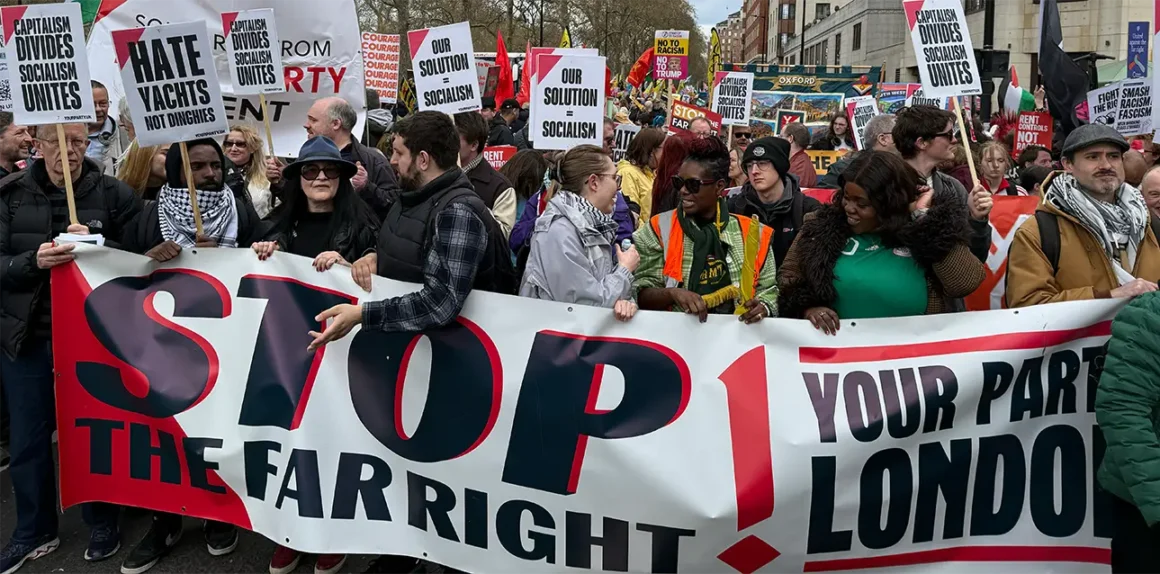
For decades the SWP has substituted the building of movements (or what it calls ‘united fronts of a special type’) like Stand up to Racism, in place of developing a concrete programme, a strategy around which the party is organ-ised and struggles for leadership within the working class move-ment. Despite calling them ‘united fronts’, the political basis of these campaigns is that of the ‘popular front’—a bloc with liberal, middle class and pro-capitalist sectors.
The SWP’s call for a ‘broad and pluralistic vision’ inside Your Party is an attempt to preserve its organisational prerogatives, and ensure YP remains at best a left-reformist party from which more radical people can be recruited to the ‘real Marxists’ of the SWP.
As Joseph Choonara’s piece shows, we are in a moment of severe turbulence: ecological breakdown, economic stagnation, far-right resurgence—the ‘horror’, but also ‘hope’ proposed by a left that can act. Given such a conjuncture Marxists should be directing ourselves towards the class ques-tion, towards the seizure of power, rather than grazing around the edges of reformist coalitions.
The SWP’s perspective ducks this obligation for revolutionaries to challenge the misleadership of the reformists by posing revolu-tionary methods of organisation and struggle. The SWP’s activists are told to ‘be visible’, build local branches, join the party—but not to fight for a revolutionary programme inside it.
Tailing the movement
The SWP’s refusal to address the class character of Your Party flows from its own centrist method. It offers no serious analysis of its social base or programme. Its leading figures—Corbyn, Sultana, and the Your Party ‘independent’ MPs—are treated as raw material for an undefined ‘insurgent left,’ rather than as distinct representatives of a reformist trend, and in the case of most independent MPs a distinct liberal trend, rooted in a commitment to managing capital-ism rather than replacing it.
In aiming not to offend the leaders it hopes to form a bloc with, criticism is posed as ‘advice’—and the ‘programme’ it suggests for the party a set of abstract principles that might exclude some of the Independent Alliance MPs, but wouldn’t meaningfully differentiate it from Zack Polanski’s Greens. So although the SWP mantra of ‘struggle not elections’ is meant to sound militant, it actually just serves to cover the void where specific forms of working class organisation and tactics are necessary to transcend the false binary of ‘streets vs parliament’.
This form of ‘revolutionary’ politics is known as ‘tailism’, a term coined by Lenin to describe those who, rather than lead the class, simply follow its spontaneous movement. It is opportunist because it ends up, like the original reformist theorist Eduard Bernstein, regarding the movement as everything, the goal of socialism as, at best, secondary. It is sectarian in that it puts the prospect of a few immediate recruits above the goal of winning the masses by challenging the reformists for leadership.
Programme
That struggle must be guided by a clear strategy: to fight for a transitional programme linking immediate demands—on wages, housing, migrants’ rights and Palestine—to the fight for workers’ power. Without that, ‘engagement’ becomes liquidation.
The SWP’s document contains no such programme. Its entire emphasis is organisational: join Your Party, be active, argue for unity. The politics are purely negative—against sectarianism, against ‘divisions’, against ‘bureaucratic wrangling’, even against internal political discussion in favour of more activism—but never for a concrete revolutionary alternative.
Workers Power believes that genuine revolutionary work within new formations requires open political confrontation, not camouflage. We think capitalism is the root cause of the cost of living crisis, the environmental disaster, and rising imperialist conflict and militarism—therefore it is in the interests of workers to organise to replace it with a planned socialist economy.
That’s why we argue that a new working class party should commit itself to a break with the capitalist state, repudiate the pro-capitalist union bureaucrats, and organise for mass struggle under a socialist banner. Of course not everyone in YP will agree; even among anticapitalists there remain serious differences of perspective and strategy.
That’s why we exist as a revolutionary current within it, to organise in a disciplined way for our perspective. The SWP rejects this perspective, preferring to retain its own self-contained apparatus while politically dissolving its programme into the reformist milieu. The SWP’s approach to Your Party mirrors its own internal regime. Its bureaucratic central-ism produces a leadership allergic to real debate, relying instead on administrative unity and organisational loyalty. This bureaucratic conservatism expresses itself outwardly as political caution. The leadership’s fear of isolation drives it to seek acceptance within broader movements, while its fear of losing control prevents genuine fusion on a principled revolutionary basis.
The outcome is predictable. The SWP will enter Your Party as a disciplined but politically silent minority, providing activists and resources while avoiding any fight for a revolutionary programme. When the project inevitably encounters the contradictions of reformism—parliamentary illusions, conciliation with the state, compromise with reaction—the SWP will have neither the authority nor the clarity to offer an alternative.
Conclusion
The SWP’s strategy towards Your Party expresses the crisis of centrism in Britain today. It combines sectarian isolation with opportunist adaptation, oscillating between proclamations of revolutionary purity and participation in reformist projects that blur all class lines. And as we said earlier the other larger currents, the SP and RCP, as well as some of the smaller ones on the far left, follow a similar pattern of opportunist adaptation.
Against this, revolutionaries must insist that the working class needs its own party—a party of working class militants guided by a strategy that charts the road from the defensive struggles of today to the objective of revolution, workers’ power and international socialism. There is no reason why that debate should not and cannot be held in front of the thousands of people flocking to join Your Party.
Anything less, however well-intentioned, merely postpones the task of socialist revolution. If you agree with our approach, then we want you to join Workers Power and help us fight for Your Party to become the fighting party of working class struggle that we need to take on capitalism today.