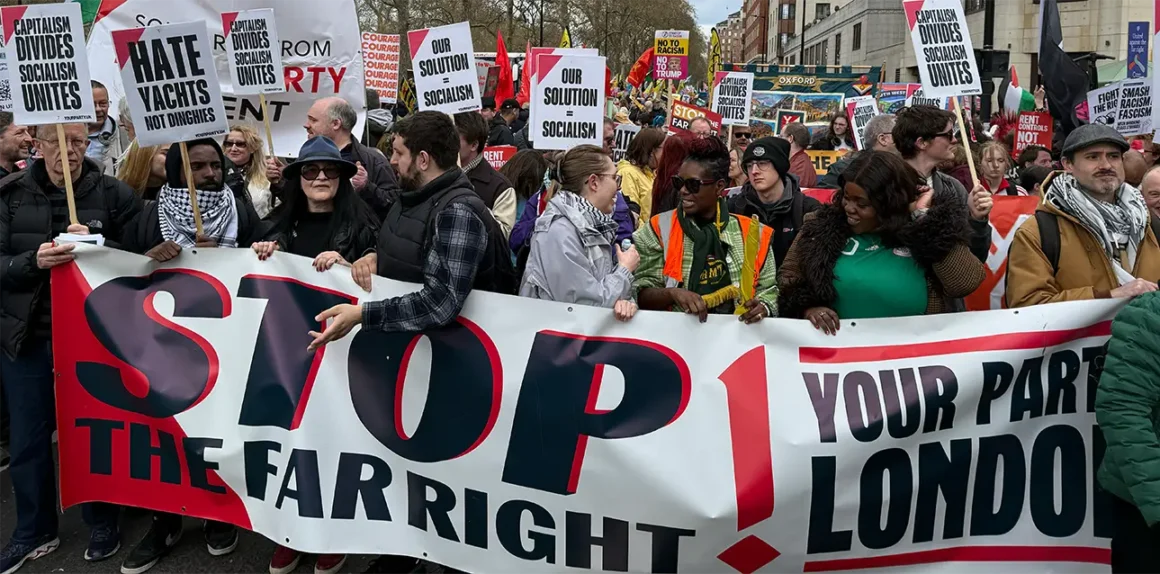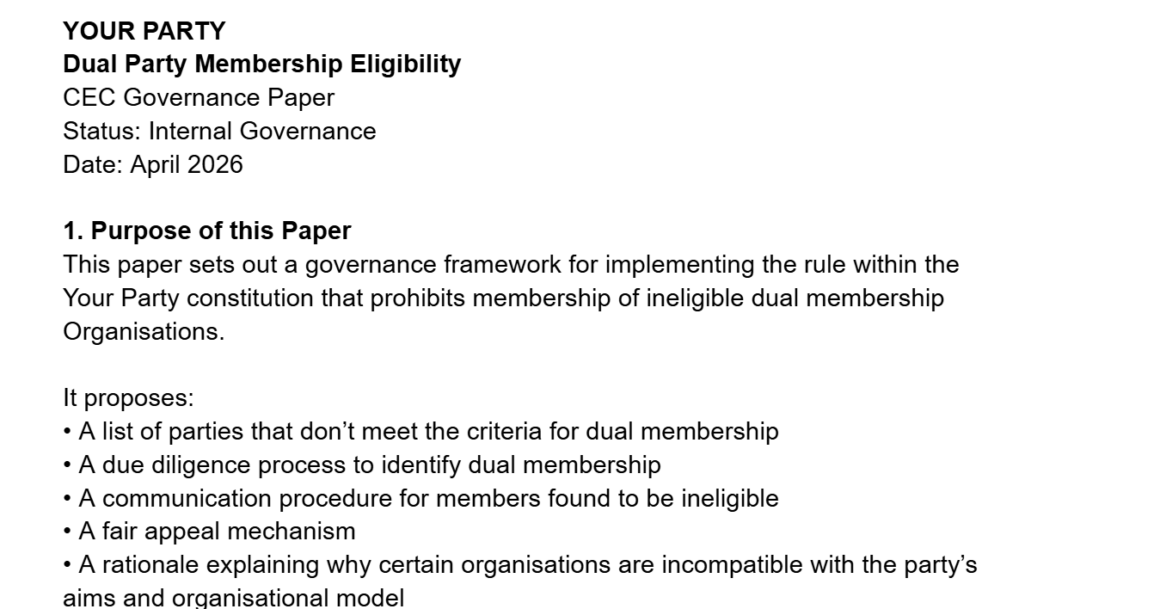

On 12 April 2026, the Central Executive Committee of Your Party voted to exclude members of organised socialist groups from membership unless those organisations were approved by the leadership.
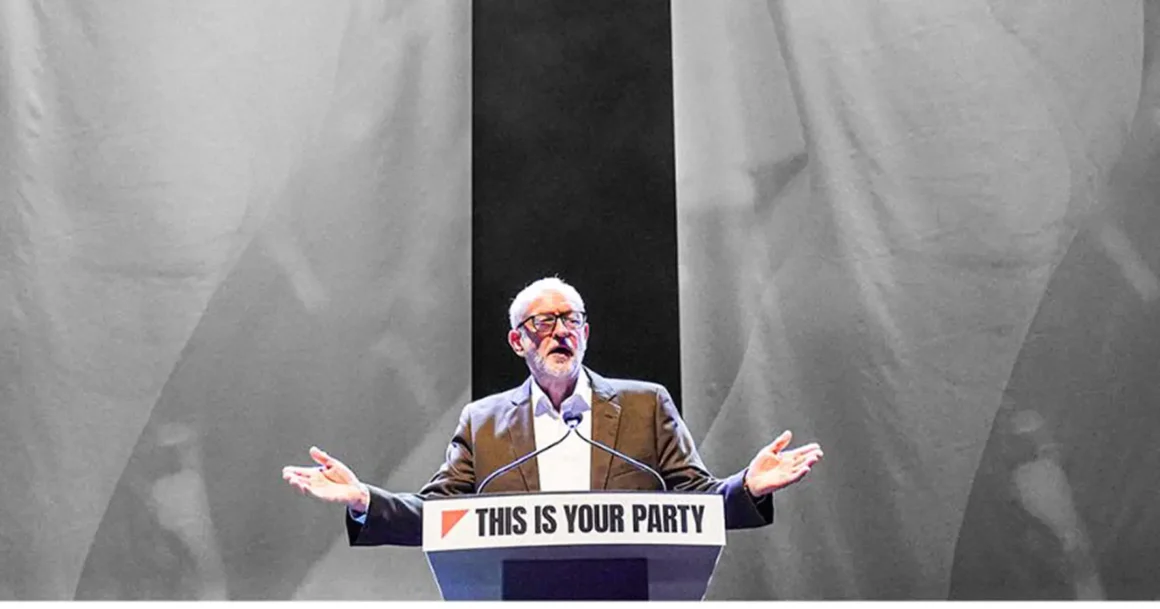
Your Party was launched last year by Jeremy Corbyn and Zarah Sultana. Thousands joined hoping it would become a genuine break to the left of Labour, which under Keir Starmer has continued its drift to the right. Instead, within months of its founding conference, the leadership has turned on the party’s socialist left.
The expulsions close a chapter. They settle, for now, the question of what kind of formation Your Party will become: not a democratic workers’ party, but a bureaucratically managed electoral vehicle, populist in form, politically formless in content, and hostile to organised opposition from its left.
The episode matters beyond Britain. It shows, in compressed form, the bureaucratic reflexes of left populism when confronted with the prospect of its own politicisation.
An injury to one
The leadership’s move is a declaration of war on the active membership. It is an attempt to smash organised opposition, silence political debate and ensure Your Party develops as a controlled electoral vehicle rather than a democratic party of the working class.
The forces around this leadership squandered the best opportunity in a generation to build a mass socialist party in Britain. More than 800,000 people initially registered interest in the project. By the time membership was formally counted, the figure had fallen to around 50,000–55,000. Control from above, organisational chaos and the absence of serious campaigning drove many away from organised politics altogether, while others drifted towards the Greens.
Instead of building branches, backing strike solidarity, or launching national campaigns against war, racism and the cost of living crisis, the CEC prioritised an internal purge that will exclude many of the party’s most active members.
The leadership claimed the expulsions were necessary for “democracy, transparency and accountability”. It argued that member-led decision-making is possible only when every member can trust that others put Your Party’s interests first. The formulation treats organised socialists as an inherent threat to unity. In reality, the decision is not about unity but control.
The right to dual membership, written into the party’s founding arrangements, is now being torn up in practice. The CEC insists dual membership technically remains possible for organisations it approves. But that only proves the point: rights exist at the discretion of the centre.
At the founding conference itself, delegates were denied a clear vote on an amendment that would have prevented bans on socialist groups, despite its popularity. This was typical of the pseudo-democratic procedures and leader-centred style that Corbyn and his circle now indulge in – features common to left-populist formations from Spain to France.
The demand that members engage with Your Party only as isolated individuals, and abstain from organising with like-minded members, is dishonest. Not all factions will be subject to the same rules. Those around the leadership will remain untouched. The purge may begin with the revolutionary left, but its real target is any organised opposition to the leadership’s future opportunism.
Get The Spark in your inbox
Workers Power’s weekly newsletter
Bureaucratic reformism
The move against revolutionary socialists mirrors the experience of Labour under Corbyn between 2015 and 2020. In both cases, the decisive obstacle was not simply pressure from the right or the media, but the power of a bureaucratic reformist layer embedded in the institutions of the labour movement.
That layer exists to regulate and contain struggle. It prioritises electoral management and internal stability over political clarification and mass mobilisation.
Under Corbyn, Labour briefly became a site of mass politicisation and radical expectation. Hundreds of thousands joined, many of them young people entering organised politics for the first time. Yet the party’s bureaucratic core – the parliamentary caucus, unelected officials and trade union leaderships – moved repeatedly to narrow debate, marginalise the organised left and block programmatic radicalisation.
Corbyn accommodated himself to these restraints. By the end, he used them against the membership’s clear will: on immigration, the second Brexit referendum and the handling of antisemitism allegations. His parliamentary socialism led him to concede to right-wing MPs because he believed office could be won only by preserving Labour’s existing electoral coalition.
That schema failed in Labour. But its essence – left Labourism – lives on in Your Party.
The new party is repeating the same trajectory in compressed form and on a smaller scale. Once again, a reformist leadership confronts the prospect that politicised members, especially those organised around revolutionary socialist programmes, will force real debate over what socialism means, how it can be achieved, and what confrontation with the state, capital and the existing political order it requires.
As in Labour, the response is not to open those debates but to close them through administrative measures.
The language has changed. Where the New Labour right spoke of ‘electability’, and Corbyn’s apparatus of ‘broad-church unity’, the Your Party leadership speaks of ‘eligibility’, ‘clarity’ and ‘trust’. The logic is familiar. Organised politics is treated as a threat, and organised political tendencies are objectively disloyal. Democracy is reduced to a passive ratification of decisions taken elsewhere.
The parallel is not accidental. The milieu of advisers, former Labour staffers, trade union full-timers and professional campaigners who clustered around Corbyn in Labour has reassembled around him in Your Party. They have brought with them the instincts acquired inside a mass reformist apparatus. Those instincts are not socialist. They are the reflexes of a social layer whose position depends on managing the relationship between the organised working class and the capitalist state: containing the former, reassuring the latter.
What can be salvaged?
The struggle over Your Party’s character has now been concluded from above. The expulsions are a fact. The question is what can be salvaged.
Thousands joined Your Party to build something that would put the working class first, at home and abroad, and challenge the machine politics of the official labour movement. That aspiration persists, even if this vehicle has been crippled by its own leadership. Branches were formed. Campaigning networks were built. New militants entered organised politics for the first time. None of that disappears because the apparatus has chosen this course.
The most useful next step for surviving branches, socialist organisations and individual activists is to turn outwards: to the fight against council cuts, the cost of living crisis, solidarity with striking workers, the defence of migrants, opposition to racism and the far right, and resistance to rearmament.
A united front on that basis, directed towards trade unions, workplace militants and community campaigns rather than confined to the organised left, could give concrete political content to the call for a workers’ party. It could keep the best forces of the Your Party experience together in common struggle while the wider questions of programme and organisation are fought out.
Those questions cannot be settled by manoeuvre. They require serious political debate within whatever association of branches and socialist tendencies emerges from the wreckage, on the basis of the open right of tendencies to organise and argue for their positions.
A revolutionary organisation should not pretend it has all the answers. It must be prepared to learn from the class. But a political programme – a strategy to lead today’s struggles towards socialism – cannot be gleaned from local branch work alone. It has to address the great questions of the day. The greatest remains the one Your Party’s collapse has posed again: reform or revolution?
For socialists internationally, the lesson is familiar. Left populism offers an apparently shorter road to political influence than the patient construction of a revolutionary workers’ party. It substitutes the authority of a leader, an electoral brand and a technocratic apparatus for the collective political life of the class. When tested by real struggle, or by the simple pressure of its own politicising members, its bureaucratic core reasserts itself against its base.
Podemos, La France Insoumise, Syriza and now Your Party: the details differ, but the basic dynamic remains essentially the same.
The task remains to build, in Britain and internationally, a revolutionary party rooted in the working class, open in its debates and armed with a programme capable of leading struggle towards power. Anything less reproduces, under new branding, the same limits that have repeatedly blocked the emergence of a mass socialist alternative.