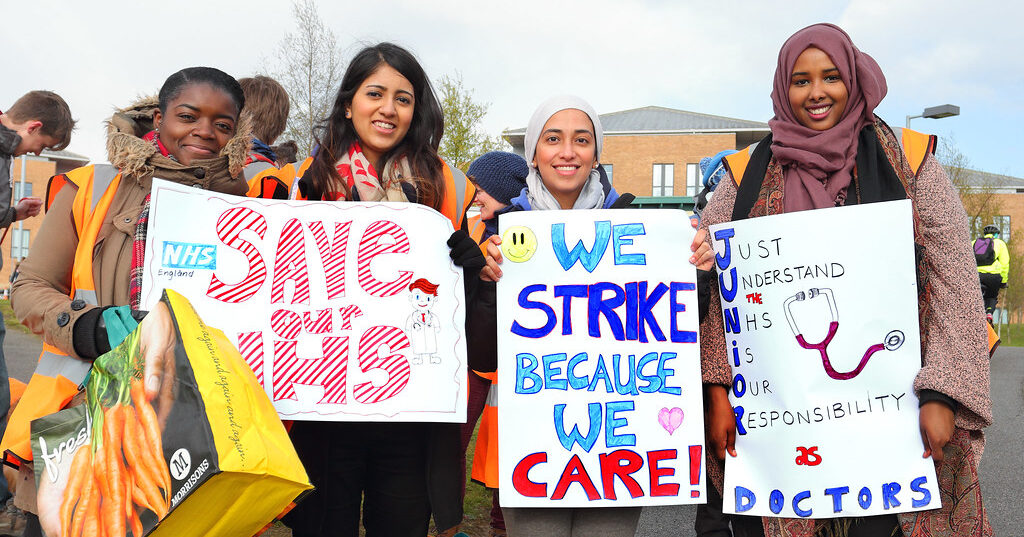
Resident doctors, formerly known as junior doctors, will strike again next month. Pay negotiations between The British Medical Association (BMA), the BMA Resident Doctor Committee (RDC) and Health Secretary Wes Streeting fell apart last month. The doctors will take five days of strike action from 7am 14 November to 7am on 19 November. This will be their 13th action since March 2023.
While talks with the government about pay erosion were ongoing, the resident doctors in the BMA raised serious concerns about not being able to secure further specialist employment, which is needed to continue their qualification. This added to their anger.
Jobs and pay
Last month the BMA balloted first year doctors about this issue and an overwhelming majority voted for strike action (97%). The BMA has therefore launched an additional, linked dispute with the Government, demanding action both on pay and lack of training places on behalf of first year doctors, who, in the coming years, will be most heavily impacted by the problem.
According to a BMA survey of members, half of resident doctors finishing their foundation training had no job secured for the upcoming year. There were more than 30,000 doctors applying for about 10,000 speciality training places. The government recently promised as part of its 10-year plan to create only a fraction of the amount of training places needed: just 1,000 over 3 years.
While resident doctors did receive a 28.9% rise over 3 years, inflation for that period, 2022-25, was 24.9%. So it only amounted to a 4% real terms uplift. This hardly compensates for the 21% real terms pay erosion that’s taken place since 2008.
Dr Jack Fletcher, recently appointed chair of the RDC said that the government has shown ‘little understanding of the crisis here and now or a real commitment to fix it’. He called on ‘the health secretary to step up, come forward with a proper offer on jobs, on pay.’
Wes Streeting has hit back claiming that he ‘can’t do that if I’m spending a quarter of a billion pounds meeting the costs of strikes,’ something he should have thought about before provoking the strike, surely. Considering that the government plans to increase defence spending to a record £87 billion by 2030, his excuse that the government does not have the cash falls flat.
Privatisation
To view this crisis as a simple matter of budgetary constraints is to miss the bigger picture. What we are witnessing follows a familiar playbook. First, a public service is systematically starved of funding until it begins to falter. Then, its shortcomings are held up as proof that the public model is inherently flawed.
Finally, private providers are ushered in as the ‘efficient’ solution. The real goal, it seems, is not to heal the NHS but to reshape it into a market where healthcare is a commodity, not a right. The doctors on the picket line are not just striking for a better wage; they are standing against this very future.
This is why their fight is everyone’s fight. If highly skilled, irreplaceable doctors can be treated with such contempt, what does that signal for nurses, porters, and every other public sector worker? The doctors’ demands for safe staffing and proper resources are, in essence, the same as patients’ demands for safe and timely care. When a doctor is overworked and underpaid, patient care suffers. Their struggle on the picket line is a defence of the principle that our health should never be a source of corporate profit.
Workers across the NHS expressed their frustration at rotten pay deals for 2024-25 in indicative ballots conducted by the Royal College of Nursing (RCN), Unison and Unite, who collectively represent most of the NHS workers. Now nurses are being told the NHS ‘can only afford’ a 2.5% increase this year, so we can expect their anger to reach boiling point.
The union leaders sat on their hands over last year’s desultory offer, refusing to take the dispute beyond the consultative ballot stage. This time NHS workers need to get organised, at workplace level and across all grades and professions, to demand united strike action to win decent pay awards for all and an end to creeping privatisation in the NHS.