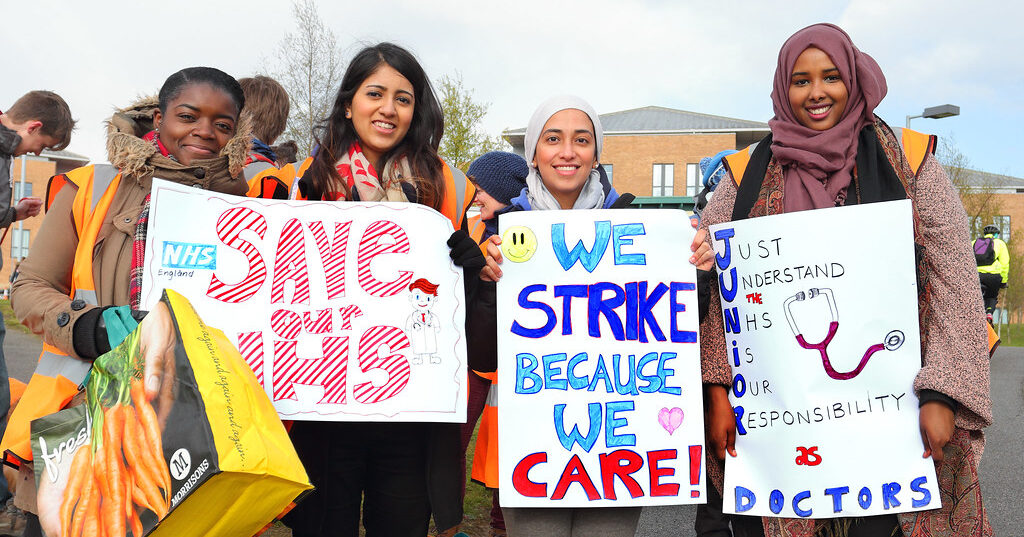
Tens of thousands of resident doctors – the backbone of the NHS – have taken strike action from 25 to 30 July, demanding a full 29% pay rise to reverse years of real‑terms erosion. The British Medical Association (BMA) argues that their pay has plunged by around 20–23% since 2008.
Last year’s award of 28.9% over three years sounds a lot, but in real terms was worth far less (inflation over the three years was 24.9%). This year’s offer of a 5.4% uplift, when the RPI rate of inflation is 4.4% is an insult to service and morale, and rows back on Labour’s pledge to deliver pay justice to the doctors.
The action marks the first major industrial confrontation with the government since the general election. Labour is opposed to pay restoration on principle, because it would set a precedent for millions of other public sector workers. On the other hand, simply ignoring the strikes as the Tories did will wreck Labour’s promises to reduce waiting lists.
Labour attacks workers
The government’s response has been twofold. In the NHS, managers have been told to carry on running as many operations as possible. In public, the government is copying from the Tory playbook and encouraging a media smear campaign against resident doctors.
Labour’s hostile approach has encouraged public clashes between NHS managers and the BMA over the use of derogations. The airwaves were flooded with consultants (not on strike) or scab doctors arguing for NHS strikes to be outlawed, causing Tory leader Kemi Badenoch to join in.
From a working class standpoint, this isn’t just a pay dispute—it’s a frontline battle against austerity. Public sector workers have suffered nearly two decades of pay suppression. Now a Labour government is running a union-busting campaign against Birmingham bin workers. In this context, the doctors’ campaign signals working class resistance, not privilege.
Though ministers tout statistics showing fewer cancellations than during previous strikes, hospitals have had to rely on costly agency staffing and premium pay arrangements to maintain safety. NHS England’s chief executive has warned that some senior doctors are taking up shifts costing up to three times their normal rate—a sign that the system is unsustainable over a long strike.
The broader NHS workforce is watching closely. Nurses—in a record turnout vote—overwhelmingly rejected a 3.6% pay award, with 91% opposed and more than 170,000 participating. They are preparing to take industrial action unless meaningful reforms to pay and working conditions are delivered.
GMB NHS members last week rejected the 3.6% by a two-to-one margin. Unite members voted in an indicative ballot by 89% to strike against the real pay cut and by 95% to take action against NHS cuts. Unison, the biggest but consistently the most conservative NHS union, accepted the government’s offer because of their low turnout. But 70% of Unison members voted to reject, so many of them may strike with the RCN if action is called.
Where next
This wave of action comes at a political turning point. Labour, elected on promises to end strikes and restore the NHS, now faces multiple union fights within a year. The unrest undermines pledges to reduce waiting lists and rebuild services. Streeting’s combative posture may appeal to Tory‑leaning commentators, but risks alienating Labour’s own base—and emboldening the wider trade union movement.
Under such pressure, the strike must succeed. A partial deal or delay would sap morale, playing into a government narrative of insider entitlement. We need to get behind the health workers: the BMA’s demand is modest in context—a return to pay levels of 2008, not windfall riches. Conservative‑framed rhetoric about public safety masks a refusal to invest in care and determination to maintain a deflated pay structure.
For resident doctors, this campaign is existential. Faced with university debts (of up to £100,000), rent, and long hours, many cannot treat medicine as a vocation if it remains uncompensated. Their struggle is a stand for dignity in labour, for public services that place care—not profits—at their centre.
Solidarity must extend beyond the NHS. Workers Power calls on union activists, campaigners, and public service workers to organise solidarity pickets, lobby MPs, and embed this fight in the broader movement against austerity. If doctors win, the ripple effect could embolden low‑paid service providers to reclaim value. If they lose, it will open the door to even deeper austerity across public sectors.
The residents’ strike is not simply a momentary disruption—it is a flashpoint in the broader class war. Workers know enough: only collective action wins.
The GMB and Unite should swiftly organise an official ballot and set common dates for strike action and link up with the BMA in a common fight to force the government to find the money to properly fund health and social care. Unison members should also demand a legal ballot, at least in those areas with a high turnout, this time with serious campaigning for a Yes vote.
In every NHS trust, workers should elect a cross-union strike committee to organise the campaign and develop links with local trade unions and communities.