
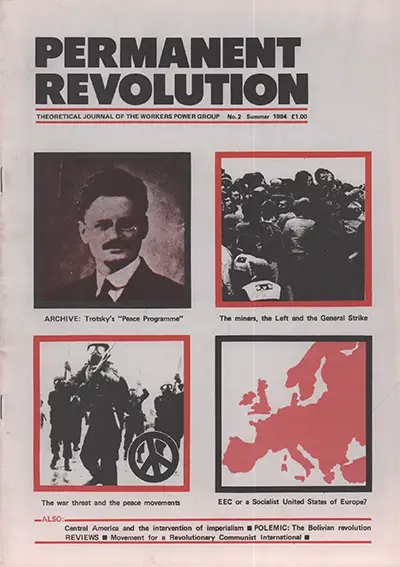
In this issue
- Editorial
- The miners, the left and the general strike
- MRCI resolution: The nature of the EEC and the elections to the European parliament
- Trotsky, Lenin and the struggle for the communist programme on war
- The programme of peace by Leon Trotsky
- MRCI resolution: The war threat, the peace movements and the communist response
- Polemic: Bolivia 1952—A polemic with Politica Obrera
- Bolivia 1952—A reply from Workers Power
- MRCI resolution: Central America, the Caribbean revolution and imperialist reaction
- MRCI resolution: Declaration of Fraternal Relations
- Reviews:
- Inside the PLO by Helena Cobban
- The British in Ireland by Geoffrey Bell
- Two obituaries to the Grenadan revolution
- Miners Against Fascism by Hywel Francis
- Class Struggle and Women’s Liberation by Tony Cliff
- Communism Under Weimar Germany by Ben Fowkes
- What is to be Done About Law and Order by J. Lea and J. Young
- The Making of Marx’s Critical Theory by Allen Oakley
- Women in Trade Unions by Barbara Drake
Editorial
This second issue of Permanent Revolution appears during the most important class struggle for a decade—the miners’ strike. The first article in this journal deals with a tactic of fundamental importance to that fight, and to the arming of the working class in the struggle against Thatcher and the ruling class—the general strike. It examines the correct and incorrect uses of the slogan current on the British left and argues the revolutionary method of fighting for such a strike.
A major part of this issue is taken up with a number of resolutions from the Movement for a Revolutionary Communist International (MRCI), of which Workers Power is a part. The resolutions were passed at the founding conference of the MRCI in April, and deal with three important questions of the international class struggle—the nature and dynamics of the EEC and communists’ attitude towards it; the growing imperialist intervention in Central America and the nature and politics of the FSLN regime in Nicaragua; and the growing imperialist war threat, including an analysis of the peace movements east and west. Lastly, we print our Declaration of Fraternal Relations, which explains the basis upon which the MRCI has been founded, and the nature and tasks of the fraternal grouping.
This issue also contains what will become a regular feature of Permanent Revolution—an archive piece from the arsenal of Marxism which has been hard to obtain in full for forty years—Trotsky’s ‘Peace Programme’, written in 1916. As the introductory article outlines, this programme covers vital questions which are of burning relevance still—the question of communists and war, the question of the unification of Europe.
The publication of the polemic on Bolivia continues one of the tasks we set ourselves when we launched Permanent Revolution—the rescue of theory and tactics from the opportunist and sectarian distortions of the centrists. The chronic bowdlerisation of the imperialist united front tactic as a means of compromising with petit-bourgeois and bourgeois nationalism by the POR of Bolivia forms the heart of this polemic. It raises in the argument such key questions as the pitfalls of giving ‘critical support’ to supposedly anti-imperialist governments and the nature and role of soviets. It also examines the use of the workers’ and peasants’ government slogan and the disastrous consequences for the Bolivian workers and peasants of ‘worker ministers’ and ‘co-government’ as a strategy for the Bolivian revolution.
Finally, the Reviews section takes up a number of key political issues raised in recent publications, including the SWP’s approach to Marxism and feminism, the collapse of the Grenadian revolution, and the limits of Republicanism in Ireland, and of its cheerleaders in Britain.
With the publication of Permanent Revolution 2 in A4 format we hope to put our theoretical journal on a more regular publication schedule. You can help in this project by contributing financially to our £10,000 fund for new typesetting equipment. Send donations to: Workers Power, BCM 7750, London WC1N 3XX.