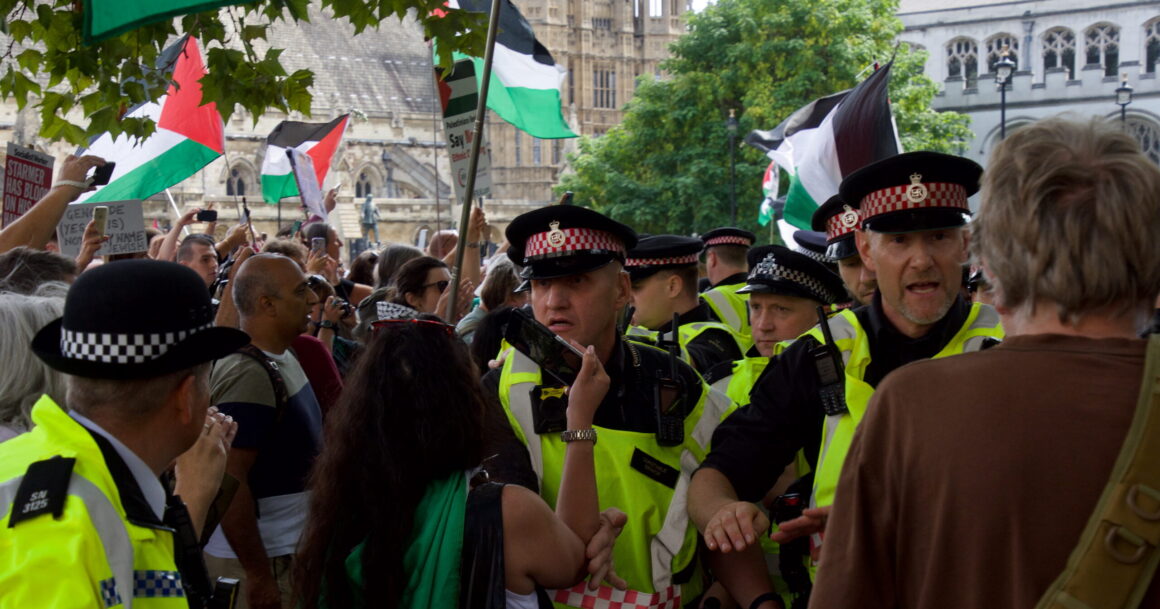

West Yorkshire Police violently arrested retired headteacher Jon Farley at Saturday’s Palestine march in Leeds for displaying an image from satirical magazine Private Eye. The image was making an ironic point about the types of ‘Palestine action’ the UK government supports – that spraying paint on RAF planes is unacceptable but shooting Gazan aid-seekers is fine. The activist was arrested under Section 12 of the Terrorism Act 2000.
Police have since dropped the case against Unite Community activist and supporter of Workers Power, Jon, who commented, ‘The manner of my arrest clearly shows the police are trying to stifle free speech on Palestine. Not least because they had no case against me – It was pure intimidation. I will be back marching for Gaza, I will not be silenced, and I urge people to join us in standing up for a free Palestine.’
Police told one of the march’s stewards they have been instructed to arrest anyone displaying the words ‘Palestine’ and ‘action’, no matter the context. When the steward asked whether they would arrest someone displaying a recent article from the Times criticising the proscription of Palestine Action, the officer refused to answer.
The steward told Workers Power, ‘I asked them whether they would be arresting [Private Eye editor] Ian Hislop and half the newsagents in the country for printing and distributing the image. They said it wasn’t an offence to print the words ‘Palestine action’, but anyone displaying them on a demonstration would be arrested.’
Others were arrested in cities across Britain yesterday for holding up signs explicitly breaching the proscription of Palestine Action: 55 in London, 17 in Bristol, 16 in Manchester and 8 in Truro. These arrests bring the total to over 200 since Palestine Action was banned. The signs held by these protesters are an open challenge to the proscription as an attack on our right to criticise and oppose the UK government’s support for Israel’s genocide.
Yesterday’s incident in Leeds was not part of the coordinated breach of the proscription and was not itself a breach. No doubt Private Eye’s lawyers reviewed the image before publication. The Leeds arrest therefore demonstrates the wider danger of the government using the Terrorism Act to silence its critics – it is a green light for the police to go far beyond the letter of the law to intimidate and arrest those critics.
Last week in Kent, police ordered a woman to remove her Keffiyeh (a traditional Arab scarf often worn to symbolise solidarity with Palestine) and a sign criticising Israel’s genocide because both items gave them ‘reasonable suspicion’ that she supported a proscribed organisation.
The fact that officers in Leeds chose to tackle a peaceful protester to the ground in a public display of violent intimidation shows that the arrest was a message to the rest of the movement that anyone protesting the genocide is now fair game. The selective application of West Yorkshire Police’s interpretation of the law – arresting a man for displaying a clipping of a magazine and dragging him to a van parked next to a newsagent freely selling that same publication – is further evidence that their aim was to create an atmosphere of fear among supporters of Palestine rather than their ridiculous claim that they were simply applying the law.
However, police in Leeds were clearly not expecting the furious response from the assembled protesters. The demonstration was a silent procession, with hundreds solemnly marching to a slow drum beat and carrying funeral shrouds and boxes representing the life-saving aid denied to Gazans. Those distributing leaflets to onlookers reported some very emotional responses, with some crying at the sight of the shrouds that represented the many thousands of children killed in Gaza.
When the snatch squad dragged the protester to the ground, others tightly gathered around demanding his release. The protest first halted and then converged on the arrest. By the time the man was being carried across the street to the police van hundreds were swarming the van chanting ‘let him go.’ Police liaison officers shoved protesters to the ground as the van forced its way through the crowd.
Activists gathered at Elland Road police station, sheltering from the rain in a gazebo decked in Palestine flags and banners. Drummers from the march and drivers beeping their horns ensured our presence couldn’t be ignored, and a sign demanding the release of the ‘Private Eye One’ was quickly erected.
The comrade was released just after 8pm with bail conditions and informed two days later that the case had been dropped. The national media has begun picking up the story, and reporting of this incident may generate some backlash against the police intimidation tactics and add to the pressure on the state to overturn the proscription of Palestine Action.
The appeal against the proscription began on Monday 21 July with its founder, Huda Ammori, seeking High Court permission to challenge the decision. Jon’s case and that of the activist in Kent were referenced at the hearing as evidence of the negative impact of the proscription on wider society.
At the time of the Terrorism Act was introduced in 2000, many activist groups, including Workers Power, warned that it would be used against peaceful protesters and the labour movement. We have been proved right. Now is the time for mass opposition, to get rid of this repressive legislation and to show in the words of the famous slogan, ‘We will not be silenced!’
But while we do this, we are also aware that Jon, Palestine Action and the multi-millioned movement across the world are not the story. Gaza is the story. Stop the bombing. Free Palestine.