Oscar J reports from the student assemblies at the Sorbonne and Jussieu and the mass march on République, where militancy was everywhere but organisation was missing.
I arrived on Friday, the day before the protest march was scheduled. The protest date was decided sponteniously, via tiktok, and the call to action was heeded on mass. The spontenaity of the protest, and of its leadership and method, are a reccuring theme I witnessed over the days I was there.
I was informed of two public student assemblies happening on the day; one at Sorbonne and one at Jussieu. The meeting of Sorbonne students was the first, and happened outside the Panthéon. Approximately one hundred and fifty young students had met in front of the Panthéon, debating the issues of the movement. Although I missed the first half of the debates due to a metro mishap, I was caught up by comrades in the ground, one of whom had just spoken to defend non-horisontalist methods of organising as I arrived. One vote was held about the need for the protests to expand and meet not just students but workers too, which was thankfully approved. Another vote about coordinating with other student assemblies however was shot down; in a tragic blow for the potential of student/worker leadership in the movement at Soborne. The horisontalists and anarchists, despite strong oration from comrades, dominated organisation at the Sorbonne. The memory of the yellow vest movement holds much weight, and this was compounded by a general distaste for outsider “organisations” (see communists).
After it was made clear that anarchism had won the day at the Sorbonne, we headed to Jussieu to see the assembly there. I was told it was a much better organised group and it was with good reason. On the fence behind us were placards, some commemorating May ’68. Discussions here were much stronger, even as anarchism and horisontalism still haunted the discussions. As one student of such persuasion disparaged the need for working class outreach, organisation, and democracy, a communist in the crowd cried something akin to “stop the shit!” Working class outreach, expansion, and coordination were debated and accepted here. A motion had been put forward for a national and regional organisation of student delegations, to coordinate national action. An essential step for such a movement to turn immediate passion into organised power. While this was agreed, a destructive alteration was added by a horisontalist, in order to stop these “outsider groups and organisations” from influencing the movement. Instead of directly electing people to these bodies based upon their arguments and principles, a random selection from a list should be used instead to prevent any one group dominating the election. A maddening and grave error, destroying democracy in hopes it will harm your opponents more than it hurts the movement. This, unfortunately, managed to pass the vote, leaving Jussieu effectively headless on the national and regional scale.
When left without a political leadership of its own, which can present the demands agreed upon by their assemblies, students will look elsewhere for leadership – to Melenchon and LFI, and to the trade unions. A representative selected at random is an entirely unknown quality, whos politics have not been scrutinised. Delegate recall is only half of the equation, where democratic selection is the first and most fundamental aspect.
Another unfortunate misstep left us somewhat pessamistic for tomorows protests. An “indicative” vote was held on how blocs should move at the protest – to have one large bloc from the university, or to seperate into several smaller blocs? Notably, this had been voted on the day before, and was now being re-litigated. What purpose could that serve, other than ego-stroking and wrecking? Pass or fail, the vote itself being on a settled matter, it could only serve to sow confusion and disorganisation at a time where police would be at their most repressive and violent. Fortunately it was rejected.
The Saturday came, and a great apprehension with it.
I walked again to Jussieu from the metro station, passing the Panthéon on my way. This time I saw a much more militant face of the movement. Where yesterday an assembly sat, now a massive crowd was marching past, chanting for Macron’s head. One flew a red flag commemorating the Commune. A police car was pushed back and had to flee from their path. Flyers were handed out to those on the streets around them, to agitate and encourage those around to come join the events.
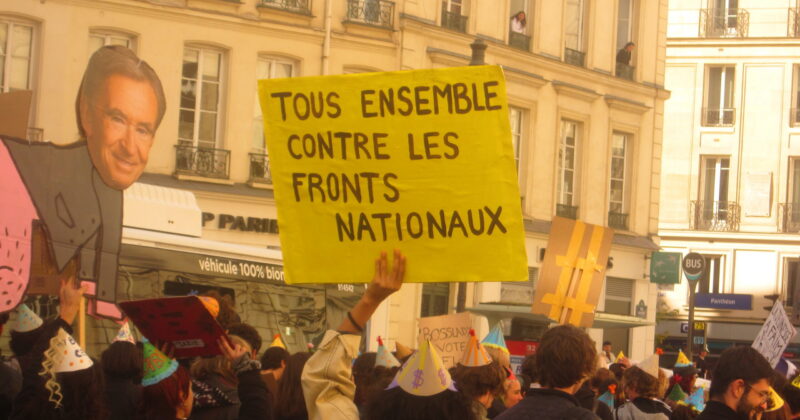
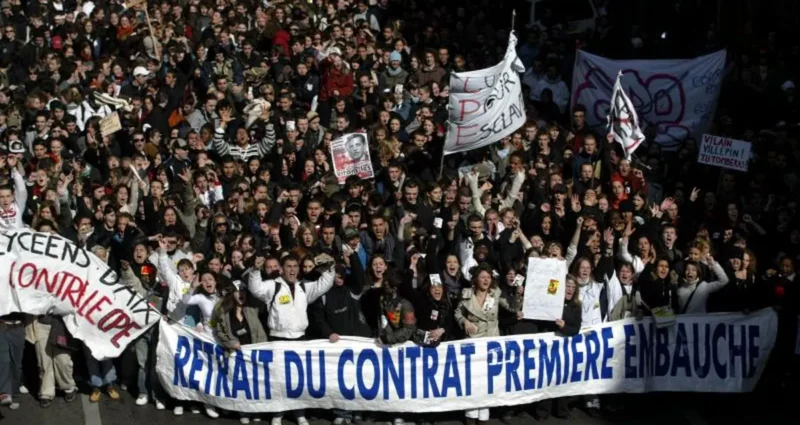
Further on I reached Jussieu, where their march has just begun. There was an acrid smell which I was told was tear gas. It is the last time any of us would have to ask what it smelled like. We marched on to Monument à la République. Police had attempted to stem the flow of people to the monument, to no effect. Police were crammed to the sides and around their vans. Disencirclement grenades were thrown at random to attempt to break up the immense crowd to little effect. The air was so thick with tear gas that a constant fog hung in the air. But all the violence the state could muster did little to deter people. Protestors climbed the monument, that monument to the ideals of the third republic, and wrote upon it “DESTROY THE SOCIAL CONTRACT” and “FUCK THE STATE”. A red flag was draped from the monument. Later, a yellow vest wast draped around her.
Of note is the class character of the march. Traditional wisdom might tell us to expect only single-issue radical students and communist groups. But end-to-end, those wide Paris streets were filled with workers, many young, many old; students from universities and high schools across the countries. And for every person who clung to liberal constitutionalism, flew the tricolour, and demanded Macron’s resignation, another was calling for the upending and destruction of the system, commemorating the Paris Commune and May 68.
Estimates put the event at 800,000 on the streets of Paris. The crowd only thinned around three kilometers away from its start at Monument.
Sunday came, and with it aftermath.
Across France, the impacts of the movment could be felt everywhere. In Limoges, the city hall had been set ablaze. Many shops of luxury goods and electronics were robbed. This was no random criminality, as bourgeois propagandists dutifully reported, but an expression of class anger. Years of contempt, declining living standards, austerity, and unemployment had all come to roost. Anger alone, despite what the horisontalists may have hoped, is not enough. Indiscriminant and random destruction may satisfy temporary rage but cannot uppend a society. The burning of the city hall expressed in firey detail hostility to the state, but it will be rebuilt. The govermnent, local and national, which it represents, still exists. The government however will sharpen its knives in preparation of retribution. Anarchism has not abolished leadership in favour of democracy and victory, but surrenedered the movement to spontaneity and uncoordination. Should this militancy be organised through workplace and school level committees, building towards general strike and coordinated political attacks at the state apparatus, there would be much greater threat to the government. The events witnessed demonstrate the greatest potential seen in a long time; and a great hunger for the end of what is, in favour of what could be. The want for struggle is here, but the leadership and organisation is not. The day-to-day struggles have became questions of class and power which existing left groups seem unable to answer.