This article covers the revolutionary events that shook Bolivia between October 1970 and August 1971. We offer no apologies for examining events that took place more than ten years ago in a small country in South America. First, those events are rich in lessons for revolutionaries seeking to develop a programme which can lead to victory and working class power in the imperialised world. Secondly, many of the leading figures and parties in this period of struggle — Juan Lechín, leader of the COB (Bolivian Trade Union Centre), the Bolivian Communist Party (PCB), Guillermo Lora, leader of POR (Lora), Hugo Gonzales Moscoso, leader of POR (Gonzales) — are still contenders for leadership within the Bolivian workers’ movement. They will undoubtedly continue to play an important role, following the return to civilian government in September last year. Therefore an examination of the politics which inform their parties, and their record during the revolutionary crisis of 1970/71, has much more than academic interest. Parts of this article are taken from a forthcoming book published by Workers Power and the Irish Workers Group on the Fourth International (see advertisement elsewhere in this paper). We invite supporters of either Lora’s organisation, POR (Masas), affiliated to the Fourth Internationalist Tendency, or of Gonzales’s POR (Combate), affiliated to the USFI, to reply to the criticisms made in this article.
Bolivia is a landlocked country of no more than six million people, with the majority of its population, about 60%, still working on the land as peasant farmers. Historically it has been one of the countries most exploited by imperialism. Its economy was massively dependent on the export of tin to the imperialist powers—most importantly the USA. Exports of tin amounted to 75% of all exports by the 1920s and still amount to over 50% today. Tin production by the turn of the century had come to be dominated by three massive family firms—Aramayo, Hochschild and Patiño—which controlled 80% of the industry and dominated the government. This oligarchy, known as the ‘Rosca’, came to be based outside of Bolivia, firmly integrated into the business communities of the imperialist heartlands.
The enormous superprofits extracted by imperialism from Bolivia and the resistance to paying taxes of the expatriate ‘Rosca’ kept the Bolivian state chronically impoverished. It was completely at the beck and call of imperialism and cruelly subject to the vagaries of the world tin market. The 1920s and 30s saw Bolivia racked by economic crises as the world slump produced a dramatic fall in tin prices. The failure of Bolivian capitalism produced a number of movements, often based in the army and drawing support from the financially squeezed urban petit-bourgeoisie, which attempted to challenge the grip of the ‘Rosca’ and negotiate a better deal with imperialism. The MNR (Movimiento Nacionalista Revolucionario), founded in the 1940s, was the most influential nationalist party during this period and became the leading force in the 1952 revolution.
Starting as an attempted putsch by the MNR and sections of the military, the April 1952 revolution became an armed insurrection led by the most powerful section of the Bolivian working class—the Bolivian tin miners. It broke the army regime and placed Paz Estenssoro and the MNR in power. The MNR government was a capitalist government, despite its revolutionary nationalist rhetoric. Under the pressure of massive peasant land seizures it carried out a major land reform programme in April 1953. Forced by miners’ strikes and demonstrations, it was compelled to nationalise the three major mining groups of the ‘Rosca’ and form COMIBOL, the state mining company.
But the regime exposed the chronic political weaknesses of the Bolivian working class and its parties. In a situation approaching dual power, where the regime was a highly unstable one, the left was unable to win the masses from the MNR. Indeed, it did the opposite. The COB supported the government, having five ‘worker ministers’ installed alongside the MNR.
The role of the POR
The POR, at that time a united party, wholeheartedly supported the entry of the ‘worker ministers’ into the government. They extended critical support to it as a government in so far as it was progressive and ‘fought the Rosca’. A resolution of the POR’s Tenth Congress (June 1953), reprinted without criticism by Lora in later years, states: ‘Far from advancing the slogan of the overthrow of the Paz Estenssoro regime we support it in order that it resists the offensive of the Rosca and we call on the international proletariat to defend unconditionally the Bolivian revolution and its transitional government.’ (G. Lora, Bolivie: de la naissance du POR à l’Assemblée Populaire, p. 35). Whilst it is justified that revolutionaries would defend arms in hand any such democratic government against domestic or imperialist reactionary attack, it is wrong to give it political support. In fact, the POR failed to expose it as a bourgeois government incapable of fighting reaction, failed to call for its replacement by a revolutionary workers’ and peasants’ government and failed to raise to the fore agitation for the arming of the workers and peasants and the dissolution of the standing army.
The failure to seize the revolutionary opportunities afforded by the April 1952 revolution was to cost the Bolivian workers and peasants dear. The government demobilised the masses, rebuilt the army and, in alliance with the Bolivian CP, crushed the left in the COB. By 1964, the army was sufficiently confident to strike at the MNR government and re-introduce military rule. The regime of General Barrientos, which was marked by its subservience to imperialism and its repression of the trade unions, involving it in a series of massacres of mine workers, lasted until 1969 when the general was killed in a helicopter crash. He was replaced by General Ovando.
It is rare that the same political leaders are offered a second chance to carry out their respective programmes. Yet 1970 in Bolivia offered just such a chance to the leaders who claimed to be fighting for socialism in Bolivia. It was a chance that proved that they had learnt nothing from their previous mistakes.
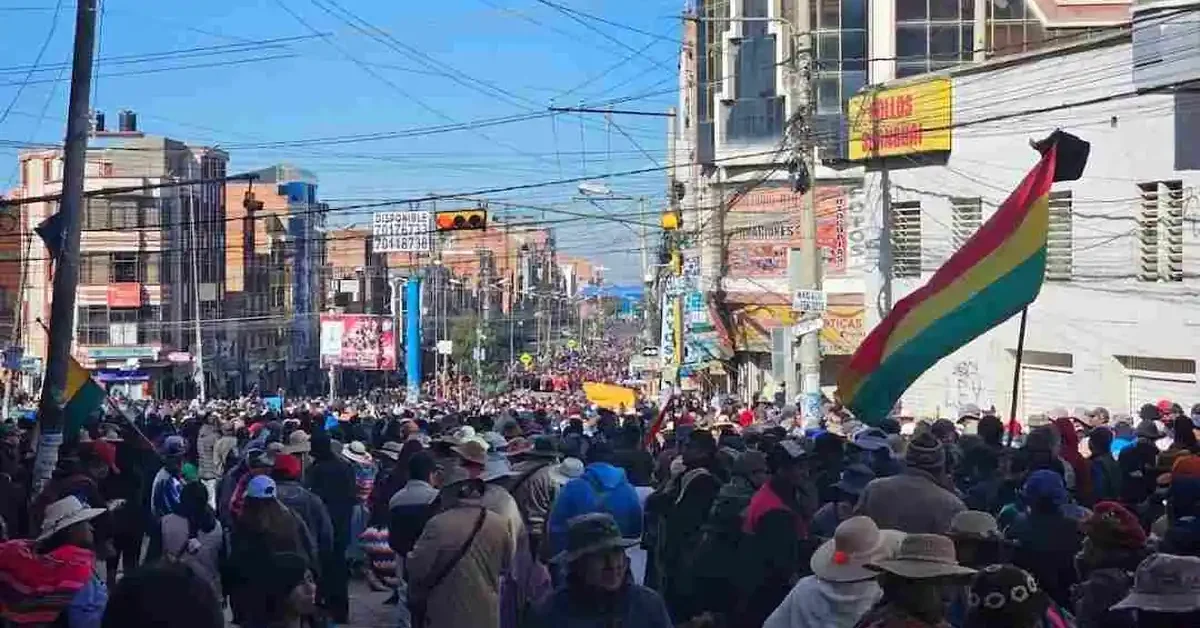
The events of October 1970 bore a striking similarity to those of April 1952. General Ovando, under the impact of the apparent success of the nationalist generals in Peru, proceeded to try and renegotiate a better deal with US imperialism. The nationalisation of Gulf Oil was to earn him the enmity of US imperialism and ensure an attempted right-wing coup. On 4 October 1970, General Rogelio Miranda obliged the US government and staged an attempted coup. However, sections of the army hesitated and the COB called a general strike against the coup attempt. Miners armed with dynamite poured into La Paz as the working class responded massively to the call. A ‘Comando Político’ was formed to organise the resistance. This political command was made up of trade union leaders from the COB, including Lechín; organisations such as the Student Federation and Peasants of the Independent Bloc, as well as political parties: the MNR, the PCB and POR (Lora), and others.
Get The Spark in your inbox
Workers Power’s weekly newsletter
‘Left’ bonapartism
Having failed to achieve a swift coup the army found itself facing a crisis similar to April 1952. It had to head off at all costs another defeat for the army at the hands of the armed workers. It chose to put forward its ‘left’ bonapartist face, in the figure of General Juan José Torres, whose base lay in the air force. Torres announced himself in rebellion against both Miranda and Ovando, making a broadcast from the El Alto air force base declaring for ‘an anti-imperialist revolutionary government of soldiers, workers and students’. Time magazine revealed how this ‘rebellion’ was organised with the connivance of Ovando: ‘After meeting with Ovando, General Torres sped to a military base outside La Paz and quietly rallied left support. When leftist Air Force pilots, flying vintage Mustang fighters, strafed the presidential palace, taking care to fire only into the air—it was all over.’ (Time, 19.10.70).
In fact the general strike had already broken the coup, and Torres provided a way out for the army, even if it meant temporarily risking a ‘left’ general, while they reorganised their forces. Torres was quick to oblige. On assuming office he offered Miranda a post ‘commensurate with his military rank’ (reported in Le Monde, 26.10.70) while General Roque Terán, a renowned right-winger, was appointed commander-in-chief.
While Torres was reassuring the military, and in fact assuring his own future downfall, he was also building up his reputation as a left nationalist amongst the masses. On his inauguration, in front of a crowd estimated at 40,000 in the Plaza Murillo, La Paz, he declared: ‘We have signed a pact of honour with the COB and universities to build a truly Bolivian and popular government.’ (Quoted in Bohemia, 16.10.70). Indeed the first part of this was true. The following day Lechín announced: ‘We give full support to General Torres, to whose government we have appealed to purge itself of pro-American elements and from which we demand constitutional liberties and guarantees.’ (Intercontinental Press, 19.10.70).
The Political Command had been in negotiations with Torres since the first day of the coup. On coming to power Torres offered the Command 25% of the ministries in the new government (making sure, of course, the key ministries of the interior, finance etc. were not on offer). Later this was increased to 50%.
Despite the previous opposition of the miners’ unions to a return to the ‘negative experience of so-called co-rule’ which represented ‘a betrayal of the historic role of the workers’ movement’, the majority of the Political Command jumped at the opportunity to enter the government. What is quite clear is that even the POR (Lora) supported the entry of ‘worker ministers’ into the Torres government, repeating their errors of 1952. Lora makes this clear in his own description of events: ‘But the opportunist tendency was brought under control since the Comando Político was persuaded (by the POR?—WP) to attach such conditions for accepting the ministries that they would have been effectively removed from the control of the President. Thus the ministers would be appointed by the Comando, which would mandate them and recall them at any time; a political advisor would work alongside each minister etc. However, this experiment was never put to the test, since Torres withdrew his offer.’ (A History of the Bolivian Labour Movement, by G. Lora.) This interesting ‘experiment’, as Lora chooses to call it, was nothing new at all. It was no more than an agreement to enter a bourgeois government and, had it been realised, would have been no different from the Menshevik entry into the Russian Provisional Government—and this after the experience of 1952!
A revolutionary policy should have involved a fight within the Political Command for the workers’ and peasants’ organisations to take power. It should have argued to break off negotiations with Torres, to kick out the MNR, and for a call to every factory, mine and workplace to elect delegates to local soviets and to a national soviet, convened by the Political Command. It should have called on workers to form their own militias and for the formation of soldiers’ committees in the army, these to send delegates to the soviets. It should have fought for a workers’ and peasants’ government directly accountable to the soviets, in order to open the road to the formation of a proletarian state.
The POR (Lora) did none of this and the Political Command effectively ceded power after the aborted negotiations on ‘power sharing’. Defending this position at a later date, Lora demonstrates a chronic tailism with regard to the role of the revolutionary party and its relation to the masses. Speaking of October 1970 he says: ‘At this time to put out the slogan for seizing power would have been the idea of a madman. This slogan did not correspond to the dominant mood of the masses who did not yet feel it an immediate need to build and construct their own government.’ (De la naissance du POR à l’Assemblée Populaire.) That is, as long as the masses supported Torres it was madness to raise the need for their own government!
The explanation of the POR (Lora)’s failure to raise these demands during this crucial period lies in its opportunist use of the anti-imperialist united front tactic. As in 1952, with its position of ‘critical support’ to Paz Estenssoro, the POR confused the defence of a bourgeois government against the threat of a right wing imperialist-backed coup with extending political support to such a government. This position had led to its acceptance of ‘worker ministers’ in 1952. It actually meant maintaining an anti-imperialist front with a section of the bourgeoisie on a strategic basis.
There is further evidence that the POR (Lora) did little to challenge the illusions of the Bolivian masses in the left bonapartist Torres. On the crucial question of arming the workers and developing slogans and actions directed towards the breaking up of the bourgeois army, the POR either remained silent or sowed illusions in Torres. Lora obviously expected the ‘force of events’ to compel Torres to arm the workers. He blandly stated: ‘Everyone (the POR included—?—WP) supposed that Torres, a friend of Ovando, would, in view of the difficult situation he confronted, have no alternative but to arm the people, as the only way of strengthening his own position. But as time passed the hope grew fainter that a clash between opposing sectors of the military would enable the masses to arm themselves.’
Lora and the POR were calmly waiting for a clash in the army between ‘progressive’ and ‘reactionary’ forces, rather than fighting for the arming of the workers and the organisation of rank and file soldiers for a sharp clash with Torres. Yet Torres had kept the army intact and its dyed-in-the-wool coup-makers in the general staff. The burning issue, literally a life and death struggle for the working class, was the struggle to break up the army as a weapon of reaction, to win the rank and file soldiers to the side of the workers, thereby guaranteeing that the workers would be armed and prepared for the inevitable coup attempt. By the time the POR (Lora) decided that Torres was not going to arm the workers it was too late. The army was making ready to strike back.
The people’s assembly
In January 1971 the right wing struck back and attempted to overthrow Torres. The coup, based on General Banzer’s cadets and elements of the Ingavi regiment, which had been the backbone of the October 1970 coup, again was met with a general strike in support of Torres. The coup collapsed, while 50,000 gathered in La Paz in answer to the COB’s call for a general mobilisation. To chants of ‘Torres, socialism, socialism, socialism’, Torres’ reply that ‘I will do what the people want me to do’ was greeted with wild applause.
A direct result of the coup attempt was the call for a ‘People’s’ or ‘Popular’ Assembly, put out by the Political Command. The Assembly, when it was convened, was to have a majority of workers’ representatives. Workers’ organisations had 132, or 60%, of delegates; 23 came from the Independent Peasants’ Confederation; 53 were allocated to petit-bourgeois elements such as professionals, teachers, students etc. As the name implies, the People’s Assembly was seen as the representative of an anti-imperialist united front. Indeed the MNR, the gravediggers of the 1952 revolution, were only excluded when Torres attacked them for their involvement in the January attempted coup! The political parties of the Political Command, all of whom were to be represented in the Assembly, each developed their own perspective for the Assembly. The Stalinist PCB wanted to build it as a popular front on the Chilean model in order to mobilise support for Torres. The POR (Lora) saw it as part of a ‘Revolutionary Anti-Imperialist United Front’ but at the same time declared it an organ of ‘dual power and a soviet-type organisation, which has made for the predominance of the proletariat in the revolutionary process’.
In fact the Assembly was a hybrid body. It was a proto-soviet whose worker representatives could have been transformed, under the correct political leadership, into a real leading soviet. On the other hand it was also a potential constituent assembly, with all classes represented on a national scale. In which direction the People’s Assembly developed depended on how the revolutionary forces within it fought to build it.
A revolutionary strategy should have involved ensuring that all delegates were elected by rank and file factory and workplace committees (many delegates were elected by the trade union leaderships). It should have concentrated on building other soviets outside of La Paz, spreading them on a national scale, calling for the construction of soldiers’ committees in the army and for their delegates to attend such soviets. Only with such a network of local soviets would the Assembly have truly become a central, national soviet. It should have supported and encouraged the peasant land seizures that were taking place and organised the building of poor peasants’ committees. Revolutionaries should have raised the slogan ‘All power to the Popular Assembly’ and counterposed the call for a ‘workers’ and peasants’ government’ to the bonapartist regime of Torres. Above all they should have fought for the arming of the workers, and the formation of a workers’ militia.
This was not the perspective of the POR (Lora). The POR opposed the slogan of ‘All power to the People’s Assembly’ as ‘ultra-left’: ‘The Assembly should put itself at the head of an insurrection, but it is only at the opportune moment, that is to say, when the masses have concretely begun to dispute state power with the military government, that the slogan “All power to the Popular Assembly” should have been raised. To do this in May or June 1971 would have been just empty rhetoric, an irresponsible game, no matter how carefully people believed they were elaborating the slogan.’
It is the merest demagogy to stigmatise the call for a workers’ and peasants’ government or the expression of no confidence in Torres as an immediate and adventurist call to insurrection. This demagogy is an infallible sign of Menshevism.
By posing the question of power before the masses, by developing concrete slogans that point in this direction, revolutionaries help lead the masses forward towards a revolutionary solution. The refusal to do this is an abdication of the tasks of a revolutionary leadership in favour of waiting for the spontaneous upsurge of the masses. Lenin did not wait for the masses to spontaneously call for a soviet state in 1917. He raised the slogan ‘All power to the soviets’—even whilst they were led by Mensheviks—as a means of winning the masses to the struggle for a soviet state. In Bolivia the alternative to developing the Popular Assembly into a genuine soviet, and doing this, in part, through the call for ‘all power’ to it, was to confine it to being a talking shop, while relying on and supporting Torres’ regime until the danger from the right had passed.
In practice the Popular Assembly, which had effectively one session lasting a few weeks, became a parliament, representative of the masses but without any power. Torres, who at first refused to recognise it, later declared it a ‘consultative’ body. Within the Assembly it appears that the POR (Lora) and the PCB acted as a voting bloc, while Lechín balanced between this wing and the peasant and student organisations. When the question of co-management of COMIBOL came up, following a proposal to develop ‘workers’ participation’ in the industry, the POR (Lora) again showed its inability to offer an independent class lead. Torres’ offer was quite clearly designed to win support from the workers in order to demobilise them in their independent struggle. Participation in a key industry would, via the medium of state-appointed union bureaucrats, undermine an independent struggle for workers’ control of the industry.
Under these circumstances participation, in itself, was not ruled out by Trotsky. He was very clear that within state-capitalist enterprises in semi-colonial countries, participation could, under the right conditions, be a useful tactic. But he was equally clear that in no way should such a tactic be dressed up as the strategy for socialist revolution. Writing of Cárdenas’ attempt in Mexico in 1939 to enlist the participation of workers within the nationalised industry, he stated: ‘It would of course be a disastrous error, an outright deception, to assert that the road to socialism passes, not through the road of proletarian revolution, but through nationalisation by the bourgeois state of various branches of industry and their transfer into the hands of the workers’ organisations.’
In Bolivia it was particularly urgent to dispel the illusion that Torres’ nationalisation plus participation was a path to revolution. It was designed to be a block to revolution. However, Lora, when the Assembly agreed to accept co-management with an equal number of workers and company representatives on boards, plus the right to appoint a general manager, precisely fell into the trap of suggesting that this was a revolution by the back door: ‘Whoever controls Bolivia’s mines becomes master of the country. Proposing control of the mines by the working class implied making the official government unworkable and relegating it to a totally useless role…Sooner or later the question of power would arise. Moreover the struggle to secure this co-participation was the best means of mobilising the masses towards the capture of power.’ (Our emphasis.)
If the POR (Lora) offered few correct tactics during this revolutionary period, neither did its twin, POR (Gonzales). This group, as part of the USFI, was fully committed to the guerrillaist strategy adopted at the Ninth World Congress. The politics of ‘guerrillaism’ had an even more disastrous record in Bolivia than in other South American countries. Guevara’s guerrilla ‘foco’ had been hunted down and wiped out by Bolivia’s US-trained counter-insurgency forces in 1967. Remnants of Guevara’s organisation opened a new guerrilla war in Teoponte in July 1970 with about 100 guerrillas, many ex-Christian Democratic youth. Four months later only six survived, having been mercilessly hunted down by the Bolivian military.
This was the perspective the POR (Gonzales) not only advocated for the Bolivian masses but was actively involved in. As a result they had little involvement in the mass struggles which prevented the October 1970 coup, seeing them as merely side shows to the ‘real’ armed struggle. Thus they could argue, in a statement issued shortly after the October rebellion: ‘The revolutionary process ripening in the vitals of the people in the depths of the mines, in the factories and universities…has its fullest expression in the armed struggle and guerrilla warfare.’ (POR (Gonzales) statement, Intercontinental Press, Nov. 1970).
The POR (Gonzales), as a result, were not part of the Political Command and were bureaucratically excluded as a political party from the Popular Assembly on the initiative of the POR (Lora)/PCB bloc. While the POR (Gonzales) made a number of correct criticisms of POR (Lora)—for instance, over the negotiations with Torres—they remained politically crippled by their ‘guerrillaism’ and ‘processism’. While they called for an armed struggle to overthrow the capitalist regime of Torres, they were incapable of developing any slogans or tactics which addressed the crucial questions of soviets, soldiers’ committees or a workers’ militia. The struggle for power and the arming of the workers was seen exclusively in military-technical terms. The construction of a ‘People’s Army’ was seen in total isolation from the political struggle and its impact on the rank and file troops. Their attitude to the Assembly was one of passive propagandism, equally as fatal as Lora’s approach: ‘The left wing to which the POR (Gonzales) belongs has developed the idea that the Popular Assembly would be a body that would discuss national problems and solutions for them but would leave the power in the hands of the mass organisations (unions, popular militia or People’s Army).’ (Interview with Gonzales Moscoso, Rouge, 17.5.71).
So both the parties which claimed to represent Trotskyism within the Bolivian working class were incapable of tackling the fundamental problems of a revolutionary situation. Although their centrism took different forms—POR (Lora)’s adaptation to the petit-bourgeois nationalist Torres regime, POR (Gonzales)’s adaptation to the petit-bourgeois Castroite and Guevarist currents—both parties stayed away from the crucial tasks confronting them: the construction of soviets and the fight for power, and the interlinked task of breaking up the bourgeois army. Both saw this latter task as primarily a technical one, drawing on the experience of the 1905 revolution summed up the importance of political agitation and mass struggle in the fight to break up the army: ‘The Army’s political mood, that great unknown of every revolution, can be determined only in the process of a clash between the soldiers and the people…the majority hesitates and awaits an impulse from outside. This majority is capable of laying down its arms, or eventually of pointing its bayonets at reaction, only if it begins to believe in the possibility of a people’s victory. Such a belief is not created by political agitation alone. Only when the soldiers become convinced that the people have come out onto the streets for a life and death struggle—not to demonstrate against the government but to overthrow it—does it become psychologically possible for them to “cross over to the side of the people”.’ (Trotsky, 1905).
The POR (Lora), with its critical support for Torres, and the POR (Gonzales), with its disdain for mass struggles, failed miserably to provide any such leadership to the working class rank and file of the army. This is all the more criminal when we consider how willing and able to carry through this task the Bolivian proletariat had shown itself in 1952 and 1971.
Banzer’s coup and the aftermath
On 19 August 1971, the army struck. Led by General Banzer and supported by the MNR and the right wing generals whom Torres had removed from power, the army occupied key cities. As late as 23 August the Political Command and the POR (Lora) were still pleading for arms from Torres. The results were predictable. Torres refused to give arms on the grounds that it would split the army. As the army moved on La Paz, having crushed resistance in other cities, students and workers put up a heroic, if hopeless, resistance to the coup. According to one estimate between them they mustered 2,000 antique Mausers against the major forces of the Bolivian army and air force. Hundreds were killed in the coup, which ushered in eight years of brutal repression.
In exile, the parties of the People’s Assembly proceeded to form a ‘Revolutionary Anti-Imperialist United Front’. Despite tapping on the word ‘Revolutionary’, this front was in fact a popular front built around a purely democratic programme of struggle. In its ranks were the POR (Lora), the Moscow and Pro-Chinese CPs, the POR (Gonzales), various other parties—and General Torres!
Lora’s POR had the most clearly worked out position on the nature of this front. In their programme they argue that while, before the coup, the perspective of insurrection and socialism was on the agenda, after the coup it was a matter of fixing different objectives. These objectives turn out to be entirely democratic: ‘the reconquest of democratic guarantees…defence of trade union organisations, recognition of…the well-being of prisoners’. (Programmatic Bases of the POR, G. Lora).
While obviously a revolutionary party would fight for such demands, alongside all other parties, to limit the struggle in advance to this is pure stagism. To join in a bloc with the principal betrayer of the revolution was nothing less than crass class collaboration. Lora’s programme argues: ‘Anti-imperialist fronts can be grouped into two categories: anti-imperialist fronts led by the bourgeoisie and petit-bourgeoisie and those led by the proletariat. Stalinism…joined and defended the first type.’
But if the proletariat, or parties claiming to represent the proletariat, join in a bloc with the historic betrayers of the revolution, it makes no difference who leads it—it is a popular front tying the working class to the chariot wheels of the bourgeoisie. What were the aims of the FRA? ‘The need is undeniably for a real, revolutionary, democratic and progressive front so that the great battle can be begun in conditions offering a real perspective for a popular and national government.’ (Manifesto of FRA, Intercontinental Press, Dec. 1971). It pointed out that the ‘task is to close ranks around the FRA, organised by the forces that fought in the battle of August (against Torres?—WP), to win the battle for the people’. It bound all organisations to the ‘fundamental line of the founding documents’ and declared any form of ‘sectarianism’ towards the popular front, in this respect, to be ‘counter-revolutionary’.
By joining such a front a ‘Trotskyist’ party was not only covering up for the betrayers of the revolution but was tying the proletariat to the bourgeois programme. This is what both POR groups were doing. The POR (Gonzales) tried to cover its traces by claiming its participation had only ‘a tactical character’ (!) whilst criticising itself for not publishing its criticisms of the manifesto. (Had it done so, it would of course have been thrown out.) The POR (Lora) defended, and continues to defend to this day, its record and its tactics, both of which were endorsed by the Lambert-led Organising Committee for the Reconstruction of the Fourth International, which it had joined shortly earlier.
The tragedy of the Bolivian revolutions—1952 and 1970/1—was that no revolutionary organisation existed which could have led Bolivian workers and peasants in a struggle for genuine proletarian power. It proved once again that a centrist leadership is invariably unable to lead a revolution, and will, if it is a serious force within the proletariat, contribute to its bloody defeat.