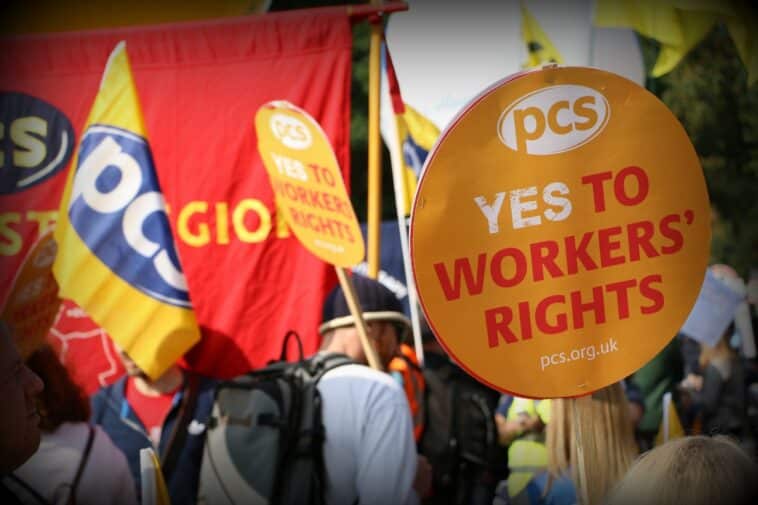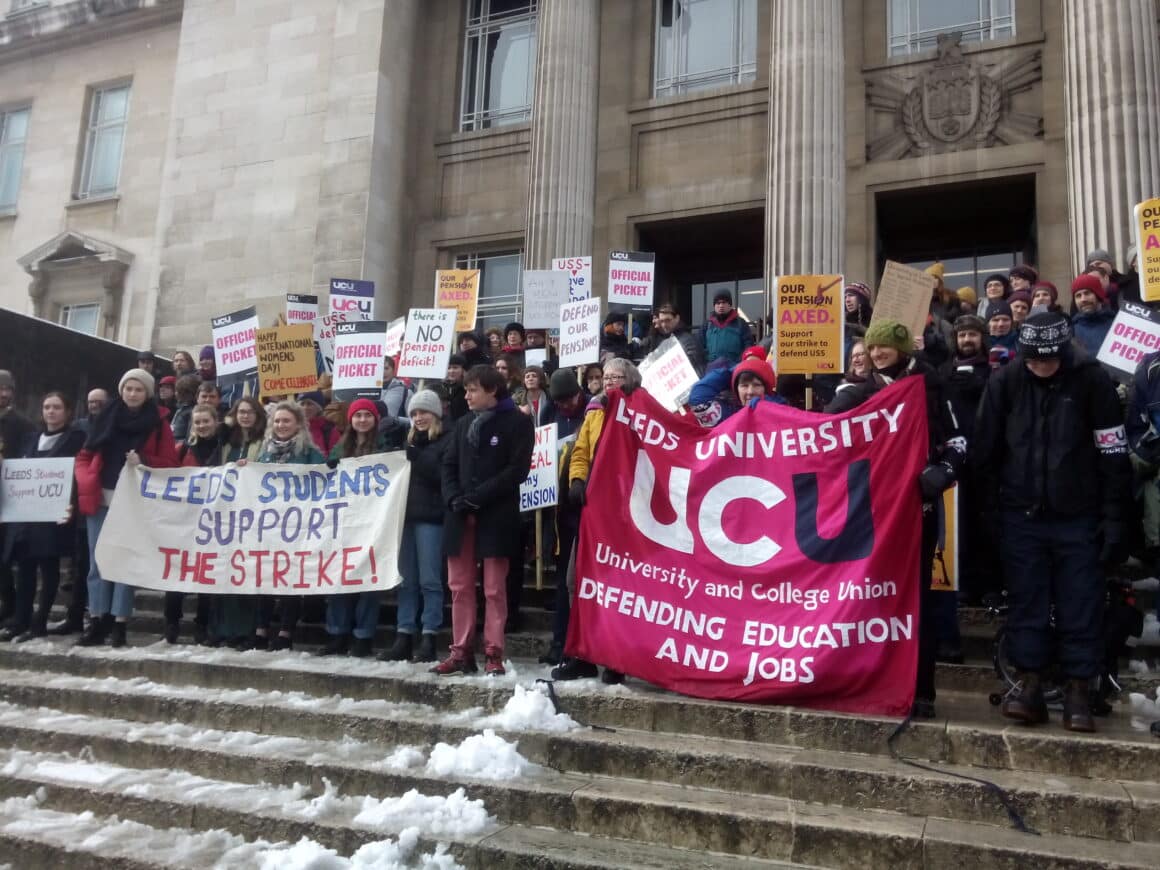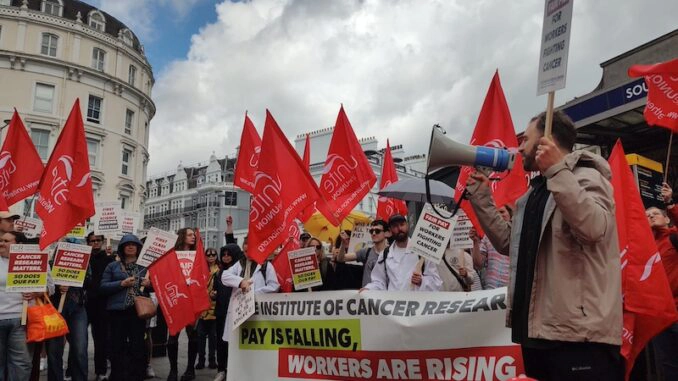
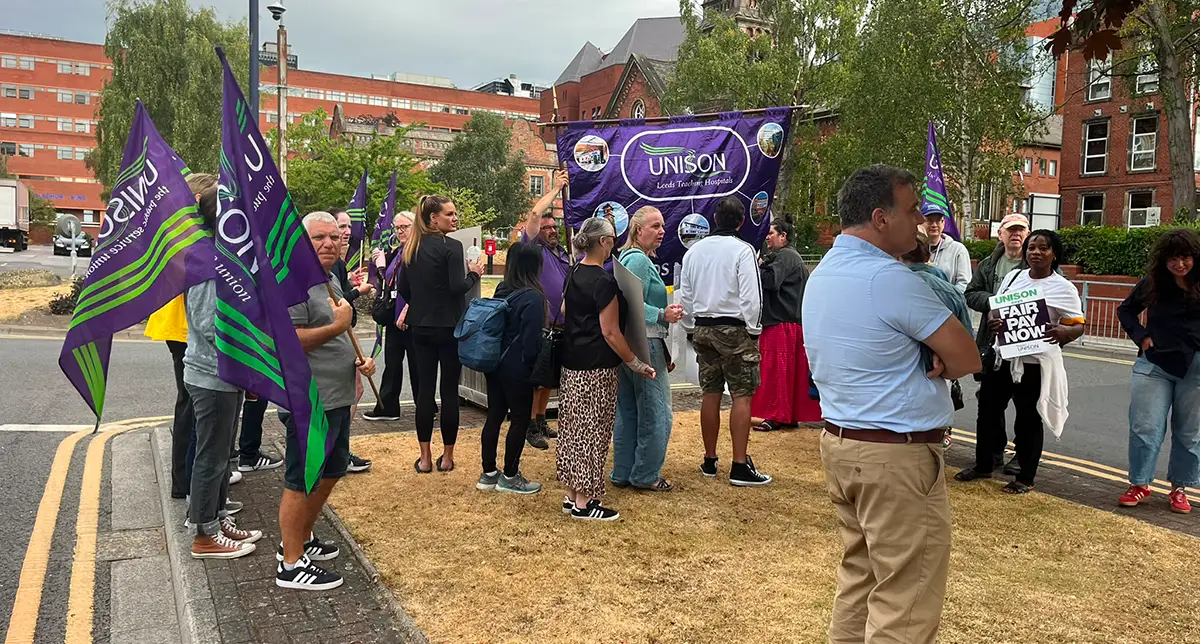
Perioperative assistants (PAs) in Leeds have been in a two-year dispute over back pay and fair grading with Leeds Teaching Hospitals NHS Trust. These workers provide vital support to nurses and surgeons in operating theatres, yet they are paid just 21p an hour more than the minimum wage. Despite being a ‘national’ health service, many workers doing exactly the same job in other NHS trusts are paid more. Unison point out that many NHS roles have changed over time and have not been re-evaluated, leaving some staff underpaid.
The dispute has already led to panel hearings, which rejected the workers’ claim to be regraded from band 2 to band 3, a rise from £12.92 to £14.05 an hour. In response the workers have escalated their action, from a 48-hour stoppage in December to five days in February and two full weeks in both June and July. Despite this, and despite more than 100 NHS trusts having settled similar claims, the trust is holding out.
I spoke to some of the strikers on the picket lines about how they thought the dispute was going. ‘I feel deflated,’ said one—which prompted me to ask more about the job and the fight. The strikers told me that the head of nursing for theatres and anaesthesia, is the main block. ‘She won’t back down, doesn’t want to be proved wrong,’ said one striker, adding that staff on other wards across Leeds hospitals do similar work but are graded band 3. ‘It’s a hierarchy thing,’ she said.
What the job involves
So what does a perioperative assistant do for a wage barely above the minimum wage? Essentially, they provide the support that keeps operating theatres safe and running smoothly: cleaning theatres, counting swabs and equipment (which matters, in case anything has been left inside a patient), handing instruments to nurses and making sure everything is sterilised. They also handle paperwork, including checking that nurses have signed off care plans before patients are collected. ‘One time the form said right leg, but an arrow had been drawn on the left leg,’ one striker told me—and no one had noticed until she pointed it out. PAs also collect and dispose of the theatre’s waste, sometimes checking the bin bags for missing instruments among the used swabs and occasional body parts.
The crux of the dispute is the trust’s claim that the workers are supervised. Union surveys of staff show that this is far from the case. In fact, they are often asked to do tasks outside their remit. ‘I’m asked to get blood because there’s no one else to do it,’ says one. Another said they are often told to use a more senior colleague’s card to access the blood gas machine, which provides crucial analysis—a senior task for which they have neither the training nor the pay.
So why are some of these workers feeling deflated? Because, after two years, no progress has been made. On the picket line, Unison officials argued that regrading disputes always take a long time but that the workers would win. They did not seem to register the low mood of the strikers, assuring them it would get resolved. Acas—the Advisory, Conciliation and Arbitration Service, a publicly funded body that offers conciliation, mediation and arbitration—offered to help, and Unison accepted. The trust refused, on the spurious grounds that it is already ‘talking to the union’—which is not the case, and would in any event mean the same people talking to one another.
Get The Spark in your inbox
Workers Power’s weekly newsletter
Solidarity needed
Meanwhile, every time the PAs strike, other workers on higher bands cover their shifts on higher pay, plus overtime. ‘They should get band 2 pay like us,’ said Leah, a striker. I asked whether any of these scabs were in Unison. The strikers weren’t sure, but thought some might be. Either way, most will belong to one union or another—which shows that solidarity has to be more than a word. It has to be an action. Some strikers agreed that a more joined-up approach with other NHS workers would help. As with previous NHS strikes, there has been a lack of coordination—the very thing needed to force a quick win rather than a long, drawn-out dispute.
Activists from Unite Community (the unwaged section of Unite) were also on the picket line, discussing how they might help move things forward. They were clear that the wider Leeds labour movement should step up to help these workers win.
The following week the strikers marched on the trust’s board meeting, backed by Unite Community, Leeds Trades Council and other trade unionists, including the Troublemakers at Work network. A strikers’ delegation asked to address the board and was refused, but the noise of the protest carried into the boardroom. Instead they met the trust’s chief people officer (CPO), who later came out to speak to the strikers. She said there had been a ‘miscommunication’ and offered a job evaluation. One Unison member was sceptical: the process can take more than a year. The delegation told the CPO that morale was low and staff were leaving. Even so, the strikers are now getting a hearing rather than being fobbed off or ignored, and they are determined to fight on.
The offer of a job evaluation is a sign the strikers can no longer be ignored, but a process that can take a year is also a way of letting the anger on the picket line drain away. It leaves the PAs where they began: the lowest-paid section, fighting alone, while workers on higher grades cover their shifts.
At the moment, negotiations with HR are going on up to the 4th of August, focussed on job descriptions that could determine if workers are upgraded or not. To up the ante, the strikers need to insist that their branch produces a leaflet appealing to fellow staff—the majority working their shifts on strike days—as well as explaining their campaign to the public. A mass campaign of agitation around the hospital could be mounted with help from the many activists from the left and other unions such as Unite Community and rank and file activist network Troublemakers At Work who turned up to help picket the Trust’s board on the 31 August. They can appeal to strikers and activists from the nurses and doctors strike to help out too and publicise their dispute within the trust. If negotiations don’t go their way, staff will also have to decide whether to escalate the action, up to all out if necessary.
All NHS workers face the continual crisis of the underfunded health service, Labour’s new plans to advance privatisation, and another cost of living crisis that will undermine pay further. The struggle in the NHS has to stop being waged section by section. Rank-and-file activists should push for a trust-wide assembly of delegates, elected from every ward, department and union at Leeds Teaching Hospitals, to draw up a common claim and to decide together how to win it, so that no section is left fighting alone and struck work is not simply covered by others. The wider labour movement that turned out for the board protest could help build it, and link the PAs’ fight to the battle for fair grading in trusts across the country.
That is what it means to turn solidarity from a word into an action. Isolated trade union battles, without clear political leadership and coordination driven by the rank and file, will struggle to win, and unions cannot be left in the hands of officials who counsel patience. The capitalist system will never give in to workers’ demands without a fight—and the working class has to be ready to fight just as hard, and together, not only for its immediate demands but to bring down the whole rotten system.