
Labour’s justice secretary, David Lammy, is seeking to remove the right to be tried before a jury of one’s peers. One of the fundamental principles of British democracy is the rule of law, yet the Labour government is using the law against peaceful protesters.
The government’s argument for this radical change—which had no democratic mandate, having never appeared in Labour’s manifesto—is the backlog of cases awaiting trial. Ministers claim that reducing jury trials will make cases conclude faster. But this would place the fate of thousands of defendants in the hands of a single judge. We have previously seen a judge replaced in an attempt to secure a verdict more favourable to state interests.
The proposal also comes against the backdrop of recent cases in which defendants’ legal representatives were barred from making closing statements or using accurate language to describe the situation in Gaza and occupied Palestine. Defendants have been prevented from explaining the reasons for their actions, while the media have faced legally enforced reporting restrictions in the recent Filton cases.
Juries were not allowed to hear why the defendants took action. Nor were jurors in the Filton cases informed that the defendants would face counter-terrorism measures despite not having been convicted of terrorism. Only one solicitor, Rajiv Menon KC, made closing remarks in these cases; the others did not make a statement. The judge accused Menon of breaching explicit directions—an extraordinary development in a British court. He later won his appeal against the contempt of court charge.
The British state has repeatedly invoked antisemitism to justify measures against protesters, direct-action groups and civil-disobedience campaigns. Yet the Institute for Government has stated that judge-only trials in England and Wales would save less than 2% of Crown Court time. The Bar Council estimates that the change would reduce the waiting time for a trial by only one week after a two-year delay. Every group agrees that the figures used by Sir Brian Leveson are exceptionally uncertain.
The government has also instrumentalised victims of sexual assault, claiming that the change is needed to support them. Charlotte Nichols, Labour MP for Warrington North, spoke movingly in the House of Commons as a rape survivor in opposition to the proposals.
Survivors of sexual assault will be horrified by the attempt to draw a false equivalence between violent crime, terrorism and political protest—and by the use of their experience to weaken the right to a fair jury trial.
The Bar Council has suggested a separate route for sexual-offence cases, with specially trained judges and barristers, and courts set aside exclusively for trying them. Under this proposal, terrorist cases would also have a separate route with less than half the delays faced by other criminal cases.
The government says it has modelled these proposed changes on the Canadian system. This is highly misleading. In Canada, defendants have a choice between judge-only trial and jury trial. This is a vital safeguard that the government has neglected to mention and is planning to omit from the British system. Public-interest cases need juries, protest cases need juries, and ethnic minorities need juries—as David Lammy’s own report highlighted.
Protests
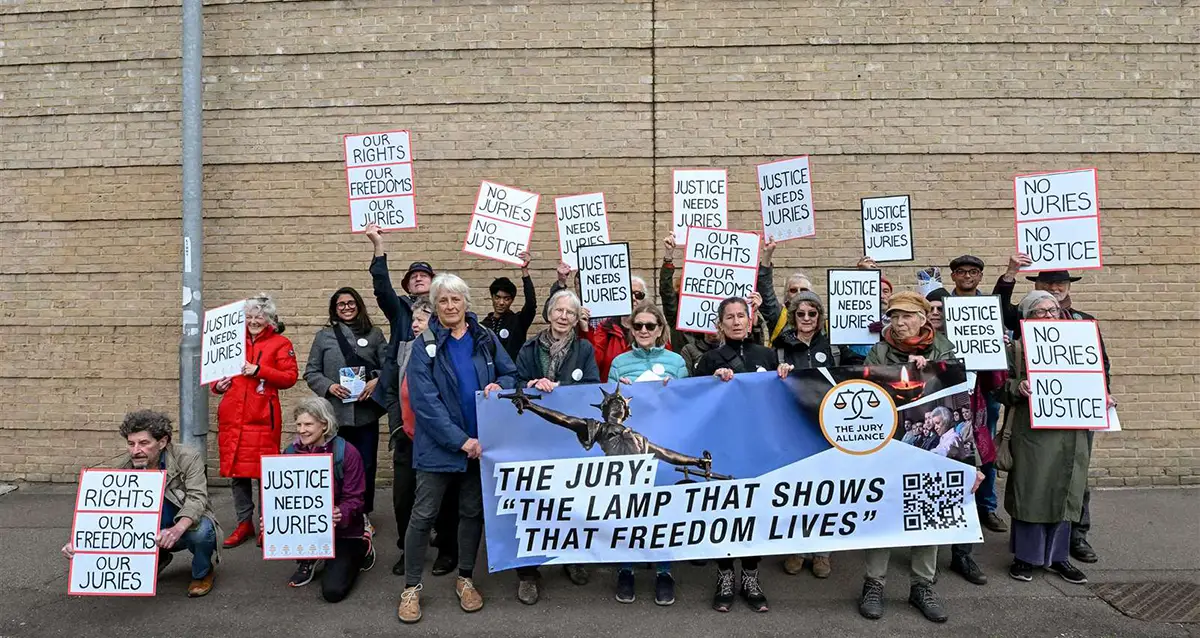
Armed with DIY banners, placards and other materials, around a dozen protesters began gathering from 9.45am outside Liverpool Crown Court, a brutalist building of red concrete.
The group had printed several hundred branded leaflets, stickers and letters for judges, barristers and solicitors making their way into court. Members of the public had varied reactions, but barristers and solicitors in particular received the letters warmly. Many openly declared their agreement with the protest against the removal of juries. The materials were supplied by the Jury Alliance, which organised similar protests across the country on 18 May.
Before the protest got underway, police approached participants several times, asking questions, monitoring the group and seeking to establish how the action would proceed. They made it clear that the protesters would be watched closely.
Many attendees had previously taken part in Defend Our Juries sit-in protests. Some are now facing charges under terrorism legislation for holding placards reading: ‘I oppose genocide; I support Palestine Action’. The overlap between Palestine solidarity, civil-rights and other campaigns shows how closely connected these struggles are.
Despite the relatively small scale of the action, the Jury Alliance was able to mobilise people in most major cities across Britain, giving it a nationwide reach. One highlight was the strong response from solicitors and other legal professionals, many of whom clearly agreed with the defence of jury trials.
However, demonstrating outside Crown Courts kept the protest static and away from the main flow of foot traffic in Liverpool city centre. That may also have been true in other cities, limiting the campaign’s reach among the wider public. Protesters were able to hand-deliver a letter to the court, but could not engage judges or senior court staff inside. The experience gives the Jury Alliance a useful basis on which to reassess its tactics, publicity and audience reach, with the aim of making a bigger impact in future.
The argument for socialist change has rarely been stronger. In Britain and internationally, we need to resist the growing repression directed against political dissenters, including environmental campaigners and Palestine solidarity activists.
More and more people are waking up to the cost-of-living crisis, while the government considers measures to classify phrases such as “From the river to the sea” and “Globalise the intifada” as banned hate speech. It invokes antisemitism and real hate crimes against Jewish people to suppress Palestine solidarity and political protest.
People are choosing between heating and eating, while the government pursues policies that protect the interests of the ruling class and support Israel’s continued occupation of Palestine. Lobbying groups and affiliated organisations also exert pressure on the British government. UK Lawyers for Israel has been especially active against protest movements, direct-action groups and civil disobedience connected to Palestine solidarity.
This is the age of ‘lawfare’: a weaponised legal system being used against the public it supposedly protects and serves. Again and again, the political establishment sides against the British working class.
For a government that claims to protect freedom of speech, this exposes a naked hypocrisy and subservience to ruling-class interests. As workers, we have to recognise that the fight has come to us and answer its call. Whether Black, white or Palestinian, when they come for one of us, they come for us all.
Challenging the legal system is necessary if we are to shift the balance of class power. Protest movements need to work together, sharing tactics, resources and knowledge. For future actions, groups such as the Jury Alliance should aim bigger, bolder and more effectively: reaching a wider public and putting real pressure on the government and the interests it serves.