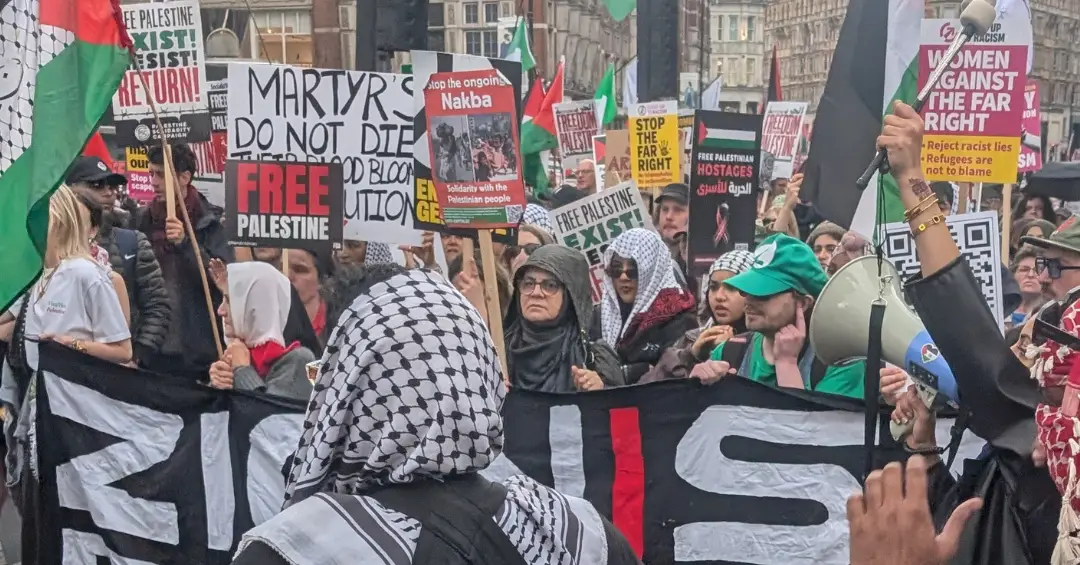
In the end the two opposing marches, Stephen-Yaxley Lennon’s (aka ‘Tommy Robinson’) Unite The Kingdom II and the Nakba annual commemorative demo, passed off without major incident. The 4,000 police mobilised had relatively little to do, arresting 11 antifascists and 20 far right activists.
This was always the intention of the organisers, who explicitly agreed to avoid confrontation beforehand as a precondition of their events taking place. Of course, both sides released figures for their turnout that are quite preposterous.
Robinson said repeatedly that there were ‘millions’ in Parliament Square, Whitehall and the Strand. It is no less absurd that the counterclaim by the SWP and others that there were ‘only’ 35,000. On the other hand, the Nakba demonstration was nowhere near the 250,000 claimed by John Rees, though the small area reserved for their rally meant many protestors left almost as soon as they arrived.
What can be said is that neither demo was as big as last September’s Robinson rally or the Together Alliance protest on 28 March. So, what does 15 May tell us about the far right and its opponents?
Unite the right?
If Robinson had hoped to replicate or improve on last September’s demonstration, he must have been sorely disappointed. Not only were numbers down, maybe half the size, but once again there were clearly quite separate contingents. The first few thousand to reach Parliament Square listened in silence to ‘Rule Britannia’ and ‘Land of Hope and Glory’. They looked even more puzzled when the Lord’s Prayer boomed out over the loudspeakers.
A second section, half an hour later and of a similar size, included several holding crucifixes and a scattering of would-be Crusaders. Robinson’s apparent conversion to ‘Christian Nationalism’ will no doubt guarantee increased funding from the US and may be used as cover for racism and Islamophobia, but is unlikely to play a central role in consolidating a mass right wing movement in Britain.
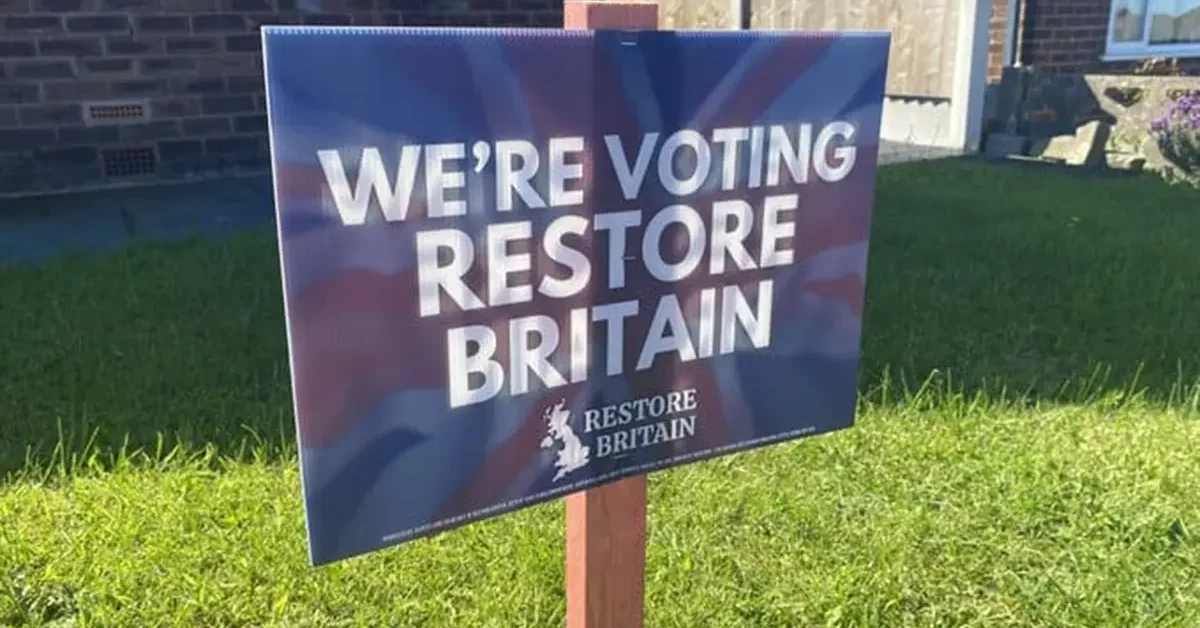
The main contingent, which entirely filled the Strand, was led by pro-Shah Iranian flags, followed by a sizeable group with England flags while Union Jacks dominated the rest of the march. Here and there, hand-made placards showed support for Rupert Lowe’s Restore Britain or Reform UK, but these were individuals, not organised groups.
Context is everything. Last September’s rally came after a summer of street activity and with Reform surging in the polls. This year, Reform is only one of five (or seven if you include the Scottish and Welsh nationalists) parties vying for a share in office. Labour has taken the heat out of the asylum hotels issue, largely by giving in to the racists’ demands for their relocation and by implementing swifter deportation.
How to unite the racist rabble into a disciplined mass movement, how to give it a coherent, unifying ideology, how to plug into the wider, global far right without losing its nationalist edge, and last but not least how to assemble a street fighting force out of all this: these are questions to which Robinson, Lowe, Nick Tenconi (Ukip), Paul Golding (Britain First), etc. have no answer… yet.
Palestine solidarity plus
The Nakba demonstration was large but also down from the numbers achieved at the height of the (ongoing) genocidal Zionist onslaught. It was upbeat, with sound systems and loud hailers beating out a constant series of chants. But, at the same time, it remained a march for Gaza, with some anti-far right elements tacked on.
In response to last September’s shock, the TUC and SWP leaderships launched two related initiatives. The first was to initiate the Together Alliance, a coalition of over 50 organisations and celebrities specifically aiming to drown out and defeat the far right. Where was it?
No doubt the SWP’s liberal outriders would have been spooked by the idea of defying Met commissioner Sir Mark Rowley and prime minister Sir Keir Starmer, both of whom condemned the slogans of the Palestine movement and blamed it for the rise in antisemitism. Defending migrants in the abstract is fine; defending migrant communities under attack from the state is quite different. What use are allies who disappear as soon as the going gets tough?
The other initiative was to take the arguments against the right into the workplace, and by so doing bring organised groups of workers onto the streets to oppose the racists and fascists: to turn paper resolutions (and tons of money) into real people on real mobilisations. The result? There were fewer than a dozen union banners on display on 15 May, no giant balloons, no national stewards of contingents. Yes, Fran Heathcote (PCS), Daniel Kebede (NEU) and Andrea Egan (Unison) spoke, but that was the status quo before the launch of the Together Alliance by the TUC and Stand Up To Racism.
Trade unions against racism
The election results of 7 May should be cause for a second alarm bell to ring in the labour movement. Reform remains the most popular party in many parts of the UK, even in parts of Scotland and Wales.
The battle to push back against the racists – so far amounting to one TUC online education course – has barely begun. Trade unions can play a leading role in opposing racism – but only if they are won to a political struggle, not just a defensive one. That means demanding the repeal of immigration controls, organising solidarity with migrant and refugee communities facing state violence and deportation, and building the capacity for self-defence against fascist attack. To do that we need to organise rank and file workers to confront a labour bureaucracy more concerned with managing relations with a Labour government than with mobilising the class it claims to represent.
But ultimately, winning the labour movement to a political struggle against racism – linking organised workers to tenants fighting eviction, to communities under racist attack, to anti-deportation campaigns – requires political organisation within the unions capable of challenging both the bureaucracy and the parties it supports. That means building toward a revolutionary workers’ party: the only form of organisation that can fuse the struggles of the workplace and the community into a conscious political force, break the grip of the bureaucracy on the labour movement, and offer the working class a real alternative to the managed decline of Labourism and the false answers of the right.
Whatever the snapshot of 15 May reveals, we are entering a period of deepening economic crisis, wars and environmental catastrophe. This will polarise society further and provide fertile ground for the right – in Britain, across Europe and internationally. The answer is not more online education courses. It is organised workers, in their workplaces and communities, fighting the racism of the state and the street alike.