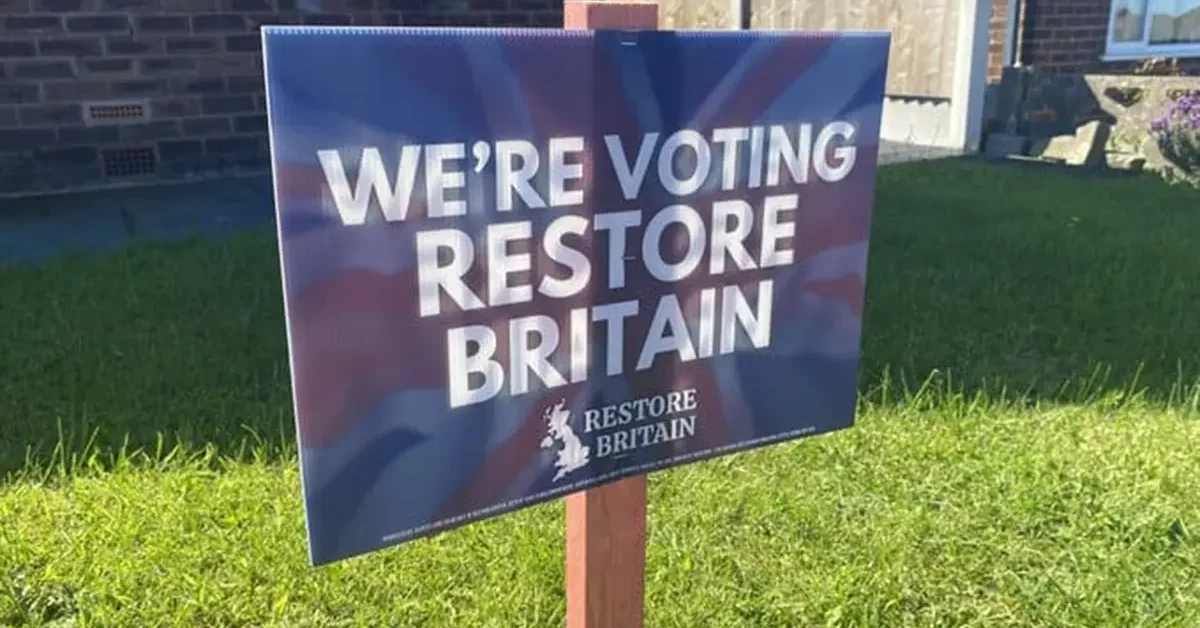
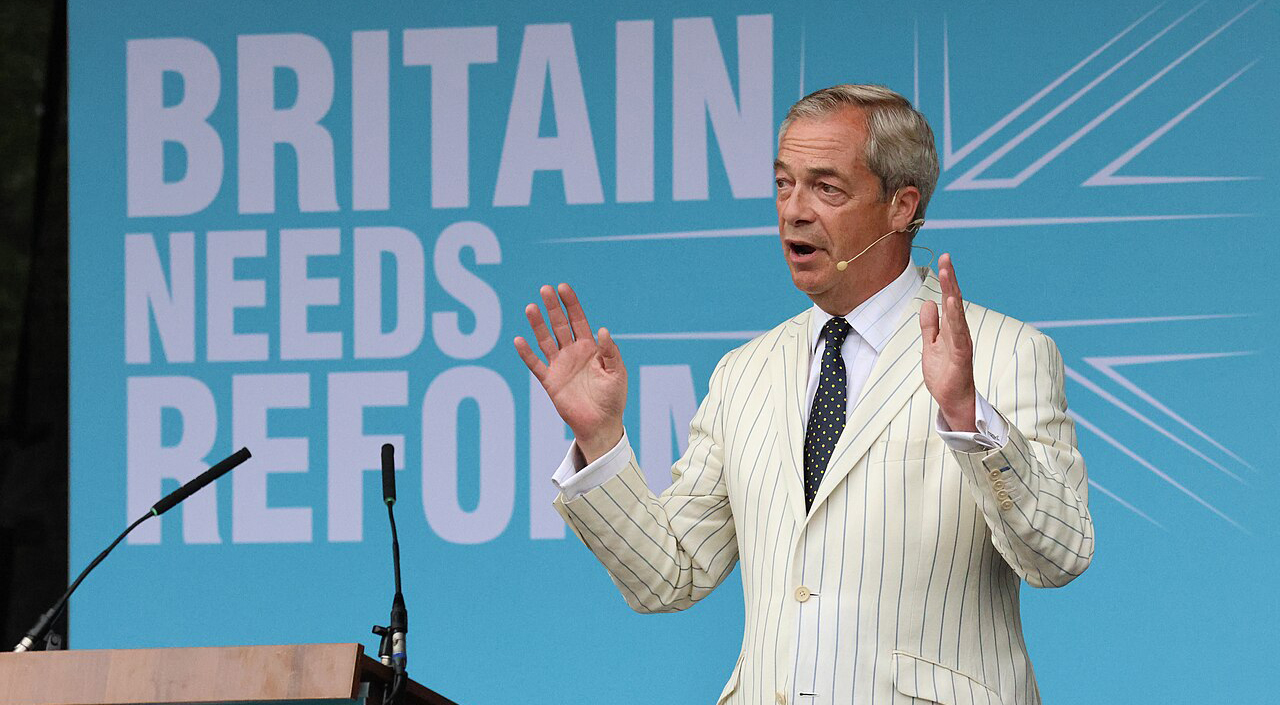
On 7 May Reform UK took control of 14 English councils, won 17 seats in Holyrood – its first elected representation there – and became the official opposition in the Senedd with 34 Members. A separate piece in this issue looks at the election results. Here we ask what kind of political project Reform is, whose interests it serves, and how socialists should respond to the claim that it now speaks for the working class.
Reform UK is the latest vehicle for a current with a much older lineage. Its roots run through the little-England chauvinism of the post-imperial Tory right: the Bruges Group, the Maastricht rebels, the Referendum Party, UKIP and the Brexit Party. It is defined by hostility to European integration, immigration and the regulatory commitments associated with both. For most of its history this was a minority current on the right of British politics.
Brexit changed that. The 2016 referendum turned a fringe tradition into a mass political force and gave a particular fraction of British capital a vehicle for a concrete class project: to break from the EU and the wider European regulatory framework, whose rules on labour, the environment and state aid placed limits, however weak, on the freedom of capital.
That meant labour-market deregulation, attacks on welfare spending, accelerated NHS marketisation, scrapping net zero to protect fossil-fuel interests, freeing finance from European oversight and opening the way to trade deals with the United States. The positive vision, insofar as there was one, was a low-tax, low-regulation, finance-led economy oriented towards profitable circuits of capital in the US, the Gulf and Asia, rather than the European market.
Its patriotism also implied rearmament and a more aggressive imperial posture abroad, as Nigel Farage and Richard Tice showed in their initial support for Trump’s Iran war before retreating when it proved unpopular.
Naturally, this project could not be stated openly. A campaign to lengthen the working day and privatise public services would not have won a referendum. The fraction of capital behind Brexit did what such fractions have always done: it built a mass base on racist, nationalist and authoritarian slogans, manufacturing a ‘crisis’ to channel legitimate working-class anger towards reactionary policies. ‘Take back control’ was the formula, but the control to be taken was capital’s, not labour’s.
Moving on from Brexit
Reform UK continues that project. Although the Tories delivered a more-or-less hard Brexit, the pandemic, the war in Ukraine and Trump’s protectionism made a freebooting Britannia harder to realise. Reform therefore claims that the central promise of Brexit – to “take back control” of the borders—was betrayed by the Tories, whose new trade deals and economic failures reduced European immigration but increased non-white immigration. It also claims Labour secretly yearns to rejoin the EU.
Reform’s donors come from the same Brexit-right current, now consolidated around the party: speculative finance, hedge funds, crypto wealth and fossil-fuel interests. They include Jeremy Hosking and Christopher Harborne, alongside a transatlantic network linking the British right to the Maga axis, the fossil-fuel lobby and the policy machinery of far-right and free-market think tanks.
The party has also drawn on the ideological apparatus around Britain’s National Conservatism wing: the Cambridge theologian James Orr, post-liberal and national-conservative writers, and GB News presenters acting as in-house propagandists.
Reform’s platform has moved further right since Brexit, emboldened by rising support and Trump’s example. Withdrawal from the European Convention on Human Rights is combined with anti-migrant policies modelled on America’s ICE. Tax cuts for business and high earners would be financed by cuts to public spending. Abolishing net zero would protect fossil-fuel interests. “Insurance-based” reform of the NHS presents privatisation as choice. Its authoritarian culture-war and policing agenda would target trade unions, protesters, climate activists and minorities.
Racism does the work of explaining away the housing crisis, wage stagnation and the collapse of public services after four decades of neoliberalism. Blame the asylum seeker, ‘woke’ councils and the Westminster ‘blob’; spare the landlord, shareholder and City.
Reform’s elite character is shown by the procession of senior Tories defecting to it. Andrea Jenkyns left the Tories and was elected Reform mayor of Greater Lincolnshire. Danny Kruger, Robert Jenrick, Suella Braverman and Andrew Rosindell all followed from the parliamentary Tory right. Malcolm Offord, a former Tory peer, now leads Reform in Scotland and sits in Holyrood.
This is a right-populist party, thoroughly capitalist in its finance, ideology and leadership, while cloaking its pro-rich policies in ‘common sense’ prejudice as Farage smiles for the cameras, pint and cigarette in hand.
The ‘white working class’ myth
Despite the efforts of a well-financed lobby to argue otherwise, Reform’s rise is not simply a working-class revolt. Its core base includes ex-Tory voters, the self-employed, small employers, retirees and older, socially conservative voters in southern and coastal England – layers long receptive to anti-immigrant politics and hostility to redistribution.
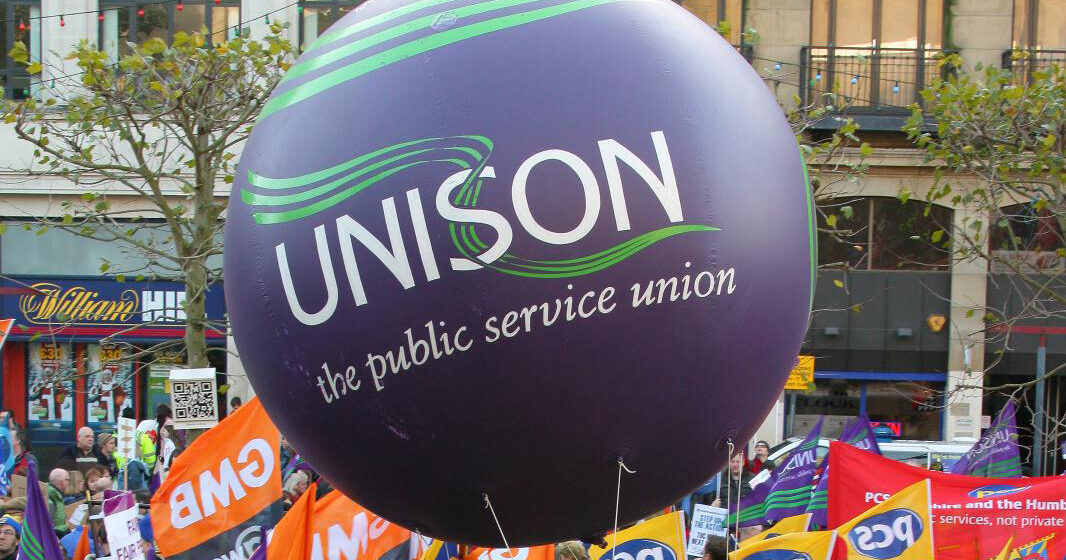
But Reform is also attracting older workers from deindustrialised areas such as Sunderland, Tameside, the Welsh valleys and the Durham coalfield, where Labour and the trade unions’ retreat from their working-class base has hollowed out class loyalties.
The so-called ‘white working class’ is an ideological construction, not a sociological reality. It racialises class, treats Black and Asian workers as anomalies, and overrides real class divisions between employers, the self-employed and wage workers. Reform’s ‘war on woke’ pits the oppressed and the poor against the residents of ‘left-behind’ towns and council estates.
Reform, like Blue Labour, uses class language to present attacks on workers as a defence of workers’ interests. Its purpose is to pull politics rightwards on migration, welfare and culture.
For some voters, a Reform ballot is less an endorsement of Farage than a protest against the ‘establishment’. But it is still more than a protest. It gives support to an increasingly right-wing and openly racist programme: stripping rights from migrants, attacking non-white British citizens, mass deportations and detention camps modelled on Trump’s America. That is not an anti-establishment vote. It is a vote for right-populist reaction.
There is no doubt Reform has attracted substantial numbers of working-class and former Labour voters. Labour bears much of the responsibility. It has failed to challenge anti-migrant politics as the default explanation for housing shortages, unemployment and social decline. In office and in councils, Labour has also helped create the conditions Reform exploits: austerity, cuts, failed housing policy and worsening public services.
What is to be done?
Decades of Labour retreat from working-class organisation, triangulation on welfare and migration, and accommodation to the bosses’ agenda produced the political vacuum that Reform now fills. In some areas Labour is losing voters in opposite directions: to Reform on the right and to the Greens on the left. Under Starmer, tougher rhetoric on borders, protests, welfare and defence has been combined with austerity that makes workers worse off. The party that claims to be confronting Reform is clearing its road.
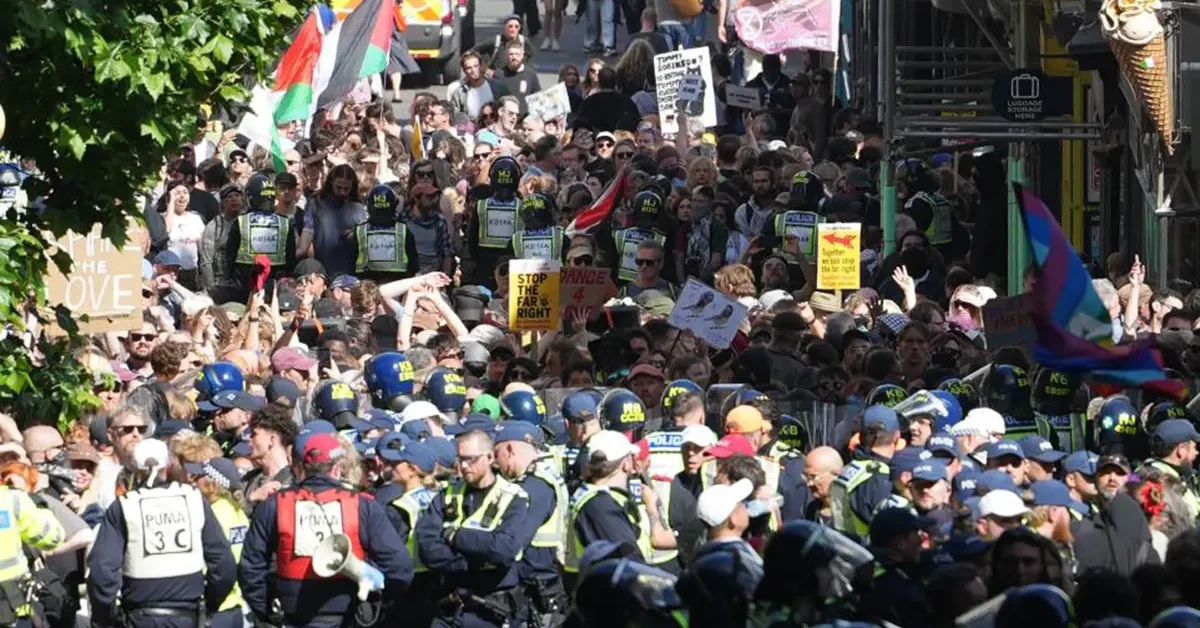
What can confront Reform is the rebuilding of working-class power. That means class-struggle anti-racism and anti-fascism in workplaces, unions and communities. It means an anti-capitalist programme on the conditions Reform exploits: housing, wages, public services and democratic rights. And it means turning anger against the employers, landlords and state institutions responsible for the crisis.
Neither Labour nor the Greens are willing or able to organise that confrontation with capital. The task falls to socialists, trade union militants and working-class organisations: expose Reform as a bosses’ party, fight racism wherever it appears, and build a political alternative rooted in class struggle.