
Trump began 2026 with a bang, kidnapping Venezuela’s president Nicolás Maduro on 3 January before loudly renewing his demand to annex Greenland, at first refusing to rule out the use of force before backing down at the Davos summit. Then after weeks of a cynical game of chicken with his “beautiful armada” encircling crisis-hit Iran, the US launched its surprise attack alongside Israel, killing Supreme Leader Ali Khamenei and aiming for regime change. All these aggressive actions are widely seen as down-payments on Trump’s new national security strategy, which formalises a radical shift in US imperialism’s foreign policy.
Underlying this is a basic plank in Trump’s outlook : ‘I don’t need international law’. Military strikes replace resolutions at NATO or the UN and long, slow, weak sanctions. Meanwhile the US withdrew from another 66 international organisations ‘that no longer serve American interests’, half of them United Nations bodies. UN Secretary-General António Guterres says it faces ‘imminent financial collapse’ by July if the US continues to withhold funding.
Of course Trump is in one sense ripping the mask off American imperialist realpolitik. Some analysts argue that the kidnapping of Maduro was out of the playbook of George Bush Sr’s invasion of Panama in 1989 to seize the president Noriega, also charged with drug trafficking, and that Ronald Reagan also withheld UN funding to force changes in policy.
But though the US has always pushed aside international law when needed, it has done so while maintaining these treaties and institutions as important tools in the cold war and globalisation era to exercise its global reach. This international ‘rules-based order’ has become increasingly a financial burden and fetter on the assertion of US interests. China’s rise and the USA’s relative decline make this unsustainable. Trump’s new National Security Strategy (NSS) published in November 2025 lays out this qualitative, not incremental change to the old order.
Biden upheld the USA’s postwar ‘360-degree strategy’ for American hegemony based on ‘the principles and institutions that have enabled so much stability, prosperity, and growth for the last 75 years… the rules-based order must remain the foundation for global peace and prosperity‘. This meant the US ‘leading the international response to these transnational challenges’ such as ‘poverty and pandemics’ hand in hand with allies.
Trump’s NSS turns this inside-out with a nakedly ‘America First’ foreign policy, based on ‘peace through strength’, applied to allies and enemies alike, ignoring or attacking global treaties and institutions. The most radical new planks of his strategy are aimed at allies more explicitly than foes, reasserting a ‘Donroe Doctrine’ of US hegemony over the Americas to keep out rivals, i.e. China.
In tandem it pushes to reconfigure Europe in MAGA’s image by undermining the EU and promoting the surge in ‘patriotic’ right populist or even far right parties. The implicit goal is to woo Russia away from China and reconcile Europe to Putin.
Trump rejects not just the ‘overextension and diffuse focus’ post-1945 strategy, but also its cover of humanitarian aid, sticking plasters on the wounds caused by a capitalist order. That isn’t because Trump is less hypocritical – his new reactionary causes are supposed persecutions of Christians (Nigeria) or whites (South Africa). He intends to drop those overhead costs or force them onto other powers.
Trump’s strategy is simple: concentrate the USA’s economic, financial and military power at strategic points – e.g. Venezuela and Iran, oil states allied to China – to force a breakthrough and reconfigure regions in American interests. The military spectacle and the ‘win’ help whip up patriotism and prejudice, overcoming fears of ‘forever wars’, as does linking it to immigration and the domestic drug crisis as Trump did with Maduro.
‘Two words, America First.’
So the National Security Strategy document ends. It is short, repetitive, full of imperial hubris and wishful thinking to paper over its contradictions.
First the reality check. The document cynically says that there is a ‘predisposition’ against intervention quoting the Declaration of Independence, before noting that ‘for a country whose interests are as numerous and diverse as ours, rigid adherence to non-interventionism is not possible’!
Already Trump has expanded counterterrorism airstrikes in the Middle East and Africa, bombed Iran’s nuclear facilities and kidnapped Maduro. Are the 200 military personnel, foisted on Nigeria’s government in the name of defending Christians, Trump’s first boots on the ground?
Its condemnation of ‘civilizational decline’ caused outrage in Europe. The plan is to cultivate ‘resistance within European nations’ by encouraging far-right parties like Germany’s AFD. This goes hand in hand with ‘building up the healthy nations of Central, Eastern, and Southern Europe through commercial ties, weapons sales, political collaboration, and cultural and educational exchanges’.
The NSS poses Europe’s decline in the racist terms of the great replacement theory, ‘that within a few decades at the latest, certain NATO members will become majority non-European. As such, it is an open question whether they will view their place in the world, or their alliance with the United States, in the same way as those who signed the NATO charter.’
The unspoken aim is to fragment the EU, undermine Franco-German imperialism and strengthen US power in Europe, all to create a ‘reliable’ and subordinate ally acting as a continental bulwark for American interests.
Another rupture is the NSS’s declared ‘Trump corollary’ to the famous 1823 Monroe Doctrine, that the US will aggressively reassert its hemispheric hegemony, integrating the Americas North and South into an US economic sphere while controlling its arctic border. Pushing Chinese companies out of Panama, bullying obedience out of Venezuela, Mexico and Colombia, blockading Cuba, all point to this long-term reorientation of policy. It aims to prevent China and Russia dominating the newly accessible sea lanes and energy supplies of the Arctic, developing as a shorter route to Europe avoiding the ‘chokepoints’ that the US dominates.
Trump’s leadership team centres on the two men likely to compete to be his successor in 2028, Vice-President JD Vance and Secretary of State Marco Rubio, as well as Whitehouse spokesman Stephen Miller, Trump’s White Christian Nationalist advisor in charge of ICE. The Strategy builds-in Vance and Millers’ open contempt for liberal Europe.
The differences can be overdrawn. The more traditional neoconservative Rubio has been tasked with heading the post-Davos negotiations on Greenland, hoping to wind down the damage wrought by Trump’s threats. He also headed the US delegation to the Munich Security Conference after JD Vance’s speech last year caused outrage.
Rubio’s appeal to a shared ‘Western civilization, Christian faith and ancestry’ received a standing ovation, but included a quiet threat: ‘while we are prepared, if necessary, to do this alone, it is our preference and it is our hope to do this together with you, our friends here in Europe‘. Besides reordering Europe in MAGA’s image, the NSS upholds NATO but ends its expansion. In other words, no to Ukraine’s membership, and concessions to Russia to achieve ‘strategic stability’.
The NSS has some other sharp shifts. It rejects ‘America’s misguided experiment’ with human rights and democracy particularly in the Middle East and Africa in favour of ‘accepting the region, its leaders, and its nations as they are’. After Israel’s successful wars, it complacently sees ‘progress towards a more permanent peace’ with an order bankrolled by the reactionary Gulf monarchies, centred on the Abraham accords with Israel’s security one of the ‘core interests’. Again this is aimed at locking China out of the region’s energy supplies.
Trump’s document gives Africa a brief three paragraphs, where a few select allies will enable energy and mineral extraction and limit ‘Islamist terrorist activity’. This malign neglect starkly papers over the real contradictions, crises and revolts that will emerge, including the Palestinian struggle.
Closer to China, there is little different from Biden in maintaining a ‘vigilant posture in the Indo-Pacific’ with its focus on ‘free navigation’ and defence of Taiwan, along with strong support for the USA’s alliances (AUKUS, Quad): ‘the bedrock of security and prosperity long into the future’. Here the aim at hemming in Chinese power is clearest and a coming clash, barely mentioned elsewhere.
Trump’s free-range use of power has as its goal to ‘maintain the strongest economy, develop the most advanced technologies, bolster our society’s cultural health, and field the world’s most capable military’. America’s economic sway and exports will be rebuilt by carrots and sticks, tariffs and ‘inducements’ (mainly access to the US market).
Meanwhile ‘America’s Financial Sector Dominance’ and ‘technological pre-eminence’ will integrate ‘allies’ under the dollar’s umbrella and Big Tech’s platforms, key sources of US super-profits and parasitism. ‘Restoring America’s energy dominance (in oil, gas, coal and nuclear)’ as well as exports goes hand in hand with pressuring allies to reject ‘the disastrous ‘climate change’ and ‘Net Zero ideologies… that subsidize our adversaries’, i.e. China.
‘Reindustrialisation’ centred on defence production is an explicit priority, with the ideological fig leaf of rebuilding the middle class and ‘American worker’. In reality few workers will benefit from military production while the rest face precarious jobs created in a deregulated, low-tax regime freed from its ‘massive welfare state’. ICE workplace raids and city invasions show what a ‘culturally’ strong America means for its multiracial workforce.
Blowback, Backlash and War
There is a rational, imperialist core to the Trump administration’s radical strategy but the limits to American power are already materialising. Pacifying Iran requires regime destruction; abducting its supreme leader won’t suffice. The Gulf states are pleading with Trump not to start a war, which would mean regional chaos as well as US casualties.
The backlash against Trump’s tariffs have seen him retreat whenever the US stock markets or bond markets tumble. Congress and the Supreme Court are now attacking the policy. Both sabre-rattling and tariff threats are central to Trump’s approach. They need to be backed up or they become ineffective, leading to decreasing returns or even humiliating climbdowns.
Imperialist allies like Germany and France baulk at a plan for their financial and tech subordination, much less tariffs and threats towards Greenland. They also have more scope than semi-colonies to pushback. They might use Trump’s diktats to embrace military spending and boost their defence production but will be driven to play off the US against China much more than in the past, even as America threatens to up the costs of this.
Canada under liberal Prime Minister Mark Carney has gone furthest, out of desperation, declaring a ‘strategic partnership’ with China. European countries including Britain are pursuing lower-key trade links. Then there is the question of the electoral cycle and whether a new Democratic president could restore some of these relationships. Nevertheless they will keep much of Trump’s reorientation, just as Biden kept his protectionist measures.
Most fundamentally, the NSS vision of a peaceful order rests on China relinquishing its global ambitions, an impossible demand. No sphere of interest or further expansion is allowed, while its policies hint at a white Christian International against China with a racist right Europe and potentially Russian Orthodox Putin. The NSS evokes how the Donroe doctrine will ensure “other great powers” remain “separated by vast oceans”, hinting that US imperialism is positioning itself not just for the scramble for the arctic but for the possibility of an inter-imperialist world war, with Eurasia not the Americas as its battlefield as in the last century.
Against Trump’s rhetoric about avoiding forever wars, the Strategy proves that the imperialist stage of capitalism is an ‘epoch of wars and revolutions’, in Lenin’s words, just as its language echoes his observation that its monopolies ‘introduce everywhere the striving for domination, not for freedom.’
Trump shows the face of a new barbarism that will plunge the world into a more brutal era of exploitation, great-power competition and war. Just as the Donroe doctrine faces increasing opposition and mass revolt at home, so it will around the world.
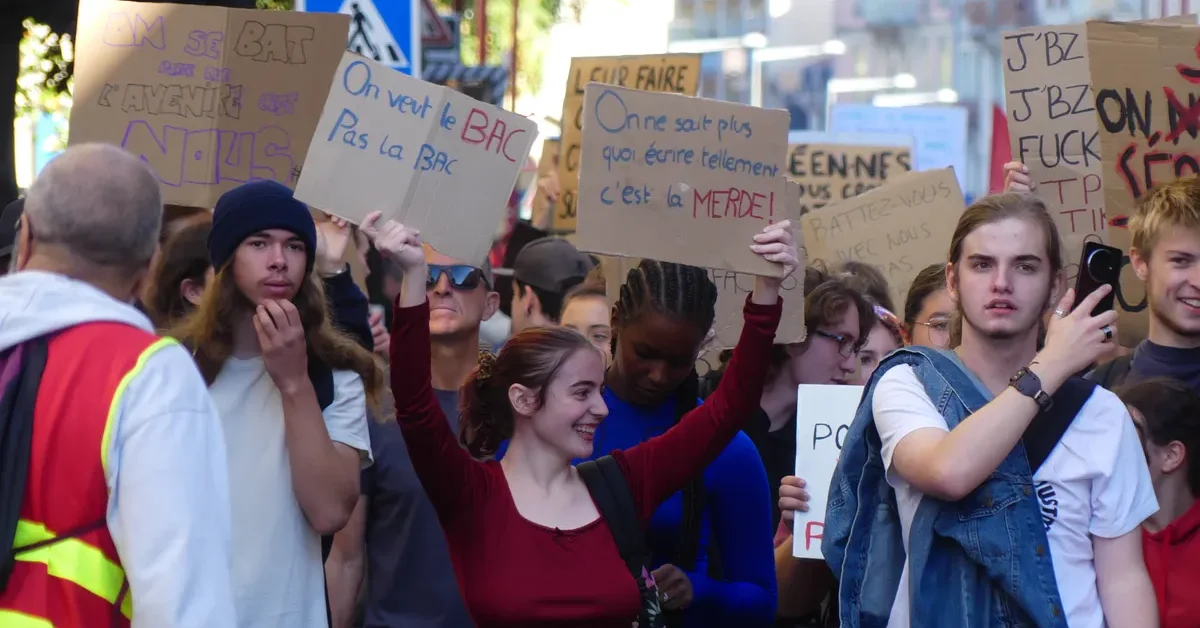
The working class and oppressed will rise again and again as 2025’s ‘Gen Z revolts’ prove, just as the global solidarity movement around the great Palestinian struggle shows the possibility of a new International. Won to a revolutionary programme, a new International can turn the inevitable resistance and anti-imperialist revolts into a global revolution against the whole rotten capitalist order.