
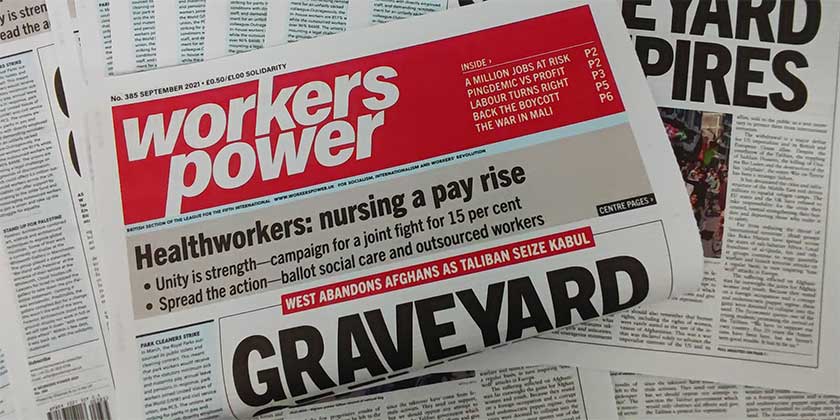
This book was first published by Workers Power and the Irish Workers Group in 1982. A revised and expanded second edition was published in 2012 covering the collapse of the Stalinist states and the restoration of capitalism.
Contents
Part 1
- The Transition from Capitalism to Communism
- From Soviet Power to Soviet Bonapartism
- Bureaucratic Social and Economic Policy
- Bonapartism in Crisis
- The Survival and Expansion After 1945
- Tito and Mao: Disobedient Stalinists
- Indochina: War, Compromise and Betrayal
- Castro’s Cuban Road: From Populism to Stalinism
- Permanent Revolution Aborted
- Stalinism and the World Working Class
- The Programme of Political Revolution
- Defence of the Degenerated Workers’ States
- Centrism and Stalinism: Revision of Trotsky’s Analysis
Part 2
- 1953–1981: Uprisings Against Stalinism
- Decline and the Failure of Reform
- The Beginning of the End
- 1989: The Year of Political Revoluiton
- The End of the Soviet Union
- China: Bringing Back the Bourgeoisie
- Conclusion
- Appendix 1: Marxist State Theory
- Appendix 2: The Programme of Political Revolution
- Appendix 3: Testing Theories to Destruction
- Endnotes
- Index
Preface to the Second Edition
When the Workers Power Group and the Irish Workers Group published the first edition of The Degenerated Revolution in 1982, it was one part of a larger project to reestablish the revolutionary programme of Marxism as developed by Lenin and Trotsky. At the heart of that programme lay the proposition that only the destruction of the bourgeois state at the hands of revolutionary workers’ councils could accomplish the overthrow of capitalism and begin the task of building socialism.
At the time, two historical developments appeared to many to have falsified that strategy; first, the Soviet Union, established by exactly the kind of revolution Marx envisaged, had actually given rise to a tyrannical and barbaric regime that used the principal economic levers of the socialist programme to maintain a dictatorship over the working class and, against Trotsky’s explicit predictions, had survived a war with imperialism. Second, capitalism had been overthrown in Eastern Europe and, later, in China, Cuba etc without any workers’ revolution.
The analysis of those developments was linked to another aspect of the larger project, the failure of the Fourth International, Trotsky’s International, to maintain a revolutionary programme in any of the principal theatres of class struggle from the late Forties on. Was this evidence of a fundamental error in Trotsky’s Marxism, or of the inability of his followers to re-elaborate it in the new conditions after the War?
For Workers Power and the Irish Workers Group, these two issues, the survival and expansion of Stalinism and the political, and later organisational, collapse of the Fourth International were fundamentally connected. The Degenerated Revolution was their answer to the conundrum. In brief, it argued that Trotsky’s analysis and method had not been proved wrong by events but his perspective of Stalinism’s collapse in the face of an imperialist onslaught had been falsified by events after his assassination, principally by the division of the imperialist camp between the Axis powers and the “democratic imperialisms” but also by the combination of Nazi strategic incompetence and the intrinsic strength of the planned economy and the resilience and martial spirit of the soviet workers—features that Trotsky had certainly noted.
In 1945, most Trotskyists around the world would have broadly agreed with this interpretation. It was the developments after the war that first divided, and then defeated, them. Before the decade was out, Stalinist forces had not only expropriated capital and established replicas of the soviet planned economy in most of eastern Europe but had been victorious against the US backed regime of Chiang Kai-shek in China. The task of developing Trotsky’s analysis of Stalinism to explain these events and using it to elaborate a revolutionary programme against both the imperialist powers and the Stalinist forces proved beyond the capacities of the, mostly young, new leadership of the Fourth International.
Some, notably Tony Cliff, the founder of the SWP(UK) concluded that, because the workers’ councils no longer ruled in the USSR and it had fallen under the rule of a new state capitalist class as early as 1928, the extension of Stalinist regimes was simply a different form of capitalism that posed no new problems for revolutionaries. Others, who continued to recognise the USSR as a degenerate workers’ state, concluded that those who had undertaken its replication elsewhere were no longer Stalinists (Tito) or, even if they remained Stalinists, had been forced to carry out socialising measures by the historical forces of progress that they believed Trotsky had identified as the motor of permanent revolution.
The programmatic consequences of these analyses were profound. To justify his characterisation of the Soviet Union, Cliff had been obliged to reject the programme of the Left Opposition in the 1920’s and identified Stalin’s policies, state capitalism in his terms, as the only practicable option for the isolated Soviet Union. This led him not only to a scrambling of Marx’s analysis of capitalism but to a “third campist” position in the developing Cold War between the US and the USSR. Meanwhile, the leaders of the FI; Pablo, Mandel, Healy, Cannon, Moreno, Lambert each in their own way accommodated to non-working class political forces in the belief that “history” would force them to overthrow capitalism as it had forced Tito.
Both Workers Power and the Irish Workers Group, which jointly published the first edition, originated in splits from the International Socialism group, now SWP, in the UK and the Socialist Workers Movement in Ireland both of which held that the “Stalinist states” were examples of “state capitalism” as that analysis had been developed by Tony Cliff in his book Russia: a Marxist Analysis. After the splits, in 1974–5, the two groups collaborated in a comprehensive review of the political tradition they had inherited. In the course of that review, and greatly facilitated by the publication of Trotsky’s writings from the 1920s and 30s, opinions within both groups moved against Cliff’s analysis but, at the same time, greater familiarity with the evolution of Trotsky’s analysis and of its programmatic implications made clear that none of the currents regarded themselves as “Orthodox Trotskyist” had actually maintained his legacy. Absorbed, as both groups were, in the heightened class struggles ofthe late 1970s, work on this and related theoretical issues proceeded slowly through internal discussion and schools. However, with the Soviet invasion of Afghanistan in December 1980 it became necessary to draw political conclusions from the work already undertaken. If the Soviet Union was a capitalist state then the invasion could only be seen as an imperialist intervention into the Afghan civil war and, as the United States was intervening on the other side, revolutionaries would have had to take a “defeatist” position.
The debate over this issue revealed that large majorities in both groups had by this time rejected the state capitalist analysis of the Soviet Union and now accepted Trotsky’s analysis that it was a “degenerate workers’ state”. That being the case, it had to be defended against imperialism and this meant supporting its victory in the Afghan war, despite opposition to the invasion itself.
In the course of the following year, 1981, theoretical work concentrated on the much more difficult issue of the expansion of Stalinism, that is, the construction of states in Eastern Europe and later in China, Cuba and Vietnam et cetera that were essentially identical to the Soviet Union but had never experienced revolutions comparable to that of 1917.
This work resulted in three main conclusions; first, a rejection of the analysis that the Stalinist parties involved had unconsciously implemented the strategy of permanent revolution under the pressure of an historic process. This analysis, often referred to as “Pabloism” but actually accepted by all the different currents in the Fourth International at the time of its Third Congress in 1951, was recognised as a revision of Trotsky’s own understanding of permanent revolution and, since these currents regarded the states that emerged as healthy workers’ states, as incompatible with the more general Marxist doctrine of the need for a conscious agent in the revolutionary overthrow of capitalism.
Secondly, that the overthrow of capitalism in these states had been made possible without a revolution because unique historic circumstances had, in effect, smashed the bourgeois state which would otherwise have defended capitalist property relations.
Lastly, the Stalinist forces that overthrew capitalism had no programme for the building of socialism based on democratic workers’ councils. On the contrary, their conception of “socialism” was modelled on the Soviet Union under Stalin and, consequently, they re-established a state of the bourgeois type. In the course of this they first formed bourgeois governments either on the model of the Popular Front, that is, in alliance with openly bourgeois parties, or through the forced merger of the Stalinist parties with social democratic parties. These governments had the task of stabilising society and, in particular, demobilising the workers’ movement.
Only when it became clear that the victorious imperialist powers were prepared to undermine these new regimes did the Stalinists re- move their former allies from power and use the governmental apparatus to socialise the key sectors of the economy. In an extension of the Comintern’s taxonomy of the different forms of workers’ government, The Degenerated Revolution coined the term “bureaucratic workers’ government” to describe the governments that undertook this “bureaucratic social overturn”.
From this analysis it was clear that, as in the Soviet Union, both the Stalinist forces themselves and the state machine they established were obstacles to any progress toward socialism and therefore had to be overthrown by a political revolution. Only this would allow the workers to take control of the socialised property and, through their own democratic planning, realise its full potential.
While this analysis resolved the problem of capitalism having been overthrown without a workers’ revolution, maintained Trotsky’s analysis of Stalinism as a counterrevolutionary force and re-asserted the strategic necessity of a revolution based on workers’ councils at all stages, a minority in Workers Power argued that it was wrong to say that the bourgeois state had been “smashed” prior to the bureaucratic overturns. They argued that this revised the Marxist programme for the smashing of the state which had to be understood as combining both the destruction of the ability of the bourgeoisie to defend its property and, simultaneously, the establishment of the essential organs of a semi-state, that is, workers’ councils and a workers’ militia. However, since all agreed that the analysis maintained the need for workers’ revolution at all points, this difference did not lead to different programmatic conclusions and could be contained within the organisation.
On the basis of this excavation of Trotsky’s own analysis and its use to develop the critique of post war Trotskyism, The Degenerated Revolution then went on to examine the later “bureaucratic social overturns” that had taken place, for example, in China, Vietnam and Cuba. In each of these a similar sequence of events could be seen; highly specific conjunctures had brought about the collapse of bourgeois rule, Stalinist-led or influenced forces had established popular front governments and attempted to maintain capitalist economies until imperialist opposition forced them to form bureaucratic workers’ governments that then socialised the key sectors of the economy and brought them under a system of bureaucratic planning based on that in the Soviet Union.
The Degenerated Revolution was never intended as simply a work of historical analysis but as a political weapon with which to intervene in the international revolutionary movement. Therefore, in addition to a review of the role of Stalinist parties within the world working class movement, it also included a clear statement of defence of the degenerate workers’ states whose formation it had analysed. Despite all their counterrevolutionary features, these states had overthrown capitalist property relations and any reversal of that would represent an historic advance for imperialism and, by the same token, a historic defeat for the working class.
However, unlike the majority of Trotskyist organisations, it did not equate “post-capitalist property relations” with “economically superior to capitalism”. On the contrary, it insisted that Trotsky’s analysis had led him to predict the inability of the Stalinist form of planning to lead to a higher, that is a more productive, economy and it concluded from this that these states were, in effect, doomed. Without political revolution, they would see falling growth rates and increasing inability to compete with imperialist economies.
In the first edition, recognition of the vital importance of political revolution to prevent an otherwise inevitable victory for imperialism was emphasised by the inclusion of a programme for political revolution that drew on both Trotsky’s own programmatic statements and on the experience of workers’ struggles within the Stalinist states.
With one exception, and some re-editing to allow the material dealing with the different aspects of the degeneration of the Soviet Union to be re-set into separate chapters for ease of presentation, the first part of this second edition reproduces the text of the original. The exception is the section dealing with the “bureaucratic social overturns” of the late 1940s and the Marxist theory of the state, essentially the issue raised by the minority in 1982.
In the first edition, an entire chapter, Chapter Four, was devoted to that subject. In the aftermath of the collapse of the Soviet Union and the other degenerate workers’ states, the League for a Revolutionary Communist International, the international tendency that had been founded in 1989 and had adopted the position presented in The Degenerated Revolution, returned to the issue in the context of reviewing its analysis of the restoration of capitalism in those states.
In the early 1990s, the League had characterised states in which pro-capitalist governments had come to power but had not yet succeeded in restoring a functioning capitalist economy, as “moribund workers’ states”. This was intended to express the continued existence ofelements of the degenerate workers’ state, for example, the continued functioning of state industry on the basis of already existing plans for production, but also the inevitability of such an economy steadily disintegrating without continued supervision from planning ministries that had been abolished.
In its debate in the mid 1990s, the League came to the conclusion that this category had to be rejected since it relied on the proposition that the class character of a state was determined by the property relations it “rested upon”—despite the pro-capitalist governments, the states in question did, indeed, “rest on” elements of the planned economy. However, it was recognised that if the same methodology were applied to the Soviet state between October 1917 and June 1918 it would have to be characterised as a “bourgeois state” because capitalist property relations were only overthrown after that date. This made clear the need to characterise states by the class in whose interests they acted. In 1917, that had been the working class, in the early 1990s it was clearly the bourgeoisie, therefore the states in question had become bourgeois states not only in form but also in class content.
What that debate also highlighted was, indeed, the distinction that needed to be drawn between the form of a state and the class content of a state. It had long been recognised, for example, that, although the class character of the Soviet Union had been proletarian, the form of its state machinery was rather that of the typical bourgeois state than of a workers’ state.
With this distinction in mind, a reconsideration of the post war overturns led to a recognition that, although the various bourgeoisies had certainly lost control of their states, insofar as a state apparatus continued to exist, it continued to be a bourgeois form of state. Consequently, the 1982 minority had been right in their insistence that the bourgeois states had not been “smashed” in the sense intended by Marx and Engels when they coined that term to describe what the revolutionary working class had to do in order to establish its own rule. [1]
In the light of this change of position, the original Chapter Four has been dropped from this edition and Appendix One on the Marxist theory of the state has been added.
Part Two of this edition begins with an overview of the uprisings against Stalinism that shook Eastern Europe in each decade after the establishment of the degenerate workers’ states and provided ample evidence of the accuracy of many of Trotsky’s insights into the dynamics of such formations. Subsequent chapters then deal with events in the 10 years after the publication of The Degenerated Revolution. This was a decade that fully vindicated the book’s analysis and culminated in the collapse of the Soviet Union, the restoration of capitalism on its territory and the decision of the Chinese Communist Party to restore capitalism under its own dictatorship. The chapters dealing with the long decline of the Soviet economy, the accelerating crisis of the late 1980s and the final collapse of the Soviet Union have been newly written for this edition, while that dealing with the quite different sequence of events in China is an edited extract from Peter Main’s “From Mao to the Market” first published in Fifth International Journal in 2007.
Lastly, Part Two of this edition concludes with a review of developments since the restoration of capitalism in the former degenerate workers’ states. These have fully confirmed the prognosis that restoration would constitute a historic defeat for the working class movement internationally. The removal of a counterweight to the global power of, in particular, United States imperialism did, indeed, allow capitalism to revive itself but, nonetheless, this served to confirm Marx’s proposition that the development of capitalism is always also the development of its contradictions. “Globalised” capitalism ensured the most globally synchronised crisis in the history of the capitalist system.
This edition also includes, as Appendix Two, the programme of political revolution adopted by the League at its founding congress in July 1989, on the very eve of the final crisis of the “Stalinist states”. This formed the basis for intervention into that crisis and that experience only identified one significant weakness in the programme; when dealing with the fight for workers’ power against the dictatorial bureaucracy, the programme rightly stressed that it was for the workers to decide who represented them and, in that context, demanded the right to form new parties with the exception of “fascists, pogromists, racists and openly restorationist forces”. The last of these exceptions proved to stand in contradiction to the existing consciousness of the workers, among whom social democratic (and, therefore,”openly restorationist”) currents gained significant support. We reproduce the original programme here as a matter of historical record.
Appendix Three takes up the first edition’s polemical themes against the “state capitalist” analysis of the degenerate workers’ states and Mandel’s reinterpretation of Trotsky’s analysis. The polemic against Chris Harman and Alex Callinicos’ re-interpretation of Cliff’s theory of state capitalism has been edited from Paul Morris’ “The Crisis of Stalinism and the Theory of State Capitalism” in Permanent Revolution No 9, published in mid 1991, and that on Ernest Mandel’s analysis has been newly written for this edition. The crisis of 2008 was clearly more than simply a turn in the business cycle, and in its aftermath a new balance of forces is emerging. As governments around the world fight to pass the costs of the crisis onto the workers and poor farmers, the need for a new international party of the working class to lead and coordinate resistance and turn it into an offensive against capitalism as a system has never been greater. In 1938, Trotsky recognised that the Transitional Programme remained incomplete in that it only charted the course to the revolutionary overthrow of the state but did not codify the strategy to be followed thereafter. The Degenerated Revolution draws out the lessons to be drawn from the history of the Soviet Union as a contribution to this still necessary completion of the revolutionary programme.


