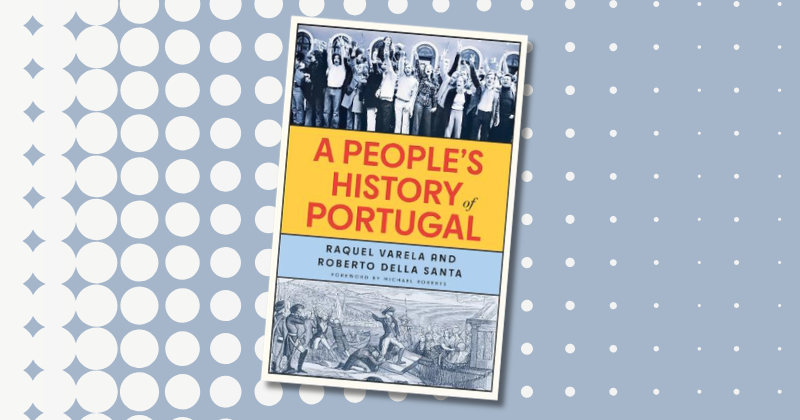
Review: A People’s History of Portugal by Raquel Varela and Roberto Della Santa, Pluto Press, 2026, 297pp
The Napoleonic Wars, which forced the Royal Court to flee to Brazil, are the starting point of Raquel Varela and Roberto Della Santa’s exploration of 200 years of class struggle in Portugal.
A People’s History of Portugal deploys a historical-materialist analysis to track the development of capital and labour from the Kingdom of Portugal, structured around the exploitation of its colonies, to the Bonapartist dictatorship of António de Oliveira Salazar and the consolidation of market liberalisation following the counter-revolution of 1975. The book focuses on the working class as an active, sometimes revolutionary subject, and its role in shaping the course of Portugal’s history.
As the first global maritime empire, Portugal inaugurated the Age of Discovery but had a weak bourgeoisie dependent on British capital. Profiting from Brazil’s gold until the 18th century, it failed to launch an independent industrial revolution. Its status as one of the weak links in the chain of imperialism was demonstrated by the 1890 crisis known as the ‘Pink Map’. This set out an inland corridor joining its colonies Angola and Mozambique, but collided directly with Britain’s Cape-to-Cairo scheme. King Carlos’ constitutional government yielded to Britain’s ultimatum to retreat, provoking popular outrage and a boycott of English goods. For Varela and Della Santa, this capitulation hastened the demise of the monarchy.
The monarchy fell in a coup on 5 October 1910, propelled by working-class support in Lisbon and across Portugal, and following a wave of strikes only a month before. While the working class were unable to claim victory, their capacity to struggle prevented the full stabilisation of the Republican regime. During a period of constant crisis, there were seven parliaments in the First Republic between 1910 and 1926. Trade unions – ‘largely influenced by revolutionary syndicalism’ – grew rapidly, but faced intense repression from the authorities.
Salazar’s dictatorship
A military coup on 28 May 1926 ended the unstable First Republic, instituting a dictatorial period that would last until 1974. Varela and Della Santa argue that the coup rested on an understanding that capitalist modernisation and accumulation, based on ‘cheap labour’ in the metropoles and ‘forced labour’ in the colonies, could not occur under a democratic regime in which workers can exercise their power.
Following the coup, the headquarters of the Portuguese Communist Party (PCP) was closed and the main trade union, the Confederação Geral do Trabalho (CGT), was banned. In the aftermath of the 1929 financial crisis, the Estado Novo – ‘an authoritarian, corporatist order’ – was established under Salazar’s leadership.
In response to the Estado Novo prohibiting strikes and lockouts in November 1933, a general strike ‘with anarcho-syndicalist predominance’ was organised against the dictatorship in January 1934. A group of mainly communist glass workers in Marinha Grande joined the revolt and took over the post office, the town hall and the National Republican Guard (GNR) post. Their uprising did not last long, resulting in over 100 arrests, but from then on Salazar designated the PCP as the main force to be fought.
In the colonies, capital accumulation was driven by a system of forced labour accompanied by brute force. The anti-colonial revolts in Portugal’s African territories began with the Cotonang uprising in Angola on 3 January 1961. When agricultural workers staged a protest demanding improved working conditions, the Portuguese authorities responded the following day with an air raid, targeting twenty villages in the area and killing hundreds of people. This sparked the Portuguese Colonial War in Angola, Mozambique and Guinea-Bissau. The book argues that the Portuguese Revolution of 1974–75 ‘emerged from the military defeat of a regular army by revolutionary guerrilla movements’. Led by Amílcar Cabral, the African Party for the Independence of Guinea and Cape Verde (PAIGC) controlled more than two-thirds of Guinea-Bissau by 1970.
Get The Spark in your inbox
Workers Power’s weekly newsletter
Revolution
The human and financial cost of a prolonged war, coupled with global factors such as the 1973 oil shock – which drove the yearly inflation rate as high as 20% – propelled Portugal into the Carnation Revolution on 25 April 1974. A whole chapter is dedicated to the revolution, but for a richer account of this period Varela’s earlier A People’s History of the Portuguese Revolution (2019) is highly recommended.
The Portuguese Revolution opened the doors to dual power, where the old capitalist state still stood but new workers’ commissions (Comissão de Trabalhadores) and assemblies acted as an alternative authority over the means of production and the government of people. As Varela and Della Santa note: ‘For 19 months, 3 million people actively participated in workers’, residents’ and soldiers’ councils, making daily decisions’. But these competing forms of sovereignty are both antagonistic and untenable.
In the end the revolution was defeated not by violence but through a civil counter-revolution led by the Socialist Party (PS) leader Mário Soares on 25 November 1975. The PCP offered no resistance. The authors argue that the PCP never intended to carry out a socialist revolution: adhering to the Stalinist conception of a two-stage revolution, its primary aim was ‘to ensure the consolidation of a democratic regime in Portugal’.
The book’s final chapter explores the post-revolutionary phase, marked by entry into the European Economic Community in 1986 and a restructuring of the economy that reinforced the dominance of foreign capital. Reliant on large loans since 1990, the Portuguese economy was hit hard by the 2008 financial crisis, resulting in the intervention of the Troika. In return for a €78 billion bailout, Portugal was required to implement a structural adjustment programme, including comprehensive privatisation, a public-sector recruitment freeze, and cuts to salaries and pensions.
This systemic assault on economic and social rights opened a period of class struggle not seen since the 1980s. Beginning in 2011, the General Confederation of the Portuguese Workers (CGTP) organised a series of general strikes, met with police repression of pickets. This anger found expression in the large vote for the Left Bloc (BE) and the PCP in the 2015 election, winning 10.2 and 8.2 per cent respectively.
However, both the BE and PCP subsequently propped up a minority, social-liberal PS government in a pact known as the Geringonça. They continued to support the government even as it mobilised the military to break a national lorry drivers’ strike in 2019. Their abandonment of class struggle for government intrigue prompted their swift electoral decline, while also creating the space for an insurgent, far-right Chega (Enough) to present itself as the ‘anti-systemic’ party in Portuguese politics.
Party
A People’s History of Portugal, linking historical developments to contemporary class struggle, illustrates how capitalism repeatedly creates the conditions that force the working class to revolt. While the Portuguese Revolution produced organs of workers’ power, it also demonstrated that revolutionary leadership and a socialist programme were necessary for the working class to conquer power.
Varela condemns social democracy for ‘collaborating and stabilizing forms of domination’ and points to the ‘deep crisis’ of trade unionism today. Unfortunately, she neither draws conclusions nor puts forward a strategy – a way forward informed by her history – for the Portuguese working class. She sketches out, in academic language, a liberated order but only asks: ‘how could such an order come to be? What kind of mediations are needed—here and now? Which unions, movements, parties? Like Marx and Engels, no cook recipes are prescribed for any future-to-come.’
The comparison is not quite correct. Although the founders of scientific socialism refused to be drawn on what a communist society would look like, they did, especially after the Paris Commune, map out a strategy to get there.
Nevertheless, this useful history should be read by those determined to learn its lessons, developing a revolutionary programme and party that can ensure Portuguese workers and youth write a new, final, liberating chapter in their history.