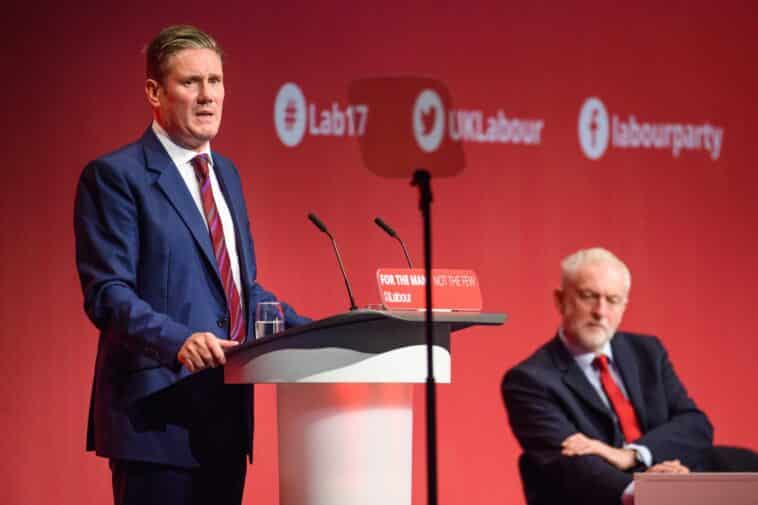
Little more than a year from a landslide victory that gave the Labour Party a huge majority at Westminster, Keir Starmer faces a divided party.
Opinion polls show the party trailing behind Reform; there has been a dramatic decline in party membership; backbenchers have refused to toe the party line and been suspended. There is even talk of a leadership challenge.
Is the party facing internal collapse in the face of mounting international instability?
At the beginning of September, Keir Starmer tacitly accepted the problem by declaring a ‘second phase’ whose priority would be ‘delivery, delivery, delivery’. That the first year had been close to disastrous was explained away as a necessary ‘stabilisation’ phase after discovering a ‘black hole’ in the government’s finances.
This was the justification for policies such as the removal of the Winter Fuel Allowance from most pensioners and the retention of the two-child cap on benefit payments.
No doubt the Tories had left major economic problems, some of them quite consciously aimed at crippling a Labour government long predicted by opinion polls. Labour, however, was well aware of this, not least because opposition leaderships are routinely briefed by the Treasury before elections.
Rachel Reeves, while Shadow Chancellor, had already made it crystal clear that she would follow the rules on taxation and spending, the famous ‘fiscal rules’, laid down by the Tory Chancellor Jeremy Hunt. Her only change would be to exclude borrowing for investment from those rules. Other than that, she was essentially going to continue with austerity.
Why make that pledge? The briefest explanation is that she wanted to minimise attacks from the right wing media that a Labour government would ‘spend, spend, spend’ and drive the economy into a ditch.
In this they were speaking on behalf of their paymasters in the City and the corporate boardrooms, who realised that the Tories were no longer fit for purpose. But they wanted to limit Labour’s leeway despite their inevitable victory.
Capitalist workers party
Their fears were not a display of political paranoia. On the contrary, they were a recognition of the distinctive character of the Labour party. Unlike the USA, where both main parties express the interests of capital, albeit different sections of capital, the Labour Party has deep roots in the organised working class. To maintain itself as a viable party, it has to deliver some benefits to its supporters.
Like the trade unions that founded it, and still provide important financial support, Labour has a contradictory character. It aims to improve the material conditions of workers but it completely accepts that this requires capitalism to be profitable. Profitability, however, is only possible through the exploitation of workers.
That is the dilemma facing every Labour government. The contradiction between maintaining capitalist stability and workers’ living standards ultimately explains its promises and the betrayals in government.
That contradiction, however, is also expressed within the party, inevitably generating a left wing and a right wing, dependent on factors such as regional, constituency and industrial considerations, as well as the particular political and ideological beliefs of individuals and leaders.
At both levels, society-wide and within the party, the tensions are not static. On the contrary, they are dynamic, reflecting above all the ebbs and flows of the class struggle. At any one time, employers may calculate that even a lengthy strike is worth the cost if it allows a big reduction in the workforce and, therefore, wages. Equally, if market conditions are strong and a stoppage would be costly, a concession on conditions or wages might be worthwhile.
Historically, in Britain, the most important example of major concessions to the working class came after the Second World War. Labour, reduced to a rump by splits in the 1930s, won an unexpected victory at a time when British capital was nearly exhausted.
Faced with their own dilemma, Britain’s bosses decided to take the advice of Quintin Hogg, later Lord Hailsham, in an address to his fellow Conservatives in 1942, ‘Gentlemen, either you give them social reforms, or they will give you social revolution’.
As a result, for most of the post-war ‘long boom’ there was little attempt to undo the 1945 Labour government’s wide ranging reforms: nationalisations, state education, massive spending on council housing and, of course, the establishment of the NHS.
That began to change in the late 1960s, but it was the Thatcher governments after 1979 that saw a wholesale strategic rolling back of reforms, deindustrialisation of whole regions and the privatisation of the service industries.
Get The Spark in your inbox
Workers Power’s weekly newsletter
Blair’s neoliberal turn
The response of Labour’s right wing, after three electoral defeats, was the rise of ‘New Labour’. Tony Blair and Gordon Brown rejected any idea of re-nationalisation. Instead they tried to manage the economy successfully.
At the same time they also introduced some reforms, for example, the Sure Start scheme, which produced a real improvement in early years provision and increased the role of women in productive labour.
Although the Labour left warned against Blair’s measures, particularly the extension of the ‘internal market’ in the NHS, it was basically sidelined. The strength of the unions was reduced as a result of de-industrialisation. Labour’s roots were withering and that tendency was hastened by Blair’s role in the Iraq war, which was hugely unpopular.
Labour left
In 2010 Labour was unable to regain the support it had lost and the Tories entered government with the LibDems. After another defeat in 2015, Labour’s right wing leadership tried to win back popular support by opening a leadership election to everyone prepared to pay £3 to become a supporter. Realising that a slate of only right wing candidates looked bad, they agreed to have one candidate from the left, ‘to make it fair’.
The outcome, of course, was a huge vote for Jeremy Corbyn, dramatic proof of the continued existence of the left within the party – and soon boosting membership by some 300,000. Despite his subsequent fall and then expulsion, Corbyn’s rise, and his near victory in the 2017 election make clear the continued support for a ‘Left Labour Party’ and this should not be ignored.
In the event of further serious losses in next May’s local elections, economic weakness, by-election losses and the prospect of a victorious Reform party, the Labour party apparatus and the trade union leaders could well decide to ditch the unpopular Keir Starmer.
In such a situation, the existence of the Labour left and its potential to revive support, for example, from the more than 300,000 who have resigned in recent years, might appear a safer option for millions of workers than risking everything on an untried, extra-parliamentary and possibly faction-ridden new left party.
Andy Burnham’s challenge
When Andy Burnham denied that he was a candidate for leadership of the Labour Party, he was not lying. There is no such election and, anyway, he is not an MP, so would not be eligible to stand as a candidate.
He was, however, dissembling. He explained, in reply to a journalist’s question, that he had said that, if Labour MPs were to ask him to stand, his record of having stood for the position twice before made clear what his answer would be.
In other words he was putting down a marker that, when the right circumstances arise, he would indeed be a candidate. It is not difficult to imagine what he had in mind: terrible results in next May’s local elections; a string of by-election losses; continued Reform UK lead in opinion polls; serious economic crisis. Everyone knows what he means.
Not an MP? No great problem. That just requires a Labour MP in a safe seat to accept a peerage. Victory in the resulting by-election would give him the momentum to challenge Starmer. From that the ‘King of the North’, as the media like to call him, could march on to his coronation.
If that scenario does not develop, his term of office as Mayor of Manchester ends in 2028, conveniently a year before the next general election has to be held. Standing for election then, against a background of virtually guaranteed major losses of Labour seats, could also position him nicely for a leadership bid. At 55, he can afford to wait.
His explanation that, if he were leader, he would be happy to work with LibDems, Greens and Jeremy Corbyn’s supporters, shows his strategy. He realises that there is a huge pool of potential support among the hundreds of thousands who have left, or been expelled from Labour under Starmer. Possibly millions of voters who are now turning to those other parties in desperation but could be won back to a ‘left’ Labour party.
Such calculations are not groundless but, for those who want to rebuild the fighting organisations and strength of the working class, they are completely secondary. The task now is not to manoeuvre for control of the Labour Party but to organise resistance to the swingeing cuts we can expect in Labour’s November budget – which, no doubt, the Mayor of Manchester will be prepared to implement.