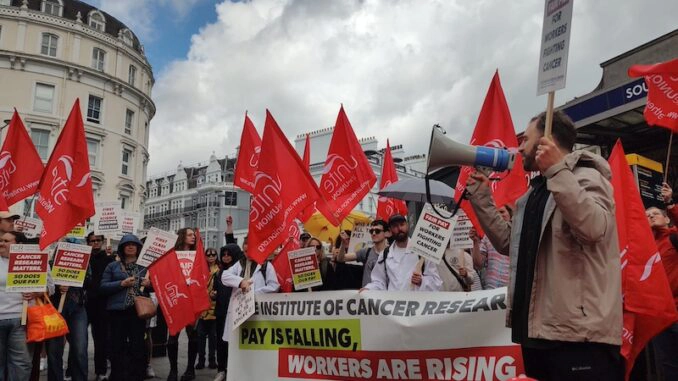
About 50 strikers at the Institute of Cancer Research (ICR) marked 55 days of indefinite action by holding a rally, a march and a mass picket on 28 August in Kensington, London. The defiant stance of the Unite members is a beacon for all workers, an example of how resistance and unity can shift even the most hard-nosed of managers.
The ICR is a world-renown part of the scientific community, doing valuable work saving lives, but their mistreatment of staff is intolerable. As the strikers chanted, ‘We fight cancer every day – we can’t do it on low pay!’
Management’s attacks started in 2019, when they unilaterally removed annual pay increments, claiming they were ‘inflationary’ – despite 100 top managers taking home £68 million a year between them, the CEO Kristian Helin on his own ‘earning’ over £400,000. They then proceeded to take away the workers’ canteen, free parking facilities and threaten their pensions. Subsequent pay erosion has led to a 16% drop in wages.
The union was too weak to stop this at the time, but a vigorous unionisation drive, helped no doubt by managers’ everyday rudeness, built up a 400-strong Unite branch, from which a 30-member strike committee has been formed. When management refused to negotiate on any of the issues, Unite called in ACAS. Obliged to attend the meeting, however, management turned on their heels and walked out!
The leadership of the strike has been strong throughout the campaign. Not only has the strike committee been able to maintain large pickets and hold a successful solidarity gig (over £1,600 raised), but they even forced management to accept rank and file members attending negotiating meetings to hear what they had to say. This last tactic proved so successful that ICR eventually refused to talk in front of the very staff whose pay and conditions they were cutting.
Next steps
The truth is that ICR has enough money (£30 million in liquid cash reserves, another £35 million in assets) to pay for full pay restoration (costing £16 million) immediately. Having conceded on other issues, like the canteen, they have shifted from a 3.75% offer to 5%. But the union is quite rightly holding out for more for the lowest pay.
Low pay, especially for post-doctorate researchers, is a big issue. Many are on as low as £14.80 an hour, the London Living Wage, which in posh Kensington & Chelsea is not enough to survive. A meeting with management, followed by a mass members’ meeting, was due to be held in the afternoon of the rally.
But the strike is hampered by Unite’s industrial strategy, which is commendable insofar as it supports all-out indefinite action, but terrible when it comes to spreading disputes. Although there are other disputes in the health (Maudsley hospital, St Thomas’) and higher education (London Southbank, Goldsmith’s) sectors, it has been the rank and file who have made the links, not Unite’s leadership.
If the dispute is not settled on 27 August, strikers need to broaden their campaign, link up with other strikers and turn the heat up. The so-called charity sector has for too long squeezed its workforces, using moral blackmail. University graduates have for too long been forced to live on low wages. The time for a united fightback is now.