

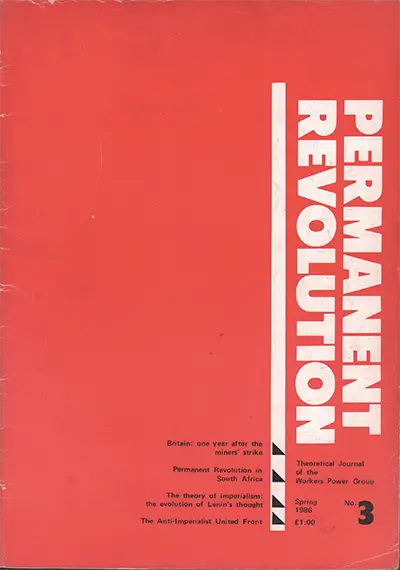
Permanent Revolution No. 3, Spring 1986
- Editorial
- Britain: One year after the miners’ strike
- Theory of imperialism: The evolution of Lenin’s thought
- MRCI Theses: Permanent Revolution in South Africa
- Polemic: The Anti-Imperialist United Front (GOR)
- Reply: In defence of the revolutionary Comintern
- Review: Writings and Speeches 1928–34 by James P Cannon
- Review: Against the Stream: A History of Trotskyism in Britain 1924–38 by Sam Bornstein and Al Richardson
- Reviews:
- Red guards and workers militia in the Russian revolution
- Cuba: The radical face of Stalinism
- Jamaica under Manley
Editorial
With this issue Permanent Revolution makes its reappearance after an absence of twenty months. This long gap, while regrettable, was unavoidable in the circumstances. The propaganda and agitational tasks that fell upon Workers Power during the 1984–85 miners’ strike forced us to concentrate our resources elsewhere. Three pamphlets (Women’s oppression, women’s liberation and socialism; The Road to Working Class Power; and Where Next for the NUM?), together with a fortnightly paper for most of the strike, inevitably delayed work intended for this journal. In addition, we have produced seven issues of a Workers Power bulletin for miners, The Red Miner.
Events within the left since the defeat of the miners’ strike, however, have only served to underline the urgent need for our theoretical journal. The rapid shift to the right within the Parliamentary Labour Party and the trade union bureaucracy over the last year (the nature and consequences of which are charted in the first article) has been accompanied by a crisis of direction within the far left.
Official Stalinism has split in two, with the simmering disputes between the Morning Star and Marxism Today coming to a head over the drawing-up of a balance sheet of the NUM’s Great Strike. The WRP was likewise unable to stay intact. The sectarian leadership of this organisation, personified by Gerry Healy, was unable to meet the challenge of the miners’ strike with a realistic revolutionary strategy. Healy’s rantings were no substitute for such a strategy, as many WRP members found out through their contact with the class struggle. The class struggle itself acted as a catalyst in the crisis of their organisation. The permanently faction-ridden Socialist League (British section of the United Secretariat of the Fourth International) has been riven in two along the Mandel–SWP (US) fault line.
Within the Labour Party itself, the left has undergone “realignment” around the question of Kinnock’s leadership. Tribune and the LCC have “defected” to Kinnock and the witch-hunters, taking with them the majority of the old municipalist left. At the other end, the Labour Left Co-ordination is attempting to rally the “hard left”.
In the struggle to establish political ground in this process of “realignment”, the reformist and centrist left rain down adjectives on each other. Take your pick. Do you belong to the “participatory”, “soft”, “credible”, “broad” or “cuddly” left? Or alternatively, are you of the “serious”, “class-struggle”, “macho”, “vanguardist”, “genuine”, “hard” or “ghetto” left? As for Permanent Revolution, we prefer the admittedly older, but more honest, label “revolutionary left” to describe its content and aims.
The creation of a revolutionary combat party remains the most burning need of the working class. The left will not be regrouped on a lasting basis, nor this party built, out of the simple adoption of one or more names. Profound differences of theory, programme, strategy and tactics divide the left. Permanent Revolution exists to advance a revolutionary Trotskyist perspective and through this act as an “instrument for the creation of a revolutionary party” (Trotsky).
In this issue, we extend the debate on the question of the Anti-Imperialist United Front that we began in Permanent Revolution No. 2. Of fundamental importance within revolutionary strategy in the semi-colonial world is the question of the nature of political alliances between the working class and non-proletarian forces in the struggle against imperialism and its national agents. The Iranian revolution, the Malvinas War, Bolivia, Sri Lanka and the Philippines today all present this problem in different forms. The debate with the GOR of Italy on the revolutionary origin and later corruption of this tactic within the Comintern is contained here.
The article The Evolution of Lenin’s Thought is the first of a series of articles on the theory of imperialism. We begin by tracing the evolution of Lenin’s political economy, from his initial work on Russian capitalism to his pamphlet on imperialism.
Permanent Revolution is the theoretical journal of Workers Power, but Workers Power itself is part of the Movement for a Revolutionary Communist International (MRCI). The programmatic advance of the MRCI since the founding conference (see PR2) is registered here by the inclusion of the Theses on South Africa. These were subject to a thorough discussion in the sections of the MRCI (in Britain, Ireland, France, West Germany and Austria) before their adoption at a delegate conference on 31 December 1985. Outlined here in summary form is our collective view of the imperialist nature of South Africa, the development and role of apartheid capitalism and the key elements of a programme necessary to bring total victory for the black masses.
In our review section, we carry three major review articles. The rich lessons of the early experience of the Trotskyist CLA for a fighting propaganda group today stand out clearly from the two-volume collection of writings and speeches of James Cannon, which cover the years 1928–34. The late 1920s and 1930s are also the focus of Bornstein and Richardson’s stimulating book on the birth and early difficult years of British Trotskyism, which is also reviewed here. Finally, in the review of Richard Cornell’s book The Revolutionary Vanguard, the role of the youth movements in the Second International and early Comintern is examined.