
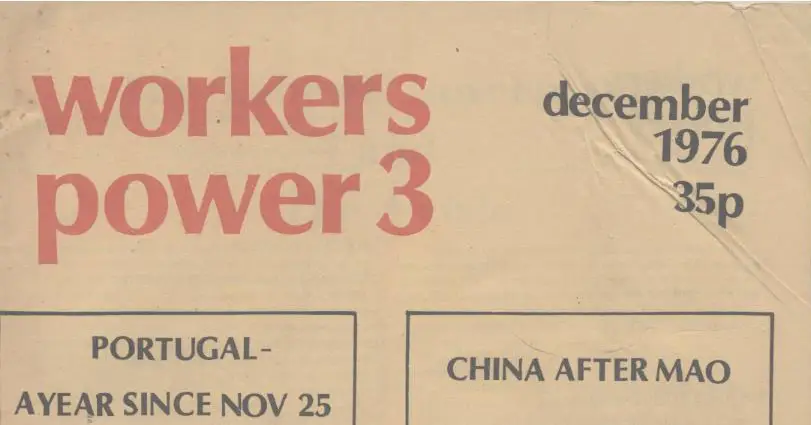
Up until one year ago this month Portugal seemed poised on the brink of socialist revolution. Discipline on the army had broken down to such an extent that it was no longer a reliable weapon in the hands of the ruling class. Struggles for workers’ control in the media had created an independent workers’ daily paper, Republica, and similarly at Radio Renascenca the workers had wrested control from the Catholic church. Striking building workers trapped the Constituent Assembly in the Sao Bento Palace until their demands were met, almost driving the seat of bourgeois rule out of Lisbon to the conservative north.
The events of November 25th 1975 completely reversed this situation and shifted the balance of forces firmly in favour of the right wing. Such a fundamental change could not have resulted merely from a clever manoeuvre by the right in the armed forces, particularly at a time when they were so weak. There is no doubt that a right-wing coup was planned by people like Ramalho Eanes and Jaime Neves (head of the Amadora commandos), but in itself this does not explain the defeat of November 25th and the retreat of the working class since then.
The fundamental reasons lie in the crisis of leadership of the working class movement. By November 25th the class struggle had reached such a peak that there were only two alternative directions: either onto the seizure of power or backwards into a period of defeat and demoralisation. It is possible that only the weakness and division of the bourgeoisie at the time avoided a far bloodier defeat for the working class. As it was the bourgeoisie gained two vital objectives: purging and disabling the left in the army and regaining its hold over the media. The workers’ organisations were left intact but seriously demoralised, particularly so because of previous illusions in the lefts in the Armed Forces Movement (AFM) who were now totally routed.
Some organisations on the left, notably the USFI, lay the blame for the defeat almost exclusively on the ‘insurrectionist line’ of the PRP — BR and other centrist groups. Certainly to call for an insurrection when the overwhelming majority of the working class was still under the influence of the reformist parties was completely wrong. When this dominance was still demonstrated by the failure of the lefts to win the workers and neighbourhood commissions to acting as soviets, to determine mine ones policies entirely by the far reaching but confused radicalisation of the soldiers was an error of the greatest magnitude. To accommodate to the confusion of the soldiers vis-a-vis the AFM and charismatic bonapartist figures like Carvalho was a crime. Yet the greatest crime was their failure to even attempt to win.
In so far as the centrist groups are to blame it is their failure to win Communist and Socialist Party workers through a correct united front approach in the months leading up to November 25th which is central.
A massive united resistance by the workers’ commissions and the rank and file soldiers organisations could have foiled the right wing on November 25th and left the workers and soldiers organisations stronger than ever. But the principal leaders of the working class, the PCP, did not look to the workers at all. At their most radical, they were hoping that Carvalho would lead a left-wing coup which would get the CP more government places at minimum cost to themselves. When the right-wing plotters carried the day, the CP did not mobilise the working class in support of the paratroopers and the capitulation of a number of their key officers and sergeants in the middle of the events left the whole movement in chaos.
The CP’s role on the day
Alvaro Cunhal, the CP leader, went to see Costa Gomes and Melo Antunes and agreed not to mobilise the Lisbon workers and not to mobilise the other military units in defence of the paratroopers and also not to oppose the re-imposition of order in the armed forces. In this situation the revolutionary left were totally unable to offer a clear revolutionary alternative. Their lack of influence in the workers’ organisations made it impossible to mobilise the working class and the CP in a general strike to stop the isolation and defeat of the paratroopers.
The outcome of November 25th was therefore the re-imposition of military discipline, the appointment of right-wingers to the editorial boards of all the newspapers and the handing back of powers to the GNR (riot police force under fascism). Within weeks the GNR had opened fire on a demonstration in Oporto and picket lines in Lisbon. Hundreds of PIDE agents were released while 200 left-wing prisoners were held after the 25th. The workers continued to fight, with struggles against soaring inflation and unemployment, one of the major struggles being at the Lisbon Timezone factory. The workers’ commissions were intact, and now the working class had to look to itself rather than the left-wingers in the army to defend and advance its gains.
Having established its hold on the army and the media the ruling class was able to advance to the second stage of its strategy. A package of austerity measures including a total wage freeze until the end of February 1976 was announced. The increasingly confident right wing now looked forward to the elections to the Legislative Assembly on the second anniversary of the 1974 April 25 coup. They hoped for a stable bourgeois democratic government which could attempt to solve the economic crisis at the expense of the working class. Despite the increasing strength of the overtly capitalist PPD and CDS, it was still the Socialist Party of Mario Soares which held the key to this strategy. The result of the elections was inconclusive. The SP was the largest single party with 37% of the vote with the CP’s share increasing slightly to 17%. The CDS (a haven for Salazarists and Spinolists) doubled its vote to 15% while the PPD’s vote remained stable. The SP refused a coalition with either the CP or the right-wing parties and is attempting to rule with a minority in the Legislative Assembly. It is probably doing so only because of pressure from its working class base that the SP refused coalition with the right-wing parties.
The nature of the SP vote
Despite the fact that 54% of the votes were cast for the so-called workers parties this result should not be viewed too optimistically. For months before the elections the SP had headed the attacks on the CP in the North, on workers’ control at Republica and Radio Renascenca and on the rank and file soldiers organisations. Therefore much of the SP vote was probably a conscious right-wing one. On the other hand much of its support remains working class with its promises of “democratic Socialism” attracting workers repelled by the CP’s bureaucratic methods. It was to the rank and file of the CP and SP that revolutionaries should have directed agitation for a CP-SP government. They should have posed a programme of demands to defend and advance the gains made by the working class since 25th April 1974. Of the groups of the far left which stood in the elections only the candidates of the LCL/PRT (sympathising sections of the USFI) raised anything approaching these sorts of demands. The Maoist UDP restricted its agitation to the demand for a ‘Patriotic Anti-fascist Government’. And in its usual ultra-left fashion the PRP boycotted the elections. All in all the parties to the left of the CP obtained about 200,000 votes.
Another test for the revolutionary left came with the presidential elections on June 27th 1976. The new Portuguese constitution gives very large powers to the president. As well as president he is head of the Revolutionary Council of the armed forces and army chief of staff. He can dismiss governments and exercise emergency powers. Therefore while the Legislative Assembly provides a democratic gloss to the system, real power lies with the president. The action of the SP and the CP in signing the pact between the parties and the armed forces recognising this state of affairs actually renders them impotent. Any anti-capitalist measures passed by the Legislative Assembly can be annulled by the president.
The successful presidential candidate with 61% of the vote was General Ramalho Eanes, the right-wing hero of November 25th. He was also closely involved in the attempted Spinolist coups in September ’74 and March ’75 and was dismissed from his position as head of the Portuguese TV network after March ’75. His candidature was supported by the whole bourgeoisie, the PPD, the CDS, the SP and the army and air force. The CP was only prevented from supporting him by pressure from its base, and the CP candidature was a purely formal one. Octavio Pato, a leading figure on the right of the party gained only 8% of the poll and in a statement announcing the candidature the CP made its intentions clear: ‘The Central Committee of the PCP has decided for the time being not to support any military candidate. This however does not stand in the way of the party supporting a military officer once one is elected president of the Republic’. Pato himself stated in ‘Jornal Novo’ on May 25th: ‘While not supporting the candidacy of Ramalho Eanes… we are not hostile to it either. Nor do we present our own candidacy in direct opposition to his or a plan for counterposing the workers’ and peoples movement to the armed forces.’
The benevolent Bonaparte
The most confusing candidacy for the left groups was that of Otelo Saraiva de Carvalho. He played a leading role in the April 25 coup which toppled fascism and was imprisoned after November 25th. His campaign of mass rallies with red flags and carnations in abundance seemed to many the answer to the candidacy of Eanes and the bourgeois plan centred around this. Carvalho however is no working class candidate. It is true that COPCON was very inefficient agent of the bourgeois state during the time Carvalho commanded it, and it sometimes sided with workers struggles. But Carvalho’s record also included acquiescence when the troops were sent against Radio Renascenca, alliance with the moderate ‘Group 9’ officers in September 1975 and failure to call for all resistance on November 25th. ‘Otelo’ has always been essentially a maverick element within the military hierarchy. Examination of his programme should have warned the left not to be carried away by the enthusiasm of his personality campaign.
His programme was essentially a bourgeois one dressed up with left rhetoric about ‘Popular Power’ and ‘A friend in the Presidency’. It started by recognising the constitution and declared against the interference of the political parties in the trade unions. This ‘apartidiarism’ was reflected throughout the campaign, and the groups supporting the candidacy were not allowed to sell their literature at campaign meetings. In speeches Otelo claimed ‘It’s the parties which have divided the workers. We must unite together to create popular power’. This antiparty feeling is strong amongst some of the most militant workers. It is fuelled by the bickering and sectarianism of the centrist groupings and their failure to understand the tactics of the united front. Nevertheless, for would-be revolutionaries to go along with it and support a candidacy which could do nothing but reinforce it was disastrous. Carvalho did not argue for working class action against the bourgeois state apparatus and the formation of a workers’ militia, but pledged ‘to put the armed forces and the police force at the service of the people and the national interest, by never letting repression crush the workers’.
Otelo also declared himself in favour of the ‘AFM-People’ alliance and advocated ‘Armed forces where order and discipline prevail’ — albeit ‘not an order and discipline which are used as excuses to repress workers’! His outlook remains that of a benevolent, left-wing Bonaparte. Commending Portuguese workers to rely on him does not advance one step the self-organisation or self-reliance they need to seize and wield state power.
As far as economic policy was concerned he did not mention inflation and unemployment running at 30% and 15% respectively and stated that ‘socialism will only be achieved by our children’ and that in the meantime workers should ‘make sacrifices for the national reconstruction’ as long as they feel ‘that those sacrifices were being made in the national interest’. As far as Eanes was concerned Carvalho stated at a press conference that — ‘I do not intend to attack or discuss any army comrade chosen by the political forces as their candidate. The responsibility attached to the Presidency and the devotion it requires calls for dignity and total respect’. While criticising the backlash after November 25th, he also described Eanes as a comrade and said he would not have stood if Costa Gomes had done so.
The forces behind the Carvalho campaign were organised in ‘Groups for the Dynamisation of Popular Unity’ (GDUP). Three supposedly revolutionary groups, PRP, MES and UDP were the main participants. Once again the Portuguese far left was incapable of meeting up to basic revolutionary tasks and uncritically tailed Otelo’s campaign. In line with its ‘two stages’ theory of democratic revolution now, socialist revolution later, the UDP (the largest and fastest growing left group) even opposed the vague references to socialism in Carvalho’s platform.
Otelo achieved 17% of the vote because he seemed to offer for many militant workers a way back to the heady days before November 25th. However what was required was not more of the same old illusions, but working class action to secure its political independence from all capitalists and army officers. Central to this would have been an attack on the presidential system and the bonapartist project of the ruling class, which on only thinly veiled by Soares’ shaky minority government.
The LCI’s and the PRT’s stance
A tiny ray of light was offered by the campaign of the LCI and PRT. Although short-lived because the false claims of the candidate to an heroic anti-fascist record caused an early withdrawal, the campaign contained elements of a correct approach. The LCI/PRT stood against the pro-Carvalho tide on the Portuguese left and proposed a critical vote for Octavio Pato as the only candidate of a workers’ party. They also declared against the pact between the parties and the armed forces hierarchy and for a workers’ united front in struggle. However there were serious errors in the campaign. This bowdlerisation of the Trotskyist tactic of calling on the reformist workers parties to ‘break with the bourgeoisie and enter on the road of struggle for the workers government’ — in fact could do nothing but bolster illusions in ‘normal bourgeois democracy’. The idea that a revolutionary candidate if elected on a revolutionary programme would call on a right-wing reformist parliamentarian to form a government is pretty remarkable. Further the platform uncritically described the SP and CP as workers parties without referring to the bourgeois nature of their programmes and made no clear proposals for a programme of concrete demands to be put on a CP-SP government. The LCI which before the 25th of November had in pursuit of the ‘new mass vanguard’ of workers and soldiers, gone along with the ultra-left sectarianism of the left centrist groupings forming the GDUP, has obviously taken a sharp turn to the right. Why is this?
The LCI is under pressure from the United Secretariat of the FI to effect a rapprochement with the PRT. The PRT’s politics are those of chronic adaptation to social democracy. The PRT denounced the Republica struggle and described the 25th November uprising by the paratroopers as an anti-working class venture and therefore not a defeat for the class. During the presidential campaign it managed to couple critical support for the CP candidate with calls for a SP-only government. Under pressure from the USFI the two groupings concocted an eclectic jumble of a programme and because of pressure from the pro-Carvalho feeling amongst the working class both these organisations underwent serious splits rendering the forces of Trotskyism even more atomised and impotent in Portugal.
The current situation
With his inauguration as prime minister and safely backed up by Ramalho Eanes as president, Mario Soares proceeded to outline a number of anti-working class measures. These include a wage freeze, an increase in the productivity of labour, priming of the private sector, financial pruning of the public sector and restriction of the Minister of Agriculture, Antonio Lopes Cardoso. His defence of the Agrarian Reform has made him a favourite target for reaction, especially the Confederation of Farmers of Portugal (CAP) formed in autumn 1975 to organise resistance to the land occupations. It is possible that Cardoso could now become a pole of attraction for dissidents in the SP though he has never distinguished himself by courageous opposition to Soares and the amorphous structure of the SP makes this very difficult. The actual amount of land involved in the attacks is as yet small, but successful re-occupation by the land lords backed up by the GNR and the army will lead the way to further attacks. 1,100,000 hectares of land have been occupied by farmworkers in the Alentejo and Ribetejo regions. A law legalising the occupation of 1,800,000 hectares was passed by the Fourth Provisional Government of Vasco Gonscalves. The “disoccupations” which have been carried out involve only 101 properties covering 16,800 hectares which did not qualify under this law. But this has been done without opposition either by farmworkers or in the industrial centres. Soares has also introduced laws to compensate land owners and under pressure from the CAP the occupation of further land allowed by the law has been frozen. Cardoso’s split with the SP has come because he opposed these attacks and wanted the further 700,000 hectares allowed by the Fourth Provisional Government under the Agrarian Reform to come under the law.
The dispute came to a head at the SP Congress held from October 30th to November 1st. The report by Mario Soares as General Secretary was passed by a large majority. In it he announced tough austerity measures and attacked the dissenters within the party. Referring to the Agrarian Reform he stated that “The Alentejo region has been turned into Russian collectives”. Opposition at the Congress polarised around a group of trade union leaders who said that “they were not in opposition but expressing concern that the parties leaders were out of touch with working class feelings and that the trade union base should be strengthened, especially at a time when the working class was being asked to make sacrifices”. This grouping also attacked a new law allowing the sacking of “indolent or disobedient employees”. In the elections for the 151-strong National Political Commission the left put up an alternative slate to the leadership’s and obtained a quarter of the seats. While this opposition around Cardoso and the trade union leaders does not represent a fundamental break, it has obviously arisen in response to more fundamental differences amongst the rank and file working class base of the SP. This could lead to a split and the possibility of a coalition between the Soares leadership and the PPD/CDS then comes to the fore.
The level of the struggle of Portuguese workers is now ebbing and many left-wing teachers have been victimised. It remains to be seen whether this is a lull before the municipal elections in December or reflects a more serious demoralisation of the working class. The CP is strong in the municipalities. It faces a challenge from the GDUPs which have been maintained since the presidential elections, though they have been riven with internecine strife between the UDP and the PRP quarrelling over the ‘heritage’ of Carvalho’s personal vote which is highly unlikely to be ‘caught’ by the GDUPs. The economic crisis has worsened. The Financial Times on November 3rd 1976 stated that foreign currency reserves are still dwindling and unemployment and inflation stand at 13 and 30% respectively. Assistance to the tune of one billion escudos from western Europe has kept Portugal going since the beginning of 1976. This level of aid can be expected to continue since the right has achieved victory in the presidential elections and has a potentially strong coalition in the Legislative Assembly.
The road narrows
In the short term Soares’ right-wing social democracy is the best bet for muzzling and confusing the working class. Economic conditions however make stronger medicine inevitable. Soares’ government does not have a long life ahead of it. The alternatives facing the bourgeoisie — open military presidential rule or a coalition between the SP and the PPD/CDS (with a possible split-off of the left in the SP) — depend on the seriousness of Portugal’s economic crisis and the pugnacity and powers of resistance of the working class. The Portuguese workers however are not condemned to a choice between being eaten bit by bit or all at once by their international and national capitalists. The road is still open to the Portuguese workers to seize power — their organisations are largely intact.
Yet the road is undoubtedly narrower and beset with greater dangers than was the case twelve months ago. The continued fragmentation and impotence of the groups to the left of the CP undoubtedly tempts many militants to despair of parties and programmes and place all their hope on the spontaneity and creativity the workers have shown since April 1974.
The Portuguese workers do not need admirers or flatterers. To chart a course through the difficulties of the coming year needs the highest clarity and consciousness. A programme is necessary which focusses today’s struggles over wages, unemployment, democratic rights and the agrarian reform on their only real solution — the taking of state power by the workers’ organisations themselves.
Recognising that the Portuguese workers, despite their tremendous and profoundly revolutionary energy, still place their trust in the militants of the reformist parties, the tactic of the united front, to mobilise resistance and expose the leaders, is crucial. Above all the building of disciplined cadre-party, able to formulate and operate both programme and tactics, is the task which cannot be delayed.
A strange silence has fallen over the revolutionary left in Britain on the question of Portugal. Journals and papers once loud with the doings of the Portuguese workers have little or nothing to say. Apparently the “Lessons of Portugal” are only the lessons of success. This attitude betrays contempt both for the British and Portuguese workers. Critical analysis is the least debt internationalists can pay to the workers of the two countries. In its absence practical assistance and solidarity is likely to be missing too.


