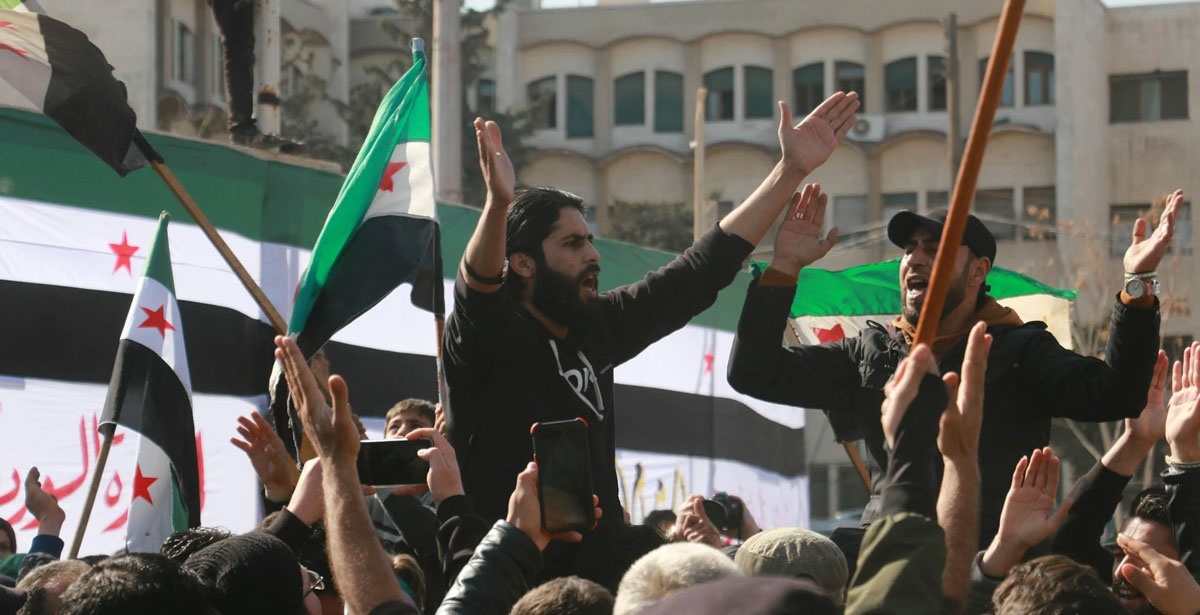
A year has passed since the fall of the Assad dictatorship. For the Syrian people, 8 December marks the day they were able to regain hope, hope for a Syria free from oppression, torture, and murder. The Assad family tyrannised the country for more than 54 years, and its demise has rightly allowed many Syrians a moment of relief. Even though many knew that HTS (Hay’at Tahrir asch-Sham; Committee for the Liberation of the Levant or Organisation for the Liberation of Syria) could not be trusted, it was ultimately the masses who made the overthrow possible by never ceasing to fight for a better life since the 2011 revolution.
The fall of the dictatorship has led, above all, to more people than ever trying to organise themselves into small groups and local structures. A culture of debate is emerging, still small but visible, and taking place in public spaces. Demonstrations and sit-ins against massacres or sectarian attacks are now possible, allowing the oppressed and workers to participate in social processes and speak out. This was not possible under the Assad regime.
However, the overthrow of Assad must also be viewed in the context of imperialist power interests. Such an analysis is often missing from political discussions about Syria. The bloody regime was sustained during and after the uprisings that began in 2011 by Russian imperialism and the regional power Iran, the latter through its ally, Hezbollah. Since Russia’s attack on Ukraine, it has increasingly withdrawn its troops and support from Syria. Meanwhile, Israel’s attacks on Iran and Lebanon have diminished Lebanon’s regional influence and weakened Hezbollah’s ability to provide political and military support on the ground.
Due to the loss of imperialist financiers and the massive corruption of the Assad family, the population became increasingly impoverished, so that support among Assad’s own followers also dwindled. Therefore HTS, which had already controlled Idlib (a city in the northwest) for several years, was able to complete the overthrow with comparatively little fighting, thanks to its alliance of various jihadist militias. Undoubtedly, Turkey also received support, or at least a green light, for the move against Assad. But large parts of the population, across different ethnicities and religions, also supported Assad’s downfall by taking military action themselves.
No Confidence in the Transitional Government – Not Today, Not Tomorrow
The fall of Assad brought HTS to power. While the masses welcomed the dictatorship’s end, many rightly distrusted the new “transitional government.” This scepticism and mistrust among large sections of the population have continued to grow over the past year, and al-Sharaa (the interim president) has done little to counter it. Such scepticism is justified, as a large part of the population does not feel represented by HTS and has never recognised its legitimacy.
The massacres of the Alawite population on the coast and the riots against the Druze population in the south made it clear that the transitional government assumes no responsibility and bears considerable blame. The violence and killings under a sectarian guise did not stop in Suweida (as-Suwayda; a city in the southwest) or the coastal region, but spread further inland.
The attempt to stabilise and legitimise the transitional government also shows clearly that it has no interest in a democratic Syria or in the participation of its own population. Rather, it seeks to consolidate its own regime politically and ideologically. In the first months it became clear: street names were changed, as was the state flag; textbooks were rewritten and curricula adjusted. The most important ministries, Defence, Interior, and Foreign Affairs are firmly in the hands of HTS. In other ministries, different actors have little free rein. One learns not to submit proposals that al-Sharaa might reject, and prefers to avoid confrontation. Numerous reports indicate that second and third-rank officials close to HTS heavily influence debates and the implementation of decisions.
Leaks have revealed that high school textbooks for grade 8 students were altered. The execution of Arab intellectuals and nationalists on 6 May 1916 by Cemal Pasha, “the butcher,” is now portrayed as the execution of “agents of the British and French” and “conspirators” against the Ottoman state. Furthermore, al-Sharaa issued a decree on national holidays that removed the “Martyrs’ Day” holiday on 6 May. The abolition and modification of the curricula serve primarily the interests of Turkey and the regime’s desire for good relations with Ankara.
Al-Sharaa has made it clear there will be no elections in Syria for the next four years. This shows he has no interest in legitimising his power, but rather in expanding his presidential authority, a clear tendency towards Bonapartism.
While the Syrian population is repeatedly put off with promises, the regime desperately needs foreign support. al-Sharaa currently derives his legitimacy mainly from his connections to US imperialism and Saudi Arabia. Domestically, he promotes his legitimacy by citing the overthrow of Assad and promising economic growth and reconstruction — a balm to the war-weary population.
But the sell out to imperialist powers and regional actors clearly indicates that al-Sharaa has no interest in providing a better life for the nearly 90% of Syrians living below the poverty line. The neoliberal restructuring of the market through the sale of state enterprises, spending cuts, and the dismissal of public employees points to a worrying economic direction.
Divide and Rule: The Politics of the USA, Israel, Turkey, and Saudi Arabia in Syria
The past year has shown that the Syrian state is moving deeper into a dependence on US imperialism within a global redivision where its territory is also a stake. This was evident not only when al-Sharaa became the first Syrian president to visit the White House, or through Trump’s remark that “He’s a handsome guy,” but also in Syria’s growing reliance on US controlled oil resources.
Even if al-Sharaa tries to sell this step to the population as a normalisation and stabilisation of the state, it ultimately deepens dependency and locks national sovereignty away in a drawer meant to stay closed. Strategic sectors such as energy, telecommunications, and defence will remain subject to political conditions linked to the lifting of sanctions and regional alignment. By regulating Syria’s access to its own oil and gas fields, refining capacity, power generation, and pipeline routes, imperialist states and regional powers further cement this dependency. Using these resources for the benefit of the population thus becomes completely unrealistic, as does any “fair” distribution of profits.
In recent weeks, it has also become clear that al-Sharaa’s diplomatic “door knocking” continues. A visit to Putin went well for him; Russian military bases remaining from the Assad era may stay. Meanwhile, Turkey is asserting its own interests in Syria, chiefly the complete exclusion of Kurdish self-administration from the newly forming state. Economically, Turkey is flooding the Syrian market with cheap goods. Thanks to close ties between the two countries, it can also deport many Syrian refugees, a major issue in Turkey’s last election which was recorded as a political success.
Internationally, al-Sharaa is trying to present a new model akin to that of the Taliban: national jihadism. With this, he aims to signal: We are not challenging the existing world order or the great powers; we are reliable partners in West Asia. We stand for peace and order that serve your economic and geostrategic interests, and we even take on the role of fighting international jihadists like IS/Daesh (Islamic State). In return, we ask for little — only international recognition, stable economic relations, and a few privileges for Syria’s ruling class and state apparatus.
Of course, al-Sharaa is aware of his role as an imperialist stooge. His Islamist orientation wins him additional recognition in the fight against other Islamist groups. The message to the US is that Islamisation within his state poses no threat. The US, in turn, is uninterested in minority inclusion; it simply wants the security of dealing with a predictable president, hence it has no issue with al-Sharaa’s orientation.
The Israeli government’s continuous bombing of Syria and occupation of large areas south of Damascus shows it does not trust the new rulers, despite their political and diplomatic manoeuvres. This mistrust is not fundamentally about jihadist ideology, but serves to warn the new leadership, as it did Assad, not to dare attack Israel. That HTS is negotiating a peace agreement with Israel demonstrates its willingness to accept the division of the Middle East and the Israeli presence, positioning itself as another US satellite.
Moreover, Israel seeks to present itself as a “protector” or “saviour” during the massacres of Druze civilians. In reality, the Israeli state aims to expand its influence in southern Syria, particularly around the Golan Heights, occupied since 1967. Druze minorities in northern Israel, though discriminated against, serve in the military and are instrumentalised by Zionism as a “model minority.” Israel’s targeted strikes in southern Syria are part of a long series of military operations against Iran, Hezbollah, Yemen, and other regional actors. The goal is to permanently weaken hostile states or actors, preserving Israel’s strategic freedom for expulsion, occupation, and genocide. The Israeli far right goes further than Netanyahu, pursuing the annexation of Syrian territory as part of a future “Greater Israel.”
Neither Israel nor Turkey has any interest in an independent, democratic Syria or a peaceful stabilisation outside their control. On the contrary, both seek to instrumentalise internal contradictions and conflicts for their own ends. Syria is a theatre for the geostrategic aims of Israel, Turkey, and Western imperialism, above all the United States.
Completion of the Arab Spring
Whether the US and Israel will accept HTS as Syria’s ruler in the long term remains unclear. It will become evident how deeply al-Sharaa can enforce dependency, market sell offs, and mass impoverishment. That he is currently doing everything to retain power is shown by his closer ties with Turkey, his ongoing submission to the US, and his close relationships with Qatar, Saudi Arabia, and Egypt. To please these actors, he deliberately avoids invoking the Arab Spring.
Syria is a country that succeeded in overthrowing a dictator. But to avoid endangering the interests of current Arab rulers, he makes no positive reference to that fact, even though it would likely win him much domestic support. Ultimately, he signals to other leaders: I am not the product of popular uprising — even if we know that is untrue. Thus, he reassures them that his seizure of power poses no “threat” that could inspire forces seeking overthrow elsewhere.
In the end, it was the Syrian masses, abandoned by the world, who fought a tyrant for over a decade. It was not al-Sharaa’s achievement alone, but the repeatedly smouldering fire of 2011. The working class, the impoverished and oppressed of today understand that overthrowing Assad was a first correct step. They know the struggle must not stop now; on the contrary, it must now gather strength. They must carry this spark forward.
Revolution Now: What Do We Need?
Syria is one of the places that shows most clearly what would be possible with an organised working class armed with a revolutionary programme. The new regime is not only unconsolidated, but has made clear it has no interest in a democratic Syria based on equality and self-determination for all nations and minorities. Instead, it seeks a centralised, Bonapartist state. The population will not accept again the inhuman life they endured under the Assad family. At this point, revolutionaries must begin organising workers, the oppressed, and the impoverished.
Political debates and clashes are already occurring. There have been initial hospital strikes against wage cuts, and solidarity demonstrations with people in the coastal region and Suweida. These are correct first steps, but revolutionaries are needed to organise these people and fight with them for a revolutionary programme. Yet the truth must be told: many cadres who could have led this task have either fallen or are in diaspora.
That is why an open discussion is vital: Which questions urgently need answers? What socialist answers can we offer activists in Syria? Currently, three issues appear especially acute, the struggle for democratic rights, reckoning with the dictatorship and the struggle against mass impoverishment.
Fight for Democratic Rights—Fight Against Oppression
First, neither imperialist powers nor the transitional government can guarantee security for all parts of Syrian society, all religions and ethnicities. The past year has shown al-Sharaa is incapable of protecting different population groups or preventing violent excesses. The working class, bled dry and exploited through poverty and war over 14 years, is, despite these deprivations, the only force that can lead such a struggle, regardless of religion or origin. Only together with the oppressed and youth can it wage a collective, democratic struggle guaranteeing self-determination for national minorities (up to secession), enabling self-determination for women, and linking these demands to workers’ control over production and reconstruction.
The common struggle of workers, peasants, and oppressed masses of all nationalities must include democratic demands, chief among them convening a constituent assembly. The population must decide its delegates through neighbourhoods, workplaces, universities, and schools. Elections must be controlled not by the transitional government, but by councils ensuring genuine grassroots democratic representation. The goal must be a state that recognises Syrian society’s diverse needs, beyond authoritarian central power and ethnic favouritism. This demand is not inherently revolutionary, but becomes a means for revolutionaries to gain a platform and raise popular awareness of their interests and the need for self-organisation.
Al-Sharaa’s attempt to stabilise his rule by co-opting old enemies, instrumentalising sectarian conflict, and relying on external forces ultimately serves a capitalist reordering of Syria. The aim is to enable foreign investment on the backs of the working class and oppressed ethnic and religious groups.
But this working class must engage at every stage. Central to this effort is the struggle for comprehensive democratic rights: for workers and their organisations, and for ethnic and religious communities at local and regional levels.
Simultaneously, democratic fighting bodies must be built, councils of workers, peasants, and ordinary soldiers that can become centres of resistance and drive the struggle toward a new revolution. This revolution must truly guarantee the democratic and social demands of the masses and lead to a workers’ government.
Reckoning with the Dictatorship
There has been no reckoning with the Assad system under al-Sharaa, nor will there be. On the contrary, the transitional government increasingly relies on the same structures and individuals left over from the Assad dictatorship. Entire archives of population data collected by the dictatorship are in its hands and are used without oversight. There have been multiple cases of people arrested on first entering Syria after years abroad because security services use the same old files and accusations.
This reproduction of violent mechanisms must be broken. All documents inherited from the Assad regime must be disclosed. Moreover, the issue of political prisoners, the tortured, and the murdered is not only an open wound for every affected family but one that still bleeds. During his months in power, al-Sharaa has neither visited prisoners’ families nor initiated an independent investigation into atrocities.
Disclosing the documents and conducting an independent reckoning are essential to heal families’ wounds, enable common struggle, and reduce mistrust between social groups.
Neighbourhood centres are needed where torture and rape survivors can receive psychological support. Women’s centres are needed to help those who suffered sexual violence in torture prisons return to society and political life. Self-defence units of the oppressed and workers, controlled by committees, are also needed to foster a collective understanding of defence against state violence.
Stop the Impoverishment of the Masses!
Over 90% of Syrians live below the poverty line. Almost all depend on foreign aid. But neoliberal market reforms only enrich the rulers and the bourgeoisie, not workers. Mass dismissals of public employees and care workers were planned in the first months. Attacks on workers will intensify. Resistance must be built in everyday spaces. Strike committees must be formed now to confront future attacks in an organised way.
Fair distribution of aid must be managed by neighbourhood committees, as must the unconditional delivery of food, medicine, and reconstruction materials. This aid must be organised under the control of neighbourhood committees where women and youth play central roles, preventing tribal leaders or religious elites from monopolising supplies.
Workers, women, and youth must organise to rebuild the power of local committees, make trade unions combat-ready, and build a revolutionary workers’ party capable of leading the fight for the overturn of capitalist property relations.
Internationally, the workers’ movement must demand the immediate and complete lifting of all imperialist sanctions, alongside unconditional delivery of food, medicine, and reconstruction materials. This aid must also be under neighbourhood committee control, with women and youth central to prevent appropriation by local elites.
Workers’ Government
Linking these struggles must lead not only to creating dual-power organs such as councils, control committees, self-defence militias, soldiers’ committees, but also to the fight for a workers’ government. Only such a government can consistently fulfil democratic demands by merging them with the tasks of socialist revolution: expropriating foreign and Syrian big capital without compensation and establishing a democratic planned economy that first meets the basic needs of wage earners, peasants, and the impoverished masses. Such a government must, from the outset, understand socialist transformation in Syria as part of a broader revolutionary overthrow across the region, in West Asia and North Africa, and a link in the chain of the international socialist revolution.