By KD Tait
The mood in Britain today is heavy with a sense of abandonment: communities worn out by austerity, workers squeezed until something breaks, and entire generations gaslit into accepting decline.
The working class families, the youth and the marginalised, who once looked to Labour as a shield against the depredations of the neoliberal offensive, today only find it peddling more austerity, militarism, and enabling genocide in Gaza.
This is the background that has produced the enthusiasm for the new left wing party being formed by Jeremy Corbyn and Zarah Sultana. It must be channelled into a fundamental task: forging a party committed not just to socialist policies, but to the method of socialist transformation rooted in the development of organised working class power in our communities, our trade unions, and our social movements.
The support for a new party is fuelled by real betrayal. For decades Labour politically exploited its working class base as collateral, while delivering the goods for capital. Now people can see that even the limited reforms which were its by-product are over. The cost of living outstrips wages, public transport crumbles, rents and utility bills soar, hospitals are underfunded, and all the while profiteering flourishes.
The failure of the Corbyn project within Labour from 2015 to 2019 was not a failure of policy—which remained overwhelmingly popular—but a failure to organise the new mass membership to replace a hostile bureaucratic machine and parliamentary party. This reflected his view that Labour could only win the next election as a ‘broad church’ with the Labour right, and therefore could not come under the democratic control of its membership.
The new party cannot afford to make the same mistake. Its success will not be measured by poll ratings or even parliamentary seats, but by its ability to act as a political weapon for the working class, amplifying its struggles and building its confidence and capacity to act for itself.
A socialist programme
The new party must define itself first by who it serves—not business lobbies, not technocratic advisers, but the working class. As a minimum it should call for:
- Public ownership under working class control of energy, transport, housing, water, and mail—linked to a democratic economic plan, not the vagaries of the market.
- A green transition rooted in jobs, justice, and social ownership—massive investment in renewable energy, green social housing, new public transport and infrastructure.
- Living wages, full union rights, job security—ending precarity, abolishing zero-hours, reinstating collective bargaining, and establishing a workers’ charter of rights.
- Rights for migrants and refugees not just to live and work here, but to enjoy full and equal citizenship rights.
- Progressive taxation and wealth redistribution, targeting the ultra-rich and corporations to fund social provisions: housing, healthcare, education, care, and local services.
- Anti-imperialist solidarity, leaving NATO and publishing its secret documents, supporting national liberation struggles, and ending arms exports to tyrannies.
This programme is far from complete but is rooted in everyday urgency—policy informed by the needs of those who endure slow violence, daily struggle, and systemic exclusion.
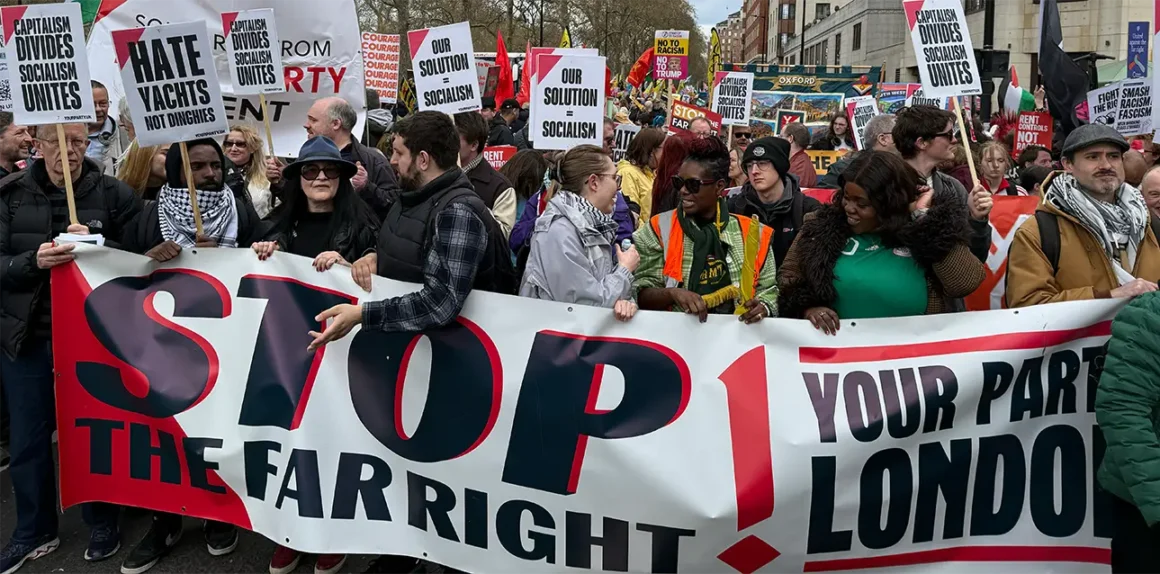
But neither can we ignore the context of a growing populist and authoritarian right. Across Britain far right movements are exploiting economic decay, housing crises, and the collapse of political trust to redirect anger away from bosses and billionaires, and toward migrants and minorities. By accepting the right’s framing on migration, Labour has refused to challenge the racist scapegoating of migrants.
The new party must be unambiguous: the alternative to the far right is working-class internationalism. That means defending the rights of migrants and refugees and fighting the ‘hostile environment’. It means building international solidarity between workers—because the same bosses that underpay migrant workers undercut everyone’s wages.
The party must reject nationalism in favour of class unity—across borders, across languages and across sectors. It must link arms with movements resisting fascism, racism, and Islamophobia in every community.
The only way to beat the far right is to offer a real material alternative—secure jobs, social housing, public services, dignity at work—and make it clear that our class enemies are not people crossing borders, but the corporations destroying jobs and communities.
But it would be a grave error to believe that peaceful protest alone, or reliance on the police and courts could defeat violent racist mobs outside mosques and hotels. Judges and police chiefs ultimately defend the interests of capital, not the multi-ethnic working class. The new party must support organised self-defence and the abolition of the police.
Get The Spark in your inbox
Workers Power’s weekly newsletter
Self-organisation
Elections matter—as platforms to project the case for socialism, to expose the crimes of capitalism, and to gain footholds in communities—but only as one part of a broader strategy. Votes provide visibility, resources and shreds of power. Yet transformative politics—real change—comes from building counter-power in workplaces, neighbourhoods, schools and campaigns, and using this to take the power from those who presently hold it.
A radical manifesto is essential, but not enough. The ruling class does not relinquish its power because a majority votes for it; it does so when confronted with an organised force it cannot ignore. Therefore, the primary function of this new formation must be to facilitate and encourage the self-organisation of our class. This means its structure must be bottom-up, not top-down.
Local branches should not be mere electoral machines, like the Labour wards became. They must be organising hubs embedded in their communities. They should set up party cells in workplaces, especially in poorly paid, precarious sectors—hospitality, retail, care, cleaning— tasked with linking up stewards and rank and file members to fight for safety, pay, staffing and solidarity action.
Branches should organise ‘people’s assemblies’ alongside tenant unions to campaign against austerity and corruption rampant in our council chambers, tackling rent gouging, evictions and service cuts—linking neighbourhoods with workplaces in joint struggle. Party councillors should vote for no cuts budgets and mobilise the working class to fight all cuts.
The party needs to fight for the needs of all those oppressed under capitalism: women, LGBT+ people, racialised communities, the youth and the disabled. It should support self-organised sections for these groups and champion their demands.
Local party formations need to launch unionisation drives, not separate from the unions but linked to the rank and file militants, rather than the layer of bureaucratic officials. We should support cross-union collaboration on pay, privatisation and the green transition.
The party needs to support organised self-defence and anti-racist campaigning to defend our communities, stop the terrorising of migrants by fascists and deportation squads, demoralise the far right gangs, and promote a working class political alternative to the politics of despair. An independent youth wing of the party could mushroom under these conditions.
The organised working class is concentrated in the trade unions. Any socialist project that fails to grasp this is doomed to irrelevance. The formal, bureaucratic link with the big unions was what ultimately constrained the left in Labour, as apparatuses often acted as a brake on radicalism.
The new party must cultivate a different relationship, based on rank and file militancy, democracy and political alignment, and won directly through solidarity and common struggle. It should encourage its members to be the best trade unionists, arguing for political strikes and a strategy of escalation against the Tory attacks and Starmer’s capitulation.
The goal should be to build organic links with the hundreds of thousands of class fighters who pack union meetings, organise walkouts, and vote for action. This is a slower, more difficult path than securing a giant cheque and a block vote from a head office, but it is the only foundation that cannot be bureaucratically withdrawn when the going gets tough.
In a world of escalating imperialist war, climate collapse, and rising fascism, a parochial national socialism is a contradiction in terms. This project must be internationalist from its core. Solidarity with Palestine is the litmus test. We must support the BDS movement: an arms embargo on Israel, full and immediate divestment from its economy, arrest warrants for its war criminals.
Let’s link up with workers’ movements and socialist parties across Europe and the globe. When French workers take to the streets, we must protest outside the French embassy. When Amazon workers organise in Germany or the US, we must be ready to synchronise action with them. We should champion the free movement of people and confront the vile racism of the state head-on.
Why the party matters
We are living through multiple crises: climate, cost-of-living, war, and a political class incapable of change. Labour is retreating to its Blairite corporate comfort zone. The far right is filling the vacuum with scapegoats and nationalist fantasies. Labour does not dare to confront them.
The obstacles are immense. The media will be unrelentingly hostile. The state will use every tool at its disposal to disrupt and undermine. The electoral system is brutally rigged against new parties. There will be immense internal pressures to soften policies, to prioritise short-term electoral gain over sinking roots based in tangible organisation and campaigns, to become a left pressure group rather than a class struggle party.
Resisting these pressures requires a clear-eyed focus on the central task. We are not building a party to manage the crisis of capitalism more humanely. We are building a political instrument to help the working class become capable of overthrowing it and building a new society. Every decision—on structure, strategy, and alliances—must be judged against this benchmark.
The energy is there. The hunger for a real alternative is palpable. The question is whether we can channel it into something durable, democratic, and powerful. The project initiated by Corbyn and Sultana can be the catalyst for a truly independent, working class political force. But it will only succeed if it remembers that socialism is not something done for the working class, but the act of the working class itself, organised, confident, and fighting for its own emancipation.