Sustained nationwide protests in Peru have led to a 30 day state of emergency and the impeachment of the president.
What started as a call from ‘Gen Z’, the student movement and sectors of workers has turned into huge protests against the regime, with the national strike on 15 October a major turning point. Protestors shouted “Enough!”— enough of the hunger, insecurity, unemployment and institutional violence that has turned the country into a land of dear and death. The protests showed that the government of Jose Jeri – less than a week old at the time – was based on congressional agreements and had no social base or legitimacy.
Political crisis
The protests started on 20 September and were triggered by the announcement of pension reforms. Later, on 8 October, an armed criminal gang raided a concert by the popular music group Agua Marina, injuring four of the performers and exposing the state’s complete loss of control of organised criminal violence.
Fearing the consequences in next year’s scheduled elections, the parliamentary alliance that sustained president Dina Boluarte began to disintegrate. At the same time, the youth once again poured into the streets of Lima, demanding Boluarte’s resignation, clashing with police. This movement sealed the president’s total political isolation.
Two days later, the Congress impeached Boluarte on the grounds of ‘pemanent moral incapacity’. They charged her with responsibility for over 50 deaths during the antigovernment protests of 2022-23, as well as corruption related to luxury gifts. With near unanimous parliamentary approval for her impeachment, the president of the Congress and right-wing leader Jose Jeri was made interim president.
Deadly repression
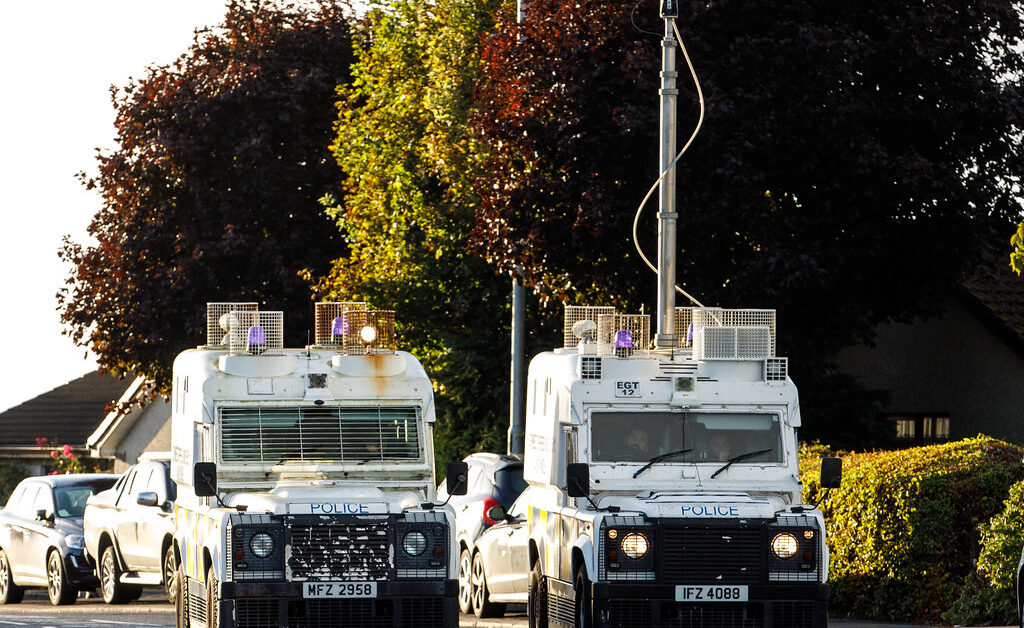
Nationwide demonstrations against Jeri were called for 15 October. In Lima, this took place at the Plaza Francia and was repressed by police. 15 were injured, including four journalists suffering from gunshot wounds. One person, hip hop artist Eduardo Ruiz Saenz, was shot dead by a plainclothes policeman.
The violent repression of protests represents a continuation of the policies of Dina Boluarte. Indeed, there are no significant differences between Jeri and Boluarte, as both are part of the same bourgeois and neoliberal bloc that serves the interests of big business, mining companies, organised crime and the military.
At the time of the massacres, Jeri’s cabinet had not been approved by congress and, furthermore, a motion of no confidence threatened to break up the fragile political balance. The entire country was in a deep crisis, in which no institution had any legitimacy and repression could no longer contain social discontent. On 20 October, protests against the repression of the previous week took place and led to the immediate downfall of the Jeri government and the dissolution of Congress.
Background
Peru has now had seven presidents in as many years: Pedro Pablo Kuczynski, Martin Vizcarra, Manuel Merino, Francisco Sagasti, Pedro Castillo, Dina Boluarte, and now Jose Jeri. Three of these are currently serving prison sentences for corruption or abuse of power. This rapid and constant succession reflects a structural crisis of bourgeois institutions which can’t be solved be changes of individual leadership.
Peru’s export revenues have been hit particularly severely by the end of the commodity boom in 2014. It remains the world’s second largest copper exporter and an important source of golf, tin, zinc and natural gas. Nonetheless, its dependence on agricultural imports, fertilisers and fuels had made the country particularly vulnerable to global shocks in recent years, particularly the price increases triggered by the war in Ukraine and the subsequent international sanctions.
The country’s economy was also significantly weakened by the coronavirus pandemic. Particularly, the crisis exacerbated the already massive inequality, leaving up to 90% of the workforce engaged in the informal sector, large parts of the overwhelmed health system collapsed, one of the world’s highest death rates from the virus. Years later, the social and economic consequences are still being felt. Poverty, unemployment and inflation are a particular burden on the rural population and on the urban poor.
The purchasing power of the population is undermined by high prices and stagnating wages. The country has a low national debt, increasing levels of trade with both China and the United States, and modest growth forecasted for this year, but the ongoing political crisis is slowing confidence in investment.
Socialist perspective
The solution to a crisis as severe and generalised as Peru’s cannot be to simply replace one bourgeois government with another. The state’s 1993 constitution dates from the years of Alberto Fujimori, and has ensured a continuity of his repressive, authoritarian and neoliberal political programme extending to the present day. This has been the political framework in which power has been constituted into the hands of fewer and fewer elites. The country’s political system is one which secures the rule of this elite and ensures that the congress, the government, and the judiciary serve their interests. The foundation of successive governments continues to be capital associations, especially the CONFIEP (Confederacion Nacional de Instituciones Empresariales Privadas).
It is the political system that is responsible pushing so much of the workforce into informal labour, for the unbounded extractivism that keeps the country impoverished. It also lies behind the growing inaccessibility of public services like healthcare and education. Meanwhile, a wealthy minority based in banks, corporations and mega mining companies destroy natural resources continue to enrich themselves.
What is required therefore is a total break with the 1993 regime and the bourgeois state. This will take the form of a free and sovereign constituent assembly, controlled by and accountable to the people, which will organise the country on new foundations: the working class and the peasantry.
If organised by the official institutions, a constituent assembly would be a diversion to allow the bourgeoisie to regroup and prepare a new offensive. This is why revolutionaries must demand an assembly convened and controlled by the wage-earning workers and poor peasant masses through their own democratic and independent institutions. These institutions must lead a struggle in such an assembly for a socialist transformation of the country, which would necessarily include the demand for nationalisation under workers’ control of domestic and foreign capital, including land. It would also demand the cancellation of foreign debt and an immediate plan to combat poverty.
To achieve these aims, the constituent assembly would need to create a workers’ and peasants’ government, and to arm the masses with the objective of creating armed popular militias.
How to achieve this?
The central question is: How do we get there? It is important to take advantage of the current situation and to agitate in enterprises, districts, universities and rural communities for the establishment of action committees that coordinate the struggles, organise strikes and build self-defence organs against the police and military. Such bodies can form the basis of a new, democratically elected assembly of the mass movement. Three central demands could unite this process:
- Establish control: Expropriation of mining, energy and ports under workers‘ control, so that the enormous raw material profits no longer disappear into the pockets of multinational corporations (especially from China and the USA), but are used to finance education, health and infrastructure.
- End poverty: State-guaranteed minimum wage and price controls on basic foodstuffs and fuel, controlled by trade unions – to ensure the survival of millions in the informal sector and to stop social impoverishment.
- Self-defence: Punishment of those responsible for the massacres of 2022/23 and 2025 and the establishment of democratically organised self-defence committees against police and military violence – only in this way can we defend ourselves against arbitrary repression and defend our interests!
It is also important to put pressure on the trade unions, including the CGTP, the largest union confederation, to take up and mobilise for such demands.
In the past, both the trade union bureaucracy and the centre-left parties have played a fatal role in containing mobilisations, thus becoming, for example, the de facto pillar of the Boluarte government. Revolutionaries have the task of organising a fight in the unions against the bureaucratic leaderships that slow down strikes, collude with employers and block any real mobilisation. It is necessary to build grassroots structures that take control of decisions and actions back into the hands of the workers, to make them a tool of struggle—not for symbolic strikes without perspective, but for a nationwide, coordinated mobilisation in the interests of the working class.
The sacrifice of Eduardo Ruiz must not have been in vain, his name must become a symbol of resistance. May his assassination be the point at which the Peruvian people say „Enough!“ and workers and youth unite in a common, revolutionary programme and party that unites all these struggles.
It is clear that our struggle can only be successful if it is consciously directed against the imperialist exploitation that has kept Peru dependent for decades. If a constituent assembly does indeed take place and revolutionary forces gain influence in it, it is clear that the imperialists will not give up their goldmine without a fight. This makes it all the more important to set up self-defence structures in companies, districts and municipalities that are able to fend off attacks by the military, police or paramilitary forces.
At the same time, the struggle in Peru must be understood as part of a common class struggle across Latin America – united with those who oppose US imperialist aggression in Venezuela and in solidarity with the current protests such as in Ecuador. Only through internationalist solidarity and joint organising can the working class of the region break imperialist domination and open up a new, socialist perspective.
- Justice for Eduardo Ruiz and all the fallen!
- Away with Jerí, away with the corrupt Congress!
- Down with the murderous regime of ’93: Expropriation!
- For a workers‘ government that puts an end to imperialist barbarism!