
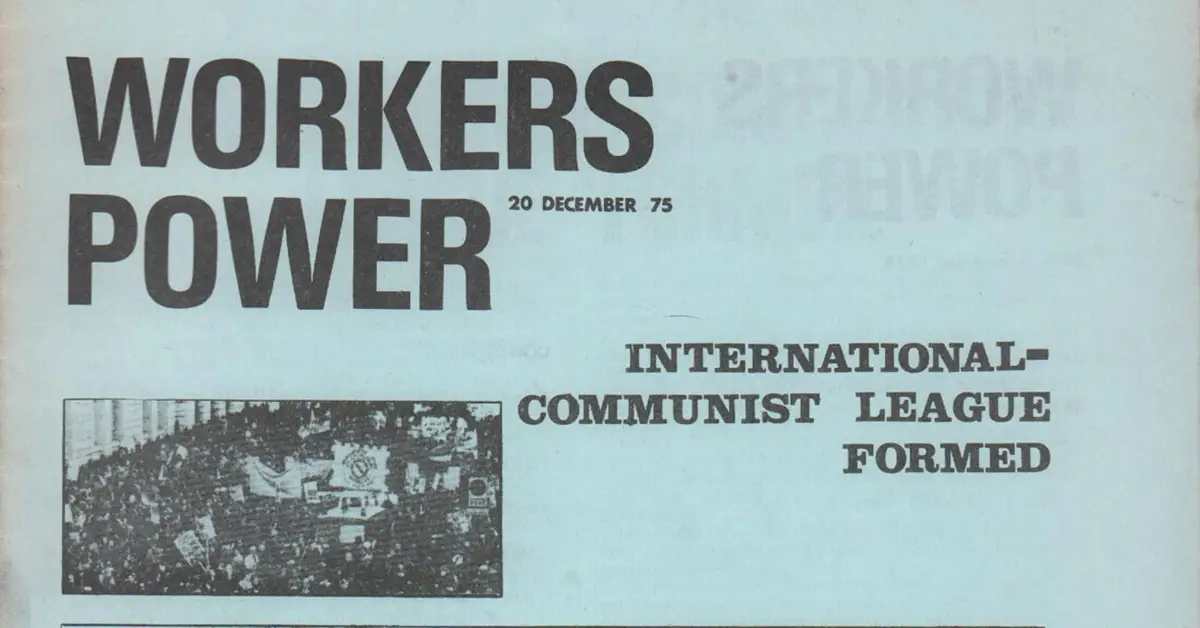
On the weekend of 13/14 December, the Workers Fight group, Workers Power (former Left Faction of IS, expelled in October 1975), and some LA-WRP comrades from the Midlands, united to form the International-Communist League. A detailed resolution outlining the basis of agreement, within which the new organisation will function under strict democratic centralism, was passed unanimously at the fusion meeting.
This is the first major fusion on the revolutionary left, involving forces sizeable enough to change the balance on the left of the so-called Communist Party, since the fusion that created the Revolutionary Communist Party in 1944.
The new organisation is born at a most critical period for our class, and its tasks and responsibilities are in consequence enormous.
The British working class is militant, combative, and has not known decisive defeat in two generations. It has recently brought down the Tory government that dared to attempt to shackle the trade unions to the bourgeois state. It has proved capable of controlling society in the negative sense, of exercising a decisive veto on the plans of the ruling class. It can control society in the positive sense of taking power out of the hands of the demoralised capitalist parasites whose strongest prop at the moment is the Labour government. The entire objective logic of the working class struggles of the past period, and much of its subjective content, add up to a drive to gain positive control of society, and reconstruct it under working-class rule.
The crisis of world capitalism, the worst in a third of a century, hits with especial force at British capitalism, because British capitalism is exceptionally decrepit. This situation makes it inevitable that the lull in the class struggle which the Labour government has secured for British capitalism will be short-lived.
The workers will not for long pay the price for capitalism’s inability to ensure their daily needs. They will not for long be conned by the double-talk about the national interest used by the ruling exploiters and their political agents.
Cul-de-sac
Major battles are imminent. The working class has not been defeated or broken — the present lull results not from defeat, nor even from exhaustion. It results from a certain perplexity in face of the doomsday economic atmosphere, and above all from the fact of a Labour government in power, backed actively by the trade union bureaucracy, and holding, despite everything, a high degree of working class loyalty.
It is, ironically, a product of the very victories which the working class won on the field of industrial struggle, culminating in toppling Heath — and of the necessarily limited nature of those victories.
The direct-action militancy is blocked in a cul-de-sac — and though the level of strikes runs remarkably high, the explosive confrontationist element has largely disappeared, for the time being, because of the existence of this Labour government. The most militant sections of the working class, including sections roused to struggle against the last Labour government, voted Labour as a class, anti-Tory vote, because there was no revolutionary alternative.
The titanic wave of direct action never reached the general strike level that would pose directly the question of power in society; and no revolutionary party existed to transmute direct-action militancy into its natural international-communist political equivalent, fighting reformist consciousness and presenting a credible electoral alternative to Labour. The ironic result is that the most militant wave of direct action since the 1920s has led to a Labour government which is proceeding with a full-scale onslaught on working class living standards, more severe than any that the Tories have ever tried.
Because of the nature of the attack, it is only a matter of time — and probably a short time — before a working class counter-offensive erupts.
For revolutionaries, the central question is to prepare an organisation that can, linking up with the direct action of the working class and integrated into its struggles, present an Action Programme that focuses those struggles beyond reformist goals. An organisation that can recruit and organise the best militants, and educate them as working class leaders with a rounded international-communist world view, thus building itself within the working class. One that can fight reformism politically and organisationally, exploiting the deadly contradiction at the heart of the Labour Party — that it is a capitalist party in its actions and leadership, a party now in government running capitalism for the capitalists at the expense of the working class, while being based on the bedrock organisations of that working class, big elements of which want to bury capitalism.
No such organisation of sufficient size and public presence has existed in the past period.
The Workers Revolutionary Party links reformist politics with organisational sectarianism, and mistakes its own sideshows for the real struggle of the working class. It has recently lost most of its industrial base, and it is not an accident, nor is it inappropriate, that its main trade union strength is now in show-business.
The WRP recruits fighters, prepared to give everything they have to revolutionary struggle, and turns them into more or less full-time newspaper sellers. It talks about the need for work within working class organisations and trade unions; work on the Irish question; the fight against fascism; it talks about a politically educated cadre party: and yet in reality it does none of these things. Gross organisational sectarianism cuts it off from work even with broad labour movement bodies. It has not been seen on the streets against fascism for over a decade. Its record on Ireland is amongst the most scandalous in the British labour movement. It responded to the outrageous raid by the police by cravenly disavowing, in the name of revolutionary politics, the use of violence by the working class; and it has in the last two months devoted more time, energy, publicity and campaigning to publicising this issue (and its leaders being held in a room by the police for a few hours) than it has given in the last five years to exposing or fighting against the murder, terror, and police state rule in Northern Ireland.
Maelstrom
Two issues show the bankruptcy of all these organisations. The anti-Common Market campaign was a delirium of chauvinism, a chauvinism which is at the root of racism and anti-Irish feeling, and is one of the strongest threads binding the working class to the bourgeoisie. All these groups joined in the obscene orgy, murmuring a few phrases about socialist internationalism to salve their consciences.
With the partial exception of the IMG, all of them have reneged and scabbed on the liberation fighters in Ireland. They have betrayed the elementary principle, that communists in an imperialist country should give full support to those fighting for freedom against ‘our own’ government and its army.
These organisations offer no hope of building a revolutionary party inside the working class, in the maelstrom of the struggles to come. Hope rests only in this: that the bitter results of what they have done in the past will teach the hundreds of devoted revolutionary militants in these groups to break decisively with them, politically and organisationally.
The fragmentation that has been a marked feature of the left in the last year or so demonstrates wide-scale dissatisfaction. The creation of the International-Communist League is a major step towards reversing and overcoming such fragmentation. We will work with comrades in these blind-alley organisations, or recently shaken loose of them, to help them reach revolutionary-communist conclusions and find their place in the ranks of those who will build an adequate revolutionary party.
What do we stand for? What is international-communism? The record of Workers Fight — whose original nucleus came from the WRP (then SLL) and Militant — is public in its press. Solidarity with the Irish struggle; an intransigent stand against the chauvinist tide on the Common Market; attempting to focus the industrial militancy of 1972 and draw out its political logic through raising and discussing the question of a general strike and its implications; relating in a principled but not abstentionist way to the Labour Party — these are some of the main themes.
The IMG is an unstable bloc of about five distinct organisations or cliques, held together by a common worship of a fetish — the so-called “Fourth International”, which is a pretentious myth: it has meaningful existence neither politically nor organisationally. Over four years the IMG has presented no coherent politics. In 1972 they were passive-propagandist maximalists. By 1975 they had veered to offering ‘Marxist’ advice to the Tribune/Benn left. When the latter — to take one example — advocate import controls, the clever ‘Marxist’ IMG merely counsels rephrasing it in good “Trotsky-ese” as “state monopoly of foreign trade” — evading the question, which class does the state serve.
‘Militant’ is a Social Democratic reformist sect, which is rarely to the left of the TUC.
IS has been a centrist diversion which successfully — often as a result of hard work by its members — inserted itself into many industrial struggles, but which vitiated all its work there because it boycotted its own nominal politics. It has been the most serious ostensibly-revolutionary organisation: but it acted throughout the 1968-72 wave of industrial direct action on the assumption that workers would spontaneously break — or already had broken — with reformism and Labour. It was therefore unable to fight reformism, except rhetorically. Having broken with the Leninist theory of the party, and with the method of the Transitional Programme, holding to a semi-spontaneist conception of how workers become revolutionaries, it was mesmerised and disarmed politically by the level of industrial combat. Having declared social-democracy dead, it now can only rail in ultra-left third-period fury at the Labour Party, which unfortunately still retains the allegiance of most of even the best industrial militants. In parallel, it has itself become an undemocratic, largely depoliticised, sect.
The record of Workers Power is found in the documents of their struggle against the IS leadership: against IS’s cowardice and evasion on the Irish struggle; against IS’s semi-syndicalist conception of trade-union work and for an understanding of the method of the Transitional Programme and the need for a serious fight against reformism; for a Leninist conception of the function of a programme and a party; for an internationalist position on the Common Market; against the degeneration of IS’s internal democracy. Workers Power neither buckled before the bureaucratic browbeating of the IS leadership, nor did it react, as others have done, by putting a minus where IS puts a plus.
Shortly the International-Communist League will publish an extended manifesto. Meanwhile, what is international-communism? It can be summed up briefly. It is the basic Marxist programme of the conquest of power by the international working class. It is the unfalsified Programme, method and experience of the Bolshevism of Lenin and Trotsky. It embodies the world experience of the workers’ struggles, including the defence and development of Bolshevism by Trotsky and the Left Opposition in battle against the Stalinist counter-revolution. It means reliance on the self-controlling activity of the working class, which it strives to mobilise on the programme of transitional demands as a bridge to the overthrow of capitalism and the attainment of workers’ power. It is the programme of the workers’ revolution, organically linked with the practical struggle to aid its development. It is not only a programme, but the struggle to build a revolutionary party to fight for that programme. Its traditions are those of the Bolsheviks and the Left Opposition: workers’ democracy, unremitting struggle for theoretical clarity, revolutionary activism, unbending hostility to and struggle against capitalism and those within the labour movement who stand for its continuation.
We call on militants who know the urgency of the situation and the possibly decisive character of the battles that loom for our class, and who know the bankruptcy of the existing left groups, to initiate discussion with us and to join the International-Communist League. The new organisation contains the forces and the will to reorganise and regenerate the fragmented and degenerated so-called revolutionary left, and thus seriously to begin building a revolutionary party.
Major step
Revolutionary socialists, international-communists; trade union militants who want to organise to fight to win next time, and who understand the need for an anti-bureaucratic rank and file movement inside the trade unions; internationalists who want to eradicate the shameful record of the British labour movement and the so-called revolutionaries on Ireland, and who are prepared to aid the Irish Republican struggle; militant women who know that women’s liberation is inextricably linked with proletarian revolution; black activists and all who want to fight racism in the working class and fascism in the streets, or wherever it rears its head — the International-Communist League calls upon you to help us build an organisation to link your various struggles into a revolutionary struggle to overthrow capitalism. An organisation which will rise above the chaos, the shambles, and the shameful record of what passes for revolutionary politics in Britain now. An organisation built according to genuine democratic centralism, in this too breaking with the existing groups’ record of bureaucratic sect-like structures. The formation of the International-Communist League is a major step forward in the building of such an organisation. Help us to build it, and to take it forward to the point where it can transform the situation on the revolutionary left — and thus the balance of class forces in Britain.
National Committee, International-Communist League


