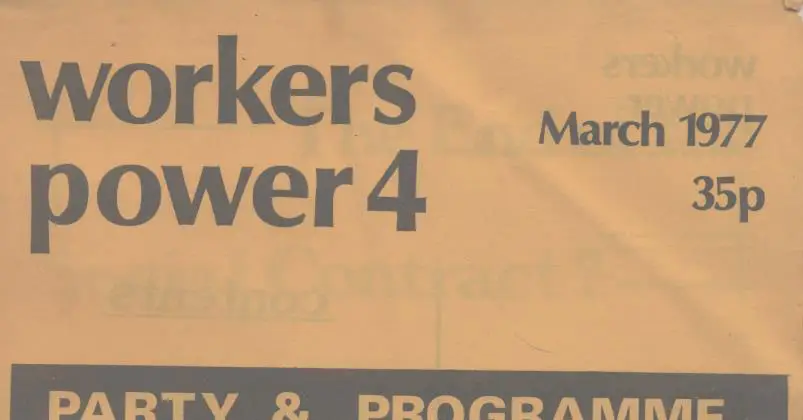
Edited by Horace B. Davis. Monthly Review Press.
The publication of this book cannot but be welcomed by Marxists. Rosa Luxemburg’s views on the national question have hitherto been known to English readers solely through the pages of those, such as Lenin, who polemicised against her. This was an unenviable fate for a major Marxist theoretician and one which was to nobody’s benefit. The three major anthologies of Luxemburg’s writings in English contain not a single item devoted to her life-long opposition to the taking up by the proletariat of the struggle for Poland’s independence — a struggle which pitted her against the opinions of both Marx and Engels.
The articles in this book start with one written before the fourth congress of the Second International, held in London in July 1896. In it Luxemburg forcefully takes up the cudgels on behalf of the historic tradition of Polish socialism — the outright opposition to the working class espousing the cause of Polish separation from Russia. The Revolutionary Socialist Party Proletariat, formed in 1882, had a short but heroic history of struggle — four of its leaders were hanged by the Tsarist authorities in 1886 and its main theoretician, Ludwik Warynski, perished in the notorious Schlusselburg Fortress whilst serving a sentence of sixteen years hard labour. It had an exemplary record of resistance to Polish chauvinism and formed an alliance with the Russian Narodnaya Volya. Rosa herself joined one of its cells in the last year of its existence.
The reasons for the Proletariat Party’s opposition to Polish independence stemmed, however, from the ‘pre-scientific’ communism of Blanqui — a belief that the coming revolution would be a socialist revolution, in Russia and Poland.
A tendency, which was to become the Polish Socialist Party, arose in opposition to this in the early 1890s. This grouping warmly espoused the cause of Polish independence and argued for the formation of an all-Polish party, that is for the splitting of the Polish sections from the German and Austrian Social Democracies and the creation of a movement which would cover all three segments of partitioned Poland. They covered their overtures to the Polish bourgeoisie and anti-Russian chauvinism with all the quotes from Marx and Engels in support of the Polish national struggle.
Rosa Luxemburg conducted a two-sided struggle. Against the PPS and the western Marxists who parroted Marx and Engels, but also against the a-historical position of the old Polish socialists. She pointed out that:
‘Marxism lies not in this or that opinion on current questions, but in two basic principles: the dialectical materialist method of historical analysis — with the theory of class-struggle as one of its corollaries — and Marx’s basic analysis of the principles of capitalist development.’ (The Polish Question and the Socialist Movement, published Cracow, 1905, Davis p. 77)
Carrying out this method in practice Luxemburg analysed the concrete social and political conditions of Marx and Engels’ support for Polish independence (the immobility of Russian society resting on the natural economy, the role of Russia as gendarme against the bourgeois-democratic revolutions in Central Europe, the revolutionary vitality of the Polish gentry up to 1861). All these factors had changed by the 1890s. Capitalism was creating a modern proletariat and bourgeoisie in Russia and Poland. Neither of these two classes had any particular interest in reviving historic Poland. Both had good reason for solidifying their ties with their Russian brothers.
Luxemburg’s practical justification came in 1905 when the party she had founded, the Social Democracy of the Kingdom of Poland and Lithuania, led the workers of Warsaw and Lodz in the mass strikes which convulsed all the industrial centres of the Russian Empire.
Lenin never objected to this element of Luxemburg’s analysis — the rejection of a separate state for Poland. It may come as a surprise to those ‘Trotskyists’ who are prepared to sprinkle Marxist ‘holy water’ over Scottish or Breton nationalism, that Lenin held that:
‘The proletariat, however, far from undertaking to uphold the national development of every nation, on the contrary warns the masses against such illusions, stands for the fullest freedom of capitalist intercourse and welcomes every kind of assimilation of nations except that which is founded on force or privilege.’ (V.I. Lenin, ‘Critical remarks on the national question’)
Therein lies the essence of Lenin’s disagreement with Luxemburg. For the latter, in her zeal to avoid the chauvinism of the PPS, argued that the Russian social democrats should strike from their programme the demand that Russia’s subject nationalities should have the right to, ‘determine their own future up to and including the right to freely secede’. As Lenin pointed out this would make Russian social democrats into chauvinists and annexationists.
Luxemburg, further, and in contradiction to her own concrete analysis of Poland, extended her analysis to all nations. Even in 1896 she was including Ireland within the category of ‘dead’ national struggles. She later extrapolated from her theory of imperialism and the outbreak of the imperialist war, the position that ‘national wars, i.e. struggles for national independence against imperialism, had no progressive content’. Lenin drew the opposite conclusion — that national struggles against imperialism had to be related to, as the great peasant struggle for land had to be, so that these ‘non-socialist’ battles might aid the proletarian revolution.
The introduction to the volume, by Horace B. Davis, the author of Nationalism and Socialism, is, like the latter work, curiously confused at key points in the attempted analysis. It is a standing indictment of the poverty of work amongst revolutionary Marxists that such a muddlehead should write the first book on the national question since Solomon Bloom’s The World of Nations (1941) — a non-Marxist examination of Marx’s views on the national question. May this omission soon be rectified! The translations compiled by Davis help such a project. Will anybody translate Otto Bauer’s Die Nationalitäten Frage?